[ หากคุณต้องการอ่านเนื้อหานี้ในฉบับภาษาไทย คลิกที่นี่ ]
The Story of Chedi Niranam
Part 1:
The Grave of 10,000 Souls
[ หากคุณต้องการอ่านเนื้อหานี้ในฉบับภาษาไทย คลิกที่นี่ ]
“We will never know their names.
We will never know how many nor exactly where they came from.
We can, however, try to tell their story so that they will never be forgotten.”
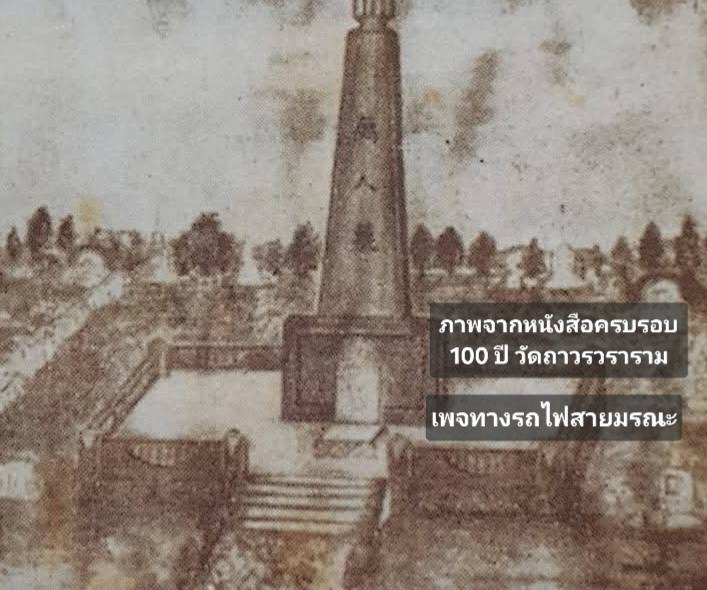
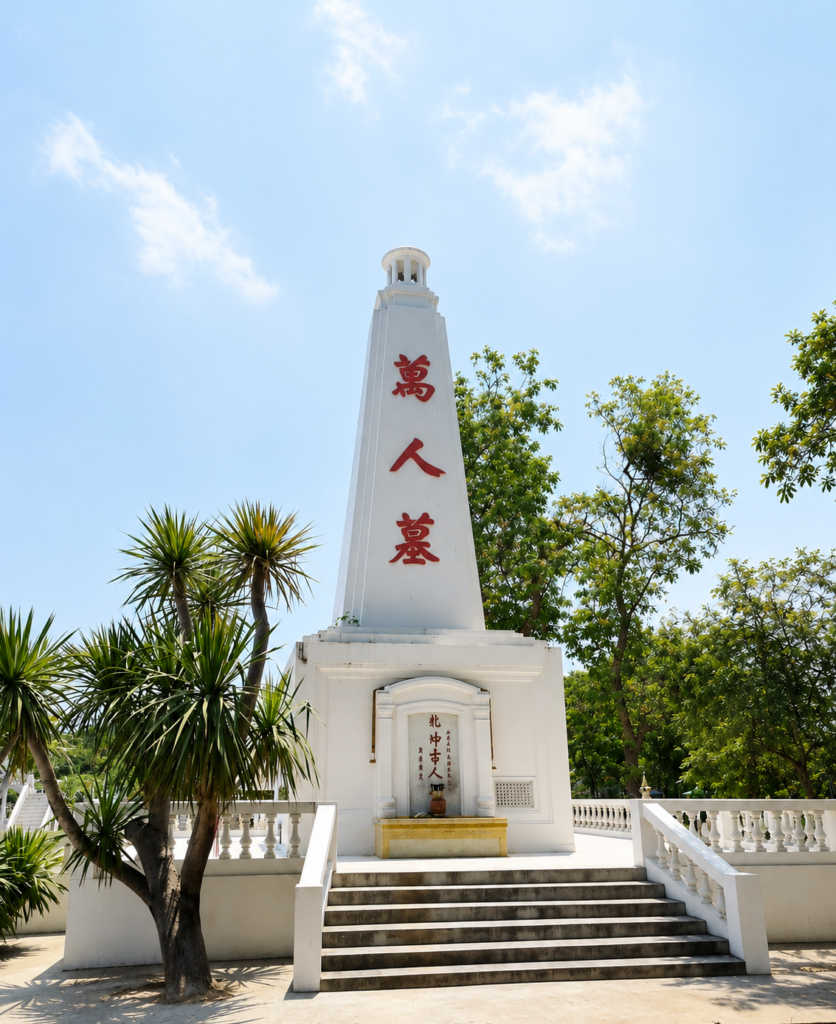
Chedi Niranam stands within the grounds of Wat Thaworn Wararam, commonly known as Wat Yuan, in Kanchanaburi. In Thai, Niranam means “unknown” or “anonymous.” The chedi was constructed in 1957 by the elders of the temple community to mark a burial place containing more than 10,000 sets of human remains. Its Chinese inscription describes the site as the “Grave of 10,000 Souls.” The Chinese character used for the number does not necessarily indicate an exact count, but rather a very large number exceeding 10,000.
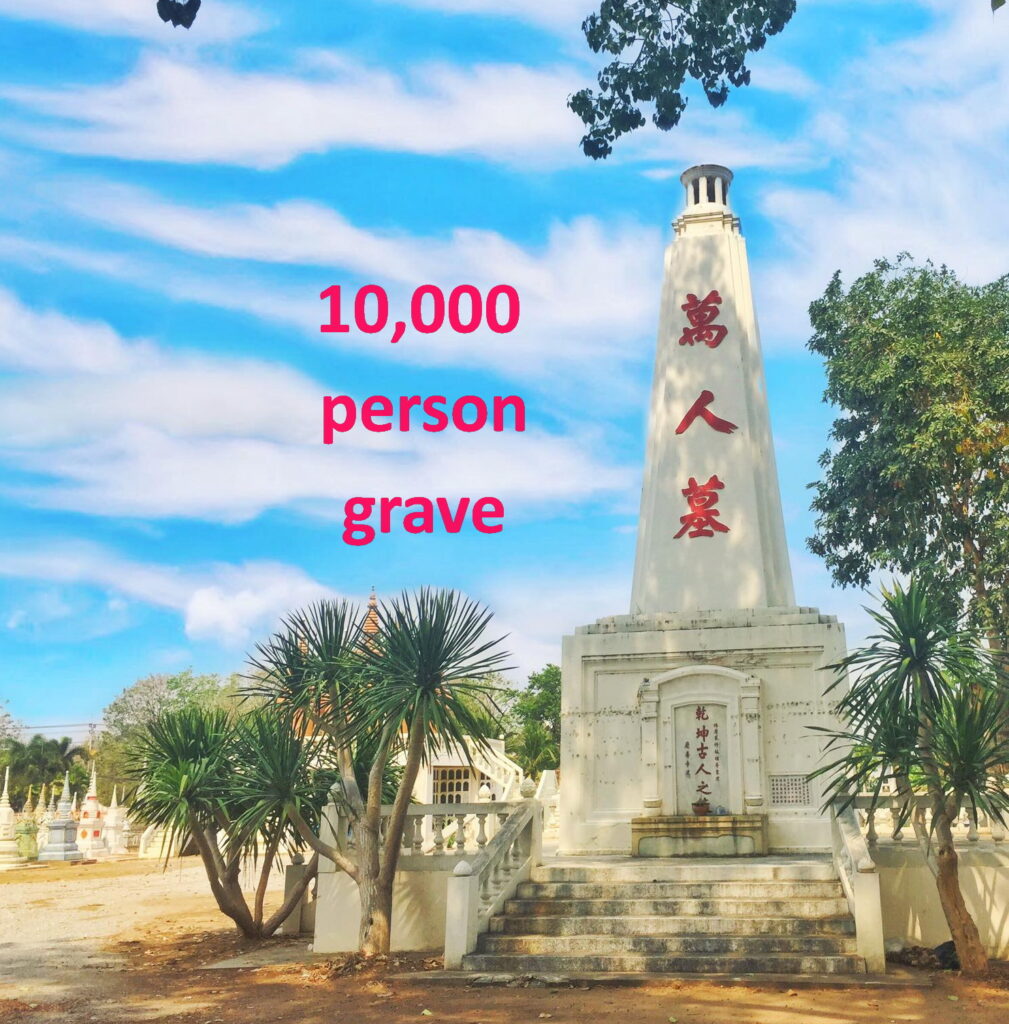
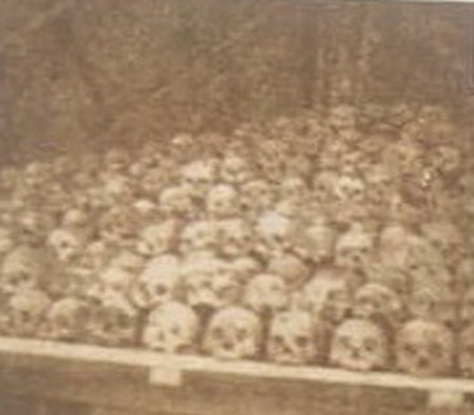
The story of the memorial begins in 1952, when the Thai government began widening and improving the SangChuto Road. As construction crews excavated the area near the temple, they began uncovering human bones. The discoveries continued as other construction projects disturbed the ground. Because the land had formerly belonged to Wat Thaworn Wararam, the abbot, Luang Bpo, accepted responsibility for the remains.
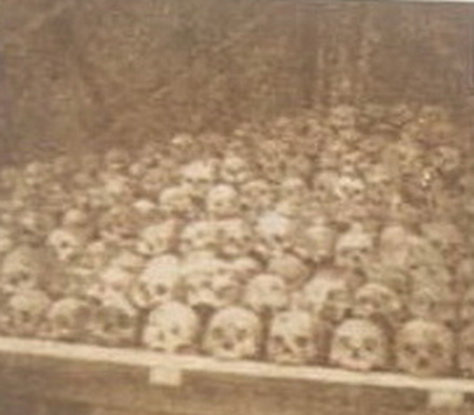
Over the following years, three major burial events took place. According to the temple staff, these reburials ultimately accounted for more than 10,000 sets of remains. After a period when no new bones were found, the burial vault was sealed and the chedi was constructed over it.
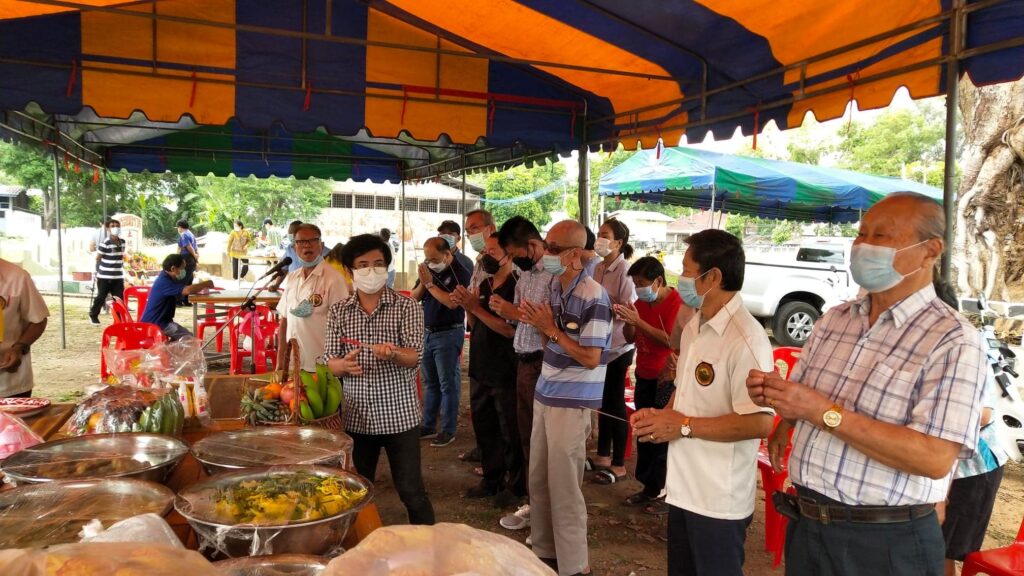
For decades that followed, nobody knew with certainty whose remains had been gathered there. No systematic effort appears to have been made at the time to establish their identities or reconstruct the circumstances in which so many people had died and been buried in the area. The temple community nevertheless continued to care for them. Every year, during the Chinese Qing Ming festival, ceremonies of remembrance were conducted at the site, honoring people whose names and histories were unknown.
The location provides an important clue to their identity.
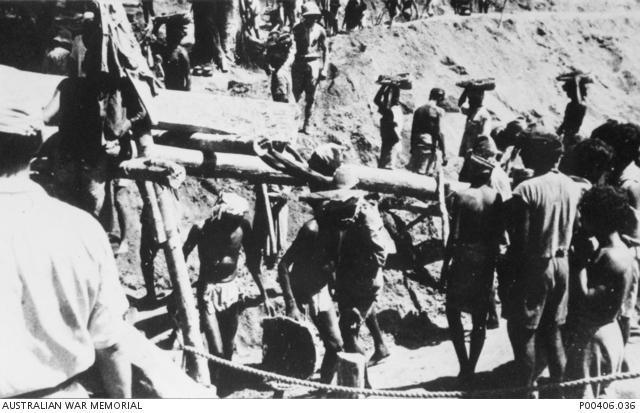
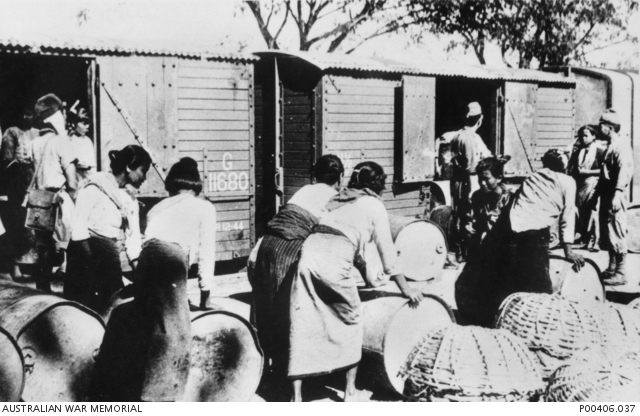
During the construction of the Thai–Burma Railway, the Imperial Japanese Army brought hundreds of thousands of Asian Forced Laborers to work alongside Allied prisoners of war. Collectively referred to by the Japanese term romusha, these workers came from a number of countries and communities. The largest group working in the Thai sector is believed to have been Tamil Indians from Malaya, although Javanese, Singaporean and Malayan Chinese were also represented. The precise number and distribution of the different nationalities can no longer be established with certainty; except that the Malay-Tamils were by far the largest group.
The organization and living conditions of these workers were extraordinarily harsh. Unlike the Allied prisoners of war, whose deaths were recorded and whose remains were subsequently recovered and placed in identified military cemeteries, the Asian Forced Laborers had no comparable system of identification. Many died without their names, dates of death or places of death ever being recorded. Some were never properly buried. The Japanese authorities, particularly because of their fear of cholera, frequently ordered bodies to be cremated in large open fires. Former prisoners of war later recalled being forced by Japanese guards to collect and burn the bodies.
The deaths did not end when the railway construction ended.
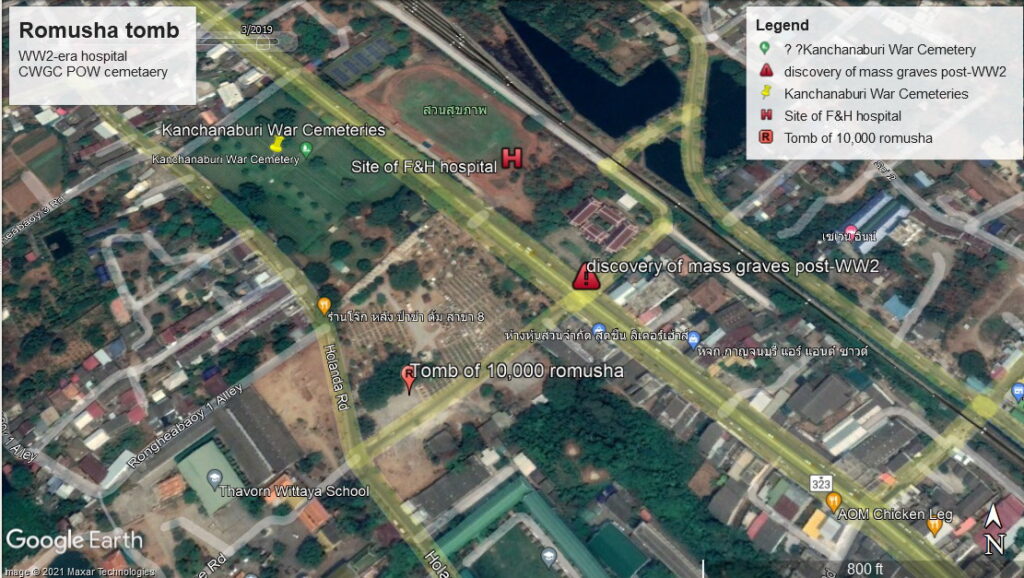
Following completion of the TBR in October 1943, the Japanese began consolidating surviving workers and prisoners into the Kanchanaburi area. Allied prisoners were concentrated in several camps, while a large camp for surviving romusha was established near the area now occupied by the CWGC Kanchanaburi War Cemetery. The precise location of the romusha camp was never properly documented, but surviving accounts place it parallel to the railway, with its western end near Wat Thaworn Wararam.
An Imperial Japanese Army hospital operated in the vicinity of the present-day cemetery. Aerial reconnaissance photographs document the hospital, which initially treated Allied prisoners who had survived the railway and, later, apparently treated the romusha as well. The concentration of human remains subsequently discovered between this hospital area and the former romusha camp provides an important geographical link between the burial site, the Asian laborers and the temple.
Oral traditions preserved among local Thai witnesses describe a grim routine that continued through 1944 and 1945 and, according to some accounts, on into 1947. Each morning, hospital staff would dig a pit[1]. Bodies of those who had died during the day were placed there, and at night that hole was covered. The process was repeated day after day. The numbers varied—sometimes one, sometimes several, sometimes more—but over an extended period such burials could have produced thousands of bodies.
This evidence must be treated with appropriate caution. The precise location of the romusha camp and the relationship between individual wartime burial areas cannot be established with complete certainty. However, the geographical evidence, the post-war discoveries, the size of the Asian labor population in Kanchanaburi and the surviving oral traditions together provide a compelling explanation for the thousands of remains eventually gathered at Wat Thaworn Wararam.
The strongest conclusion from the available evidence is that the remains beneath Chedi Niranam are primarily those of Asian Forced Laborers who had survived the initial construction period but subsequently died in the Kanchanaburi area. Within that population, Malay-Tamils appear to have constituted the majority.
The reasoning is also demographic.
The remains are unlikely to represent the local Thai population. Wartime Kanchanaburi was a relatively small rural community whose population was far too small to account for thousands of unidentified dead in one concentrated area. Moreover, Thai religious practice normally involved cremation rather than burial.
Nor are the remains likely to represent 10,000 Allied prisoners of war. Approximately 61,000 Allied prisoners worked on the Thai–Burma Railway, and about 12,000 died during the construction period. Their deaths were subject to military record-keeping, and the post-war recovery of Allied graves was undertaken systematically. Thousands of unidentified Allied bodies could not simply have disappeared into an unrecorded mass grave without leaving a substantial documentary record.
The Asian Forced Laborers, by contrast, constituted a population of sufficient size to account for such a concentration of deaths. They were poorly documented, their deaths were not systematically recorded, and their burial and cremation practices left little documentary trace.
The ethnic composition of the dead cannot be established with absolute precision. Burmese laborers constituted the largest single ethnic group among romusha employed on the entire railway system, but they worked predominantly in the Burma sector and were not brought to Kanchanaburi after the railway was completed. Other groups included Chinese from Singapore and Malaya, Javanese civilians brought to Thailand, and smaller numbers of Vietnamese. The evidence therefore points toward the Malay-Tamil population as the principal group represented among the remains at Chedi Niranam.
Additional archaeological evidence from elsewhere in Kanchanaburi strengthens this interpretation.
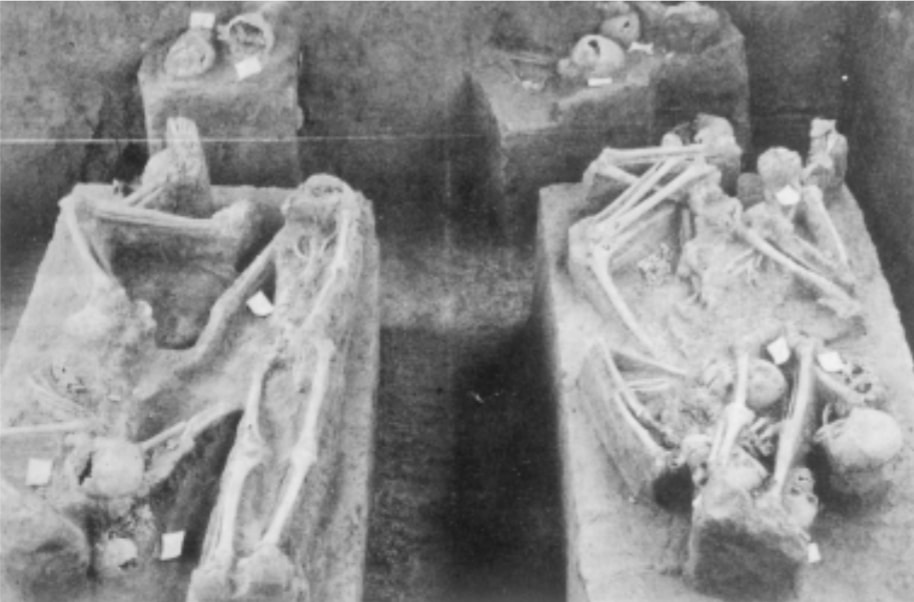
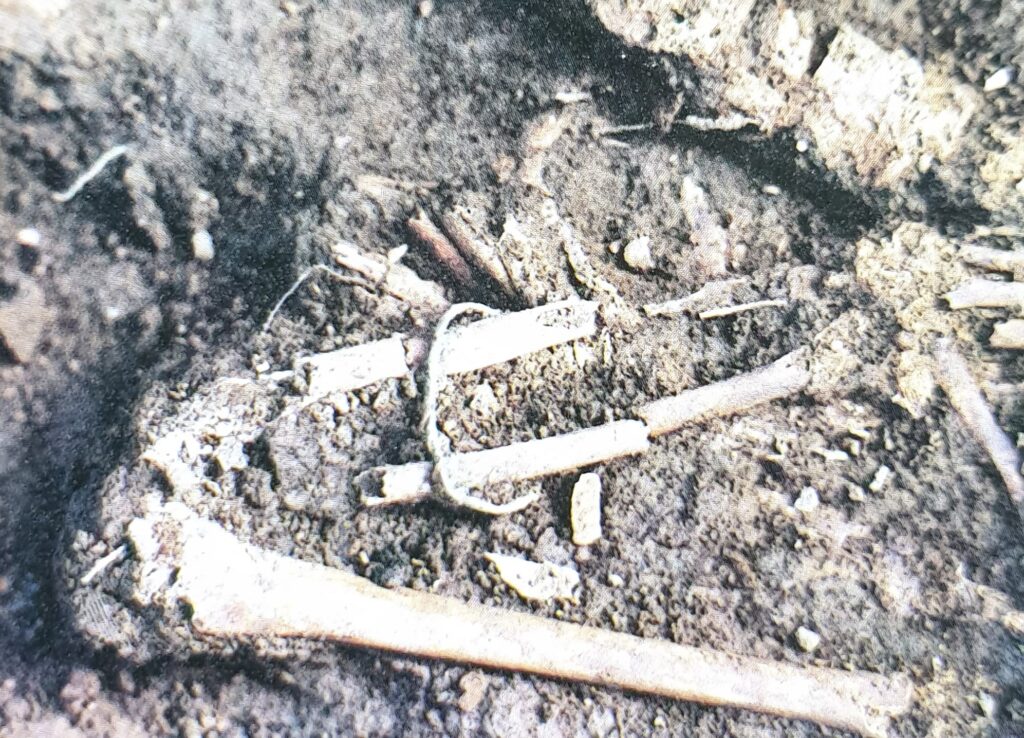
In 1990, a sugar-cane farmer discovered human remains while working his land in another part of Kanchanaburi. Archaeologists from a nearby university subsequently excavated more than 500 skeletons from multiple graves. Associated objects, including metal spoons and fragments of bottles linked the graves to the wartime era. Most significantly, one of the bodies was wearing a bracelet identified as being of Tamil origin. The site was also close to another Imperial Japanese Army hospital and to a small POW cemetery that had been excavated after the war.
The subsequent history of these remains provides another remarkable chapter in the story.
Most were removed and taken to Saraburi, where they were cremated and placed in a mass grave. However, some of the remains were transferred to a private museum in Kanchanaburi. There they were displayed in a glass case. Two sets of bones had been assembled as apparently complete skeletons, while the remaining bones were kept beneath them. The display was labelled as containing 106 sets of remains.
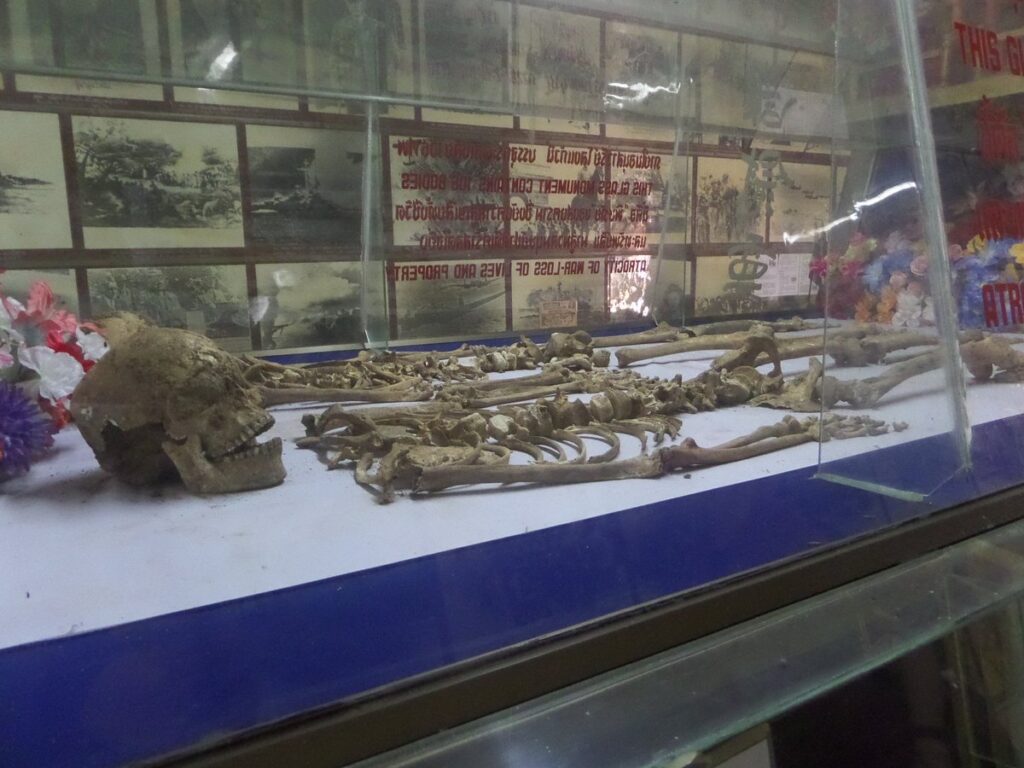
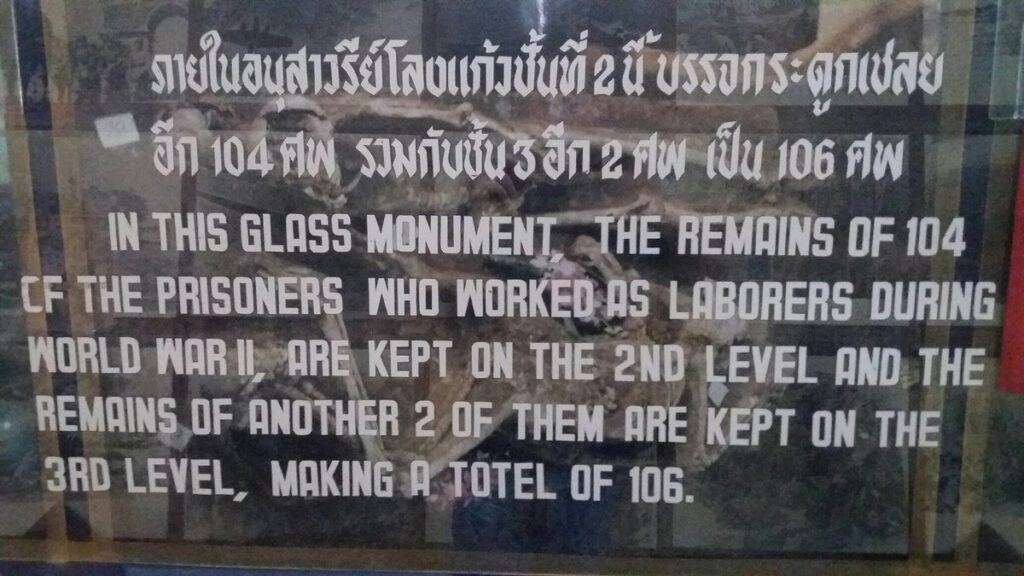
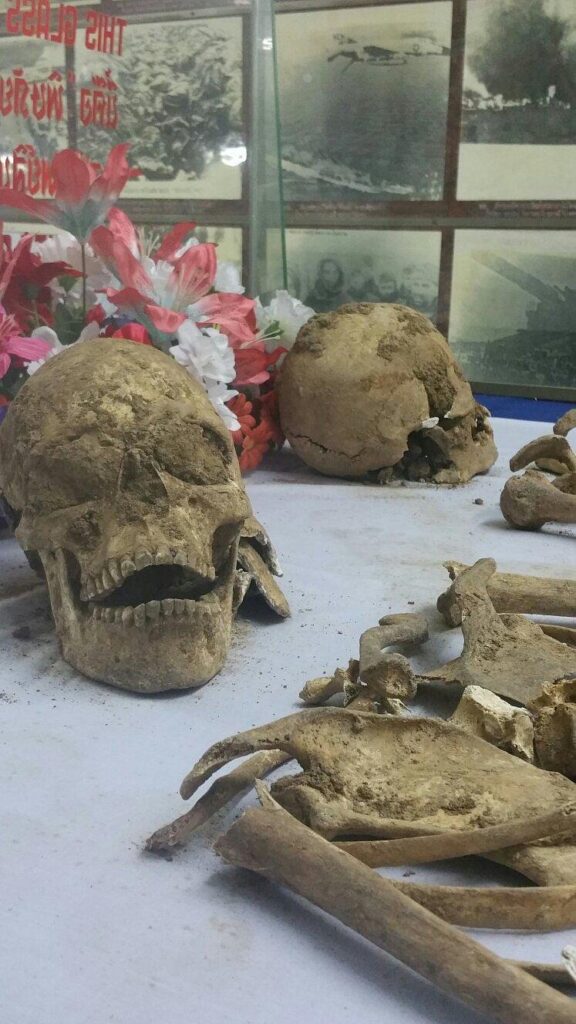
When the museum closed in 2025, the owner’s daughter contacted the Malaysians and Indians in Bangkok, who were developing the memorial at Chedi Niranam. She asked that the human remains be given an appropriate final disposition.
Before cremation, the bones were examined. The contents of the 15 boxes consisted largely of fragmented long bones, smaller hand and foot bones, vertebrae, scapulae and hip bones. There were only a small number of skulls, a few of them fragmented. The examination demonstrated that the claim that the display represented 106 complete skeletons could not be sustained. What remained was instead a collection of dis-articulated human bones representing an uncertain number of individuals.
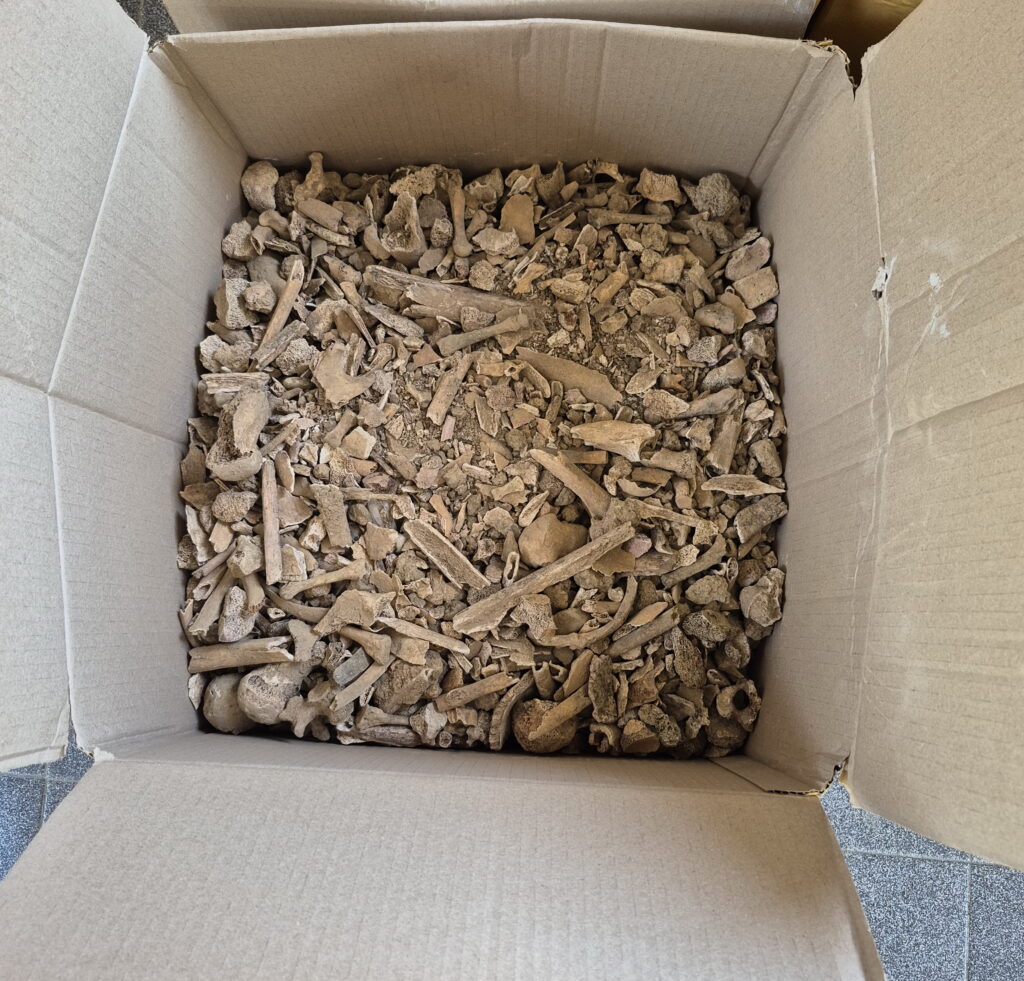
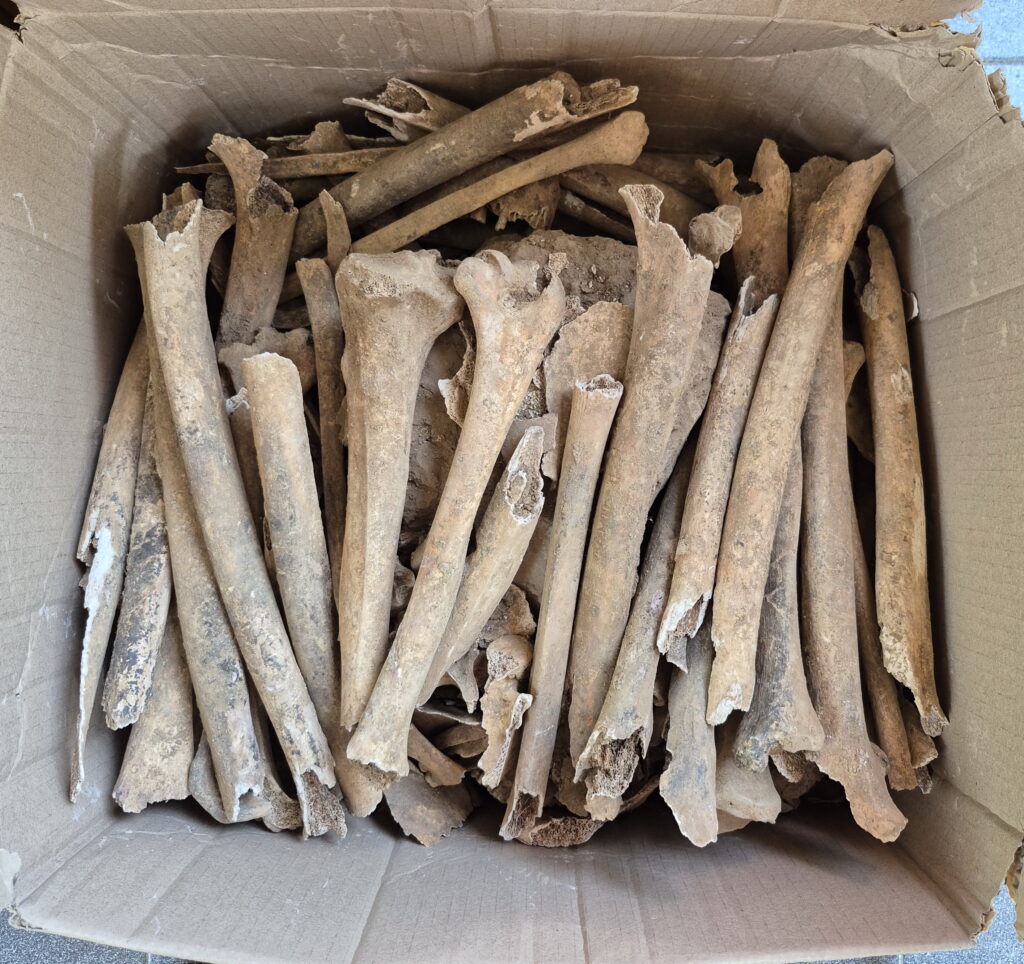
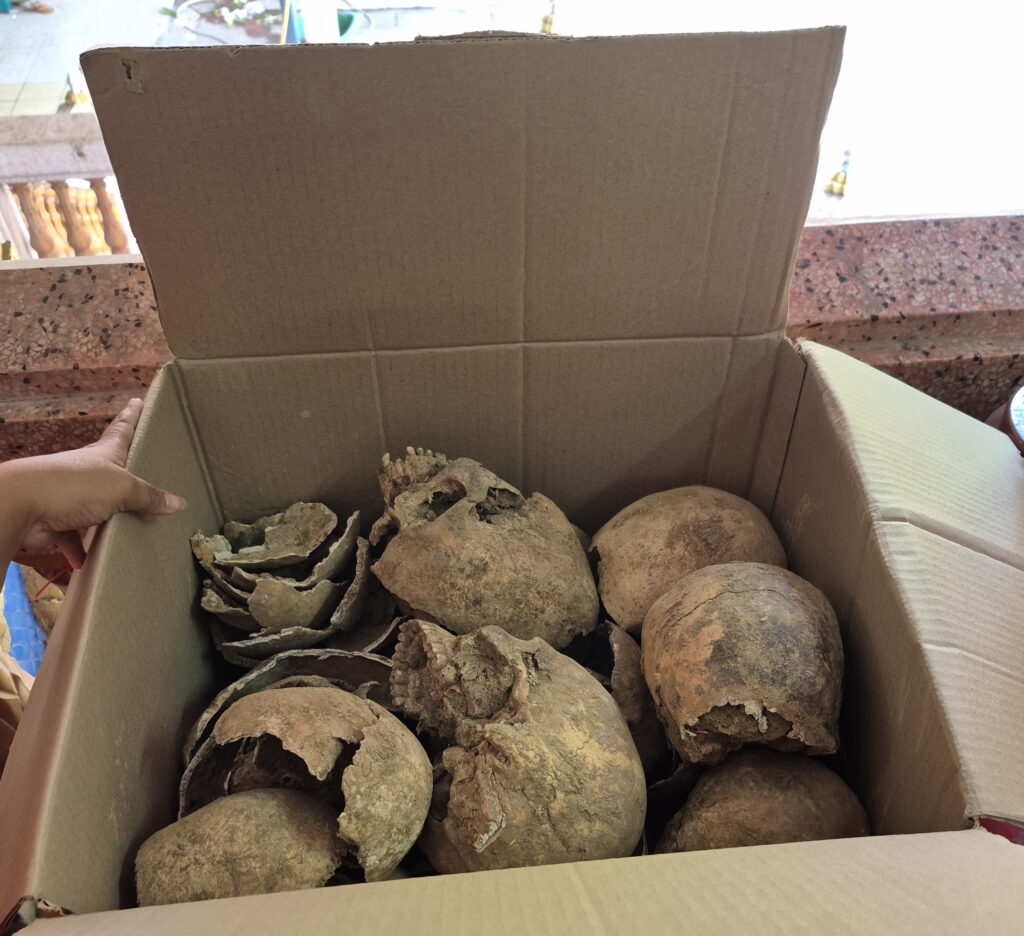
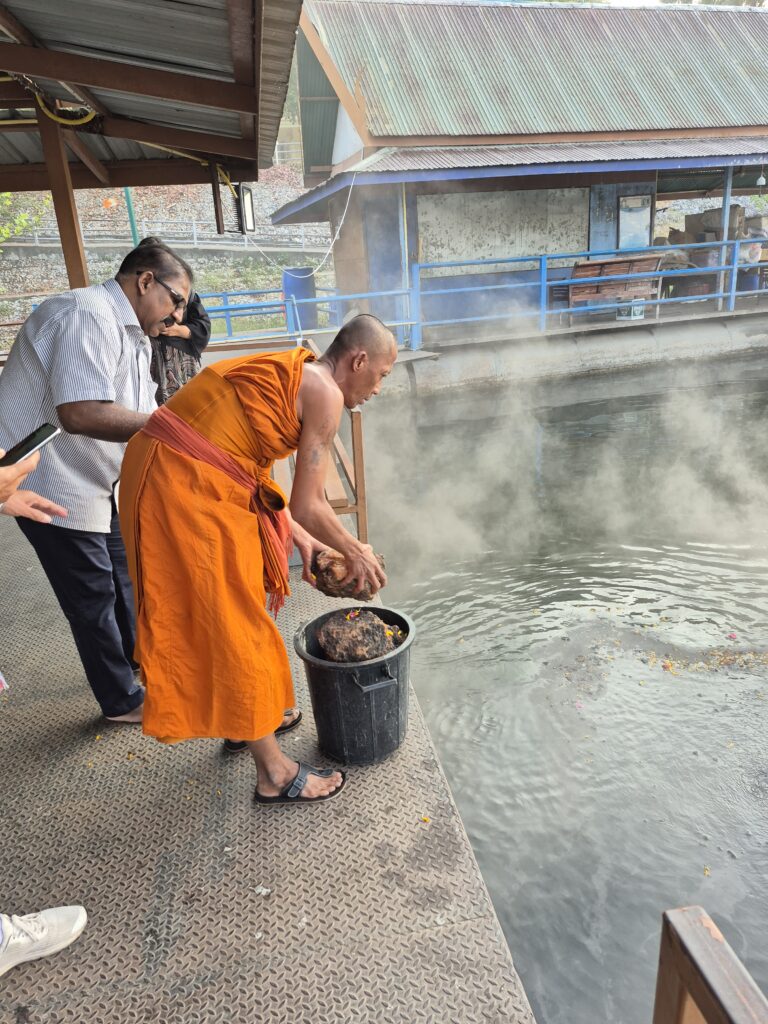
The remains were subsequently prepared for cremation. The skulls and the two sets of skeletal remains that had been displayed as complete skeletons were kept separately. The remainder of the cremains were committed to the Mae Klong River in ceremonies accompanied by Buddhist and Hindu prayers.
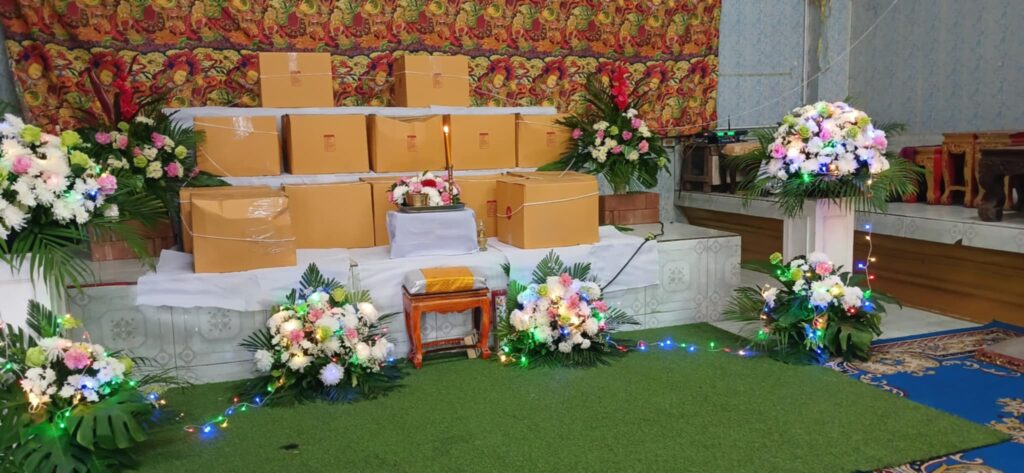
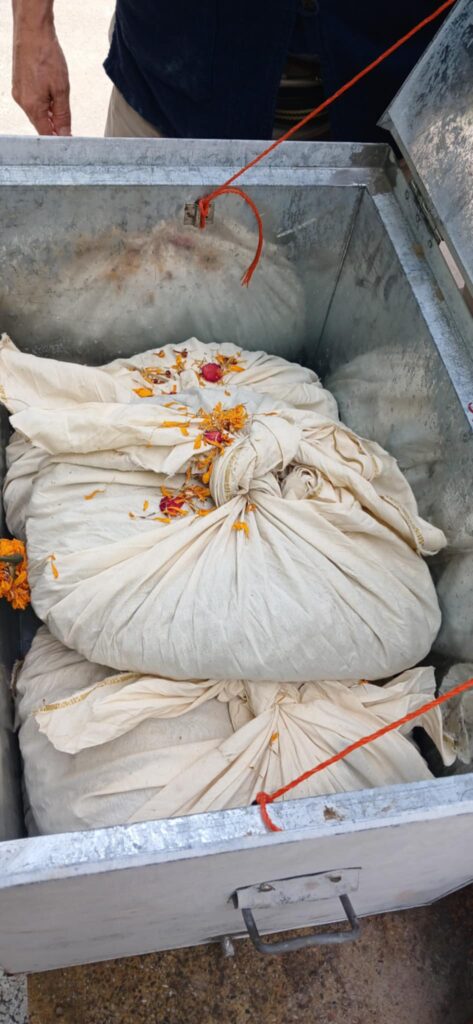
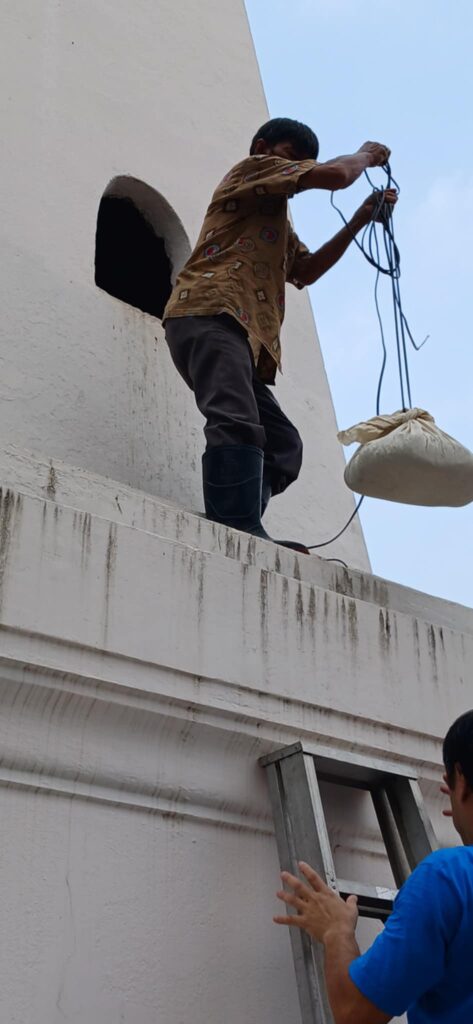
With the consent of the abbot of Wat Thaworn Wararam, the remaining bundles of skulls and bones were then taken to Chedi Niranam. Accompanied by Buddhist chants, they were placed through the vent on the side of the chedi. In this symbolic act, the remains of workers who had been separated from their fellow laborers for approximately eighty years were returned to the memorial.
There is also an important documentary clue concerning the location of the former romusha camp.
In the immediate post-war period, an Australian lieutenant named Flaws travelled along the railway and prepared maps of known POW camps and burial areas, using surviving landmarks and information supplied by former prisoners. One of his maps identifies a “Coolie Camp” near the Japanese F&H Hospital and the area now occupied by the Commonwealth War Graves Commission cemetery. His maps were principally concerned with locating Allied POW graves and therefore do not identify romusha burial areas. Nevertheless, the location he recorded is broadly consistent with the oral tradition that the romusha camp extended parallel to the railway near Wat Thaworn Wararam.
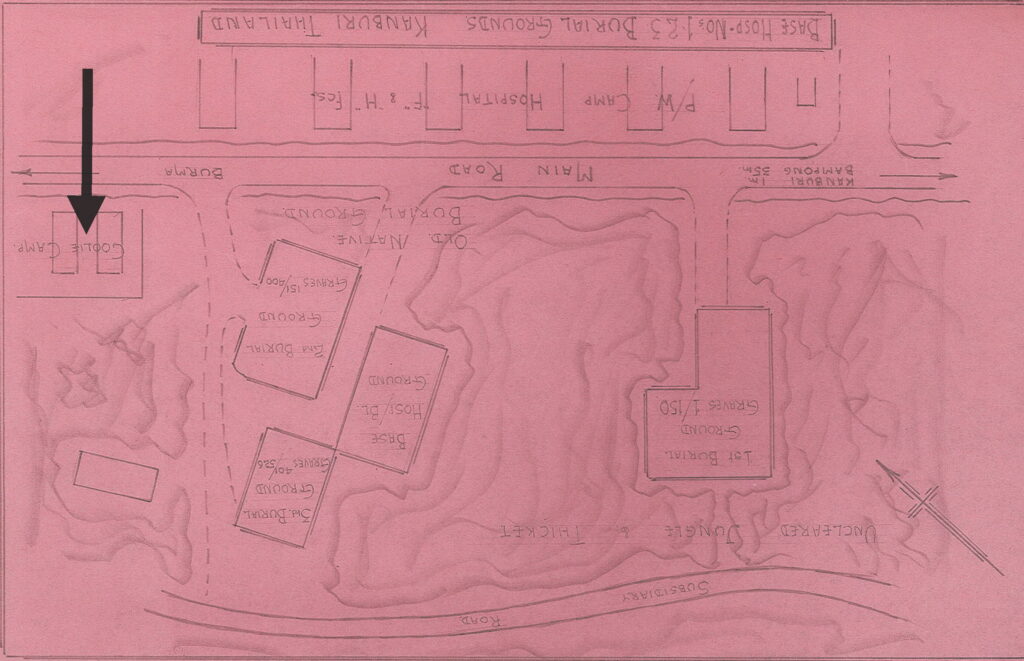
Flaws’ map cannot, by itself, prove the precise location of the romusha camp. No contemporary aerial photographic record has yet been found that establishes its exact boundaries. It does, however, provide an independent post-war geographical reference that is consistent with the broader reconstruction.
The history of Chedi Niranam is therefore one of evidence assembled from fragments: post-war discoveries, temple records and traditions, archaeological investigations, aerial photography, survivor testimony, demographic evidence and surviving maps. None of these sources alone provides a complete answer. Together, however, they provide a coherent explanation for the extraordinary concentration of human remains beneath the chedi. It can be described as putting together the pieces of a jig-saw puzzle.
The monument itself was built in 1957 because the people responsible for the remains did not know who they were burying or honoring. More than seven decades later, we can identify considerably more about them, but we still cannot recover their names or establish the precise number of individuals represented.
That limitation is fundamental.
Chedi Niranam should not therefore be understood simply as a monument to an exact 10,000 deaths. The number is a traditional description of the enormous quantity of remains found and reburied at the site. The available evidence does not permit a precise individual count.
Nor can every person represented by the monument be assigned a known nationality. The evidence indicates that the remains are primarily those of Asian Forced Laborers and that Malay-Tamils probably constitute the largest numbers within that group. Other nationalities were also present among the romusha population.
What can be said with considerable confidence is that the monument represents people who disappeared from the historical record in a way that the Allied prisoners did not.
The Allied dead have names. Their graves are marked. Their military records survive.
The Asian Forced Laborers largely disappeared into anonymous graves, mass cremations and unrecorded burial grounds.
Chedi Niranam is the physical reminder of that difference.
For generations, the Wat Yuan community preserved the remains without knowing who they were. The annual Qing Ming ceremonies ensured that the dead were not entirely forgotten even when their identities had been lost. Modern research has begun to restore some of that history, identifying the broader community to which many of the dead belonged and reconnecting their remains with the story of the TBR.
The chedi therefore represents more than 10,000 anonymous souls. It represents the thousands of Asian civilians whose labor was essential to the construction of the railway, whose suffering was largely undocumented, and whose deaths received little of the systematic commemoration subsequently afforded to the Allied prisoners of war.
We may never know their names.
We may never know precisely how many there were.
We may never know exactly where every one of them came from.
But the evidence now allows us to tell considerably more of their story.
And that is the purpose of Chedi Niranam: to ensure that people who were once anonymous are no longer forgotten.
Part 2:
The Nadukal
From Anonymous Grave to Memorial to the Asian Forced Laborers
For almost seventy years after its construction in 1957, Chedi Niranam remained a memorial without a clearly understood identity. The temple community had preserved the remains and continued its annual ceremonies of remembrance, but the people beneath the chedi remained anonymous. No one had established with certainty who they were, where they had come from, or why so many human remains had been gathered at this particular place.
That began to change in the 21st century.
The growing interest in the history of the Asian Forced Laborers of the Thai–Burma Railway brought renewed attention to Chedi Niranam. Historical research, archaeological evidence, geographical analysis and oral traditions increasingly pointed toward the conclusion that the majority of those buried beneath the chedi were Malay-Tamil laborers who had been forcibly brought from Malaya to work on the railway. Most of these Tamil workers were Hindus.
The recognition of their likely identity created an important distinction. Chedi Niranam was not simply a mass grave containing unidentified wartime dead. It was a place where the remains of a large population of Asian Forced Laborers had ultimately been gathered after their deaths. The chedi therefore had the potential to become something more than the “Grave of the Anonymous.” It could become a place where their history was finally told.
The Decision to Create a New Memorial
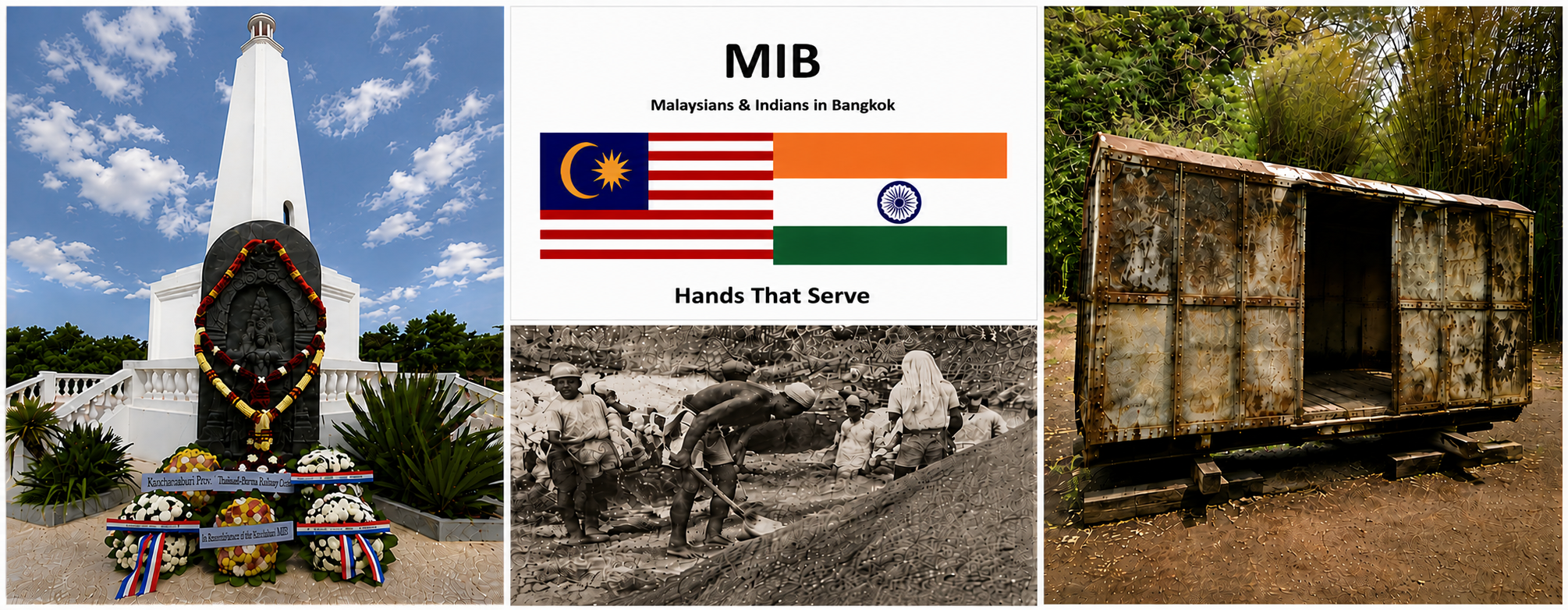
On 11 November 2021, members of the Malaysians and Indians in Bangkok[2] (MIB) gathered at the obelisk in Kanchanaburi and heard their consultant explain the history of the site. For those present, this was a significant moment. The group recognized that the existing monument represented an opportunity to establish a permanent place of remembrance for the Asian Forced Laborers who had suffered and died during and after the construction of the Thai–Burma Railway.
The effort was subsequently taken forward by this group, many of whom regarded the people represented by the chedi as their relatives and countrymen. Guided in part by the historical work of Professor David Boggett, the group sought permission from the abbot of Wat Thaworn Wararam to renovate and re-interpret the existing monument.
The objective was not to replace Chedi Niranam. The 1957 structure was itself an important part of the history. Instead, the intention was to give the old memorial a new meaning: to preserve the anonymous grave while providing a place where the story and identity of the people buried there could finally be recognized.
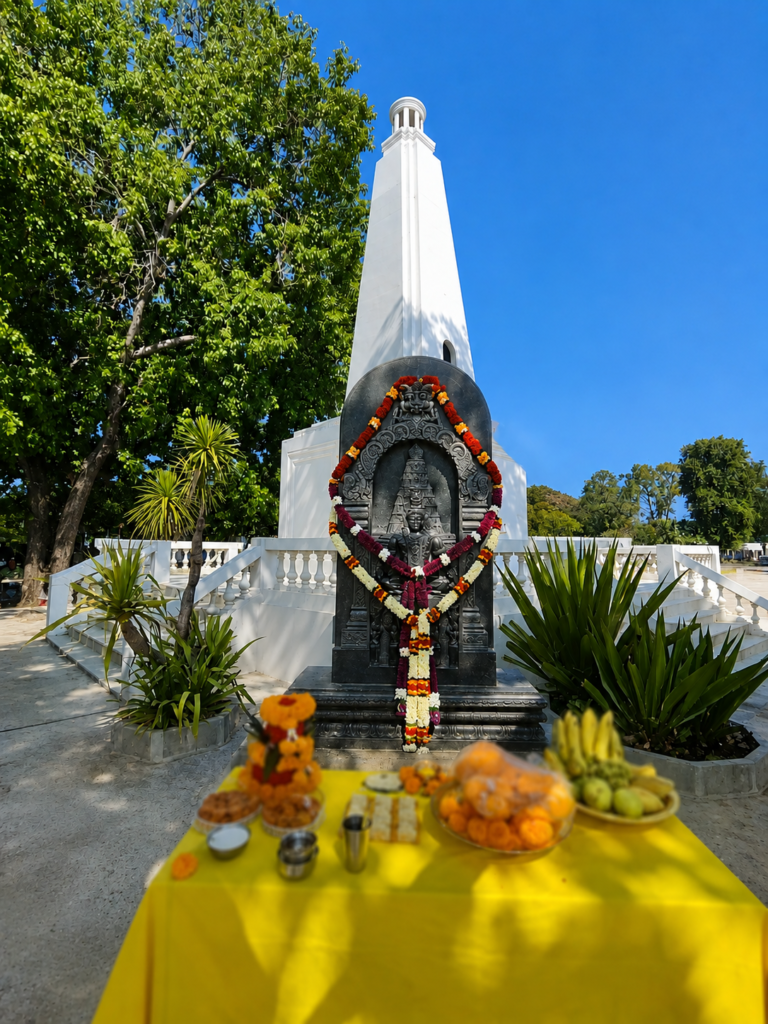
After numerous meetings and months of discussion—complicated by the COVID-19 pandemic and its associated restrictions—the abbot and temple elders agreed that a Nadukal, or Hero Stone, could be added to the existing structure.
The decision was significant step in establishing what is now referred to as the Chedi-Nadukal Pairing.
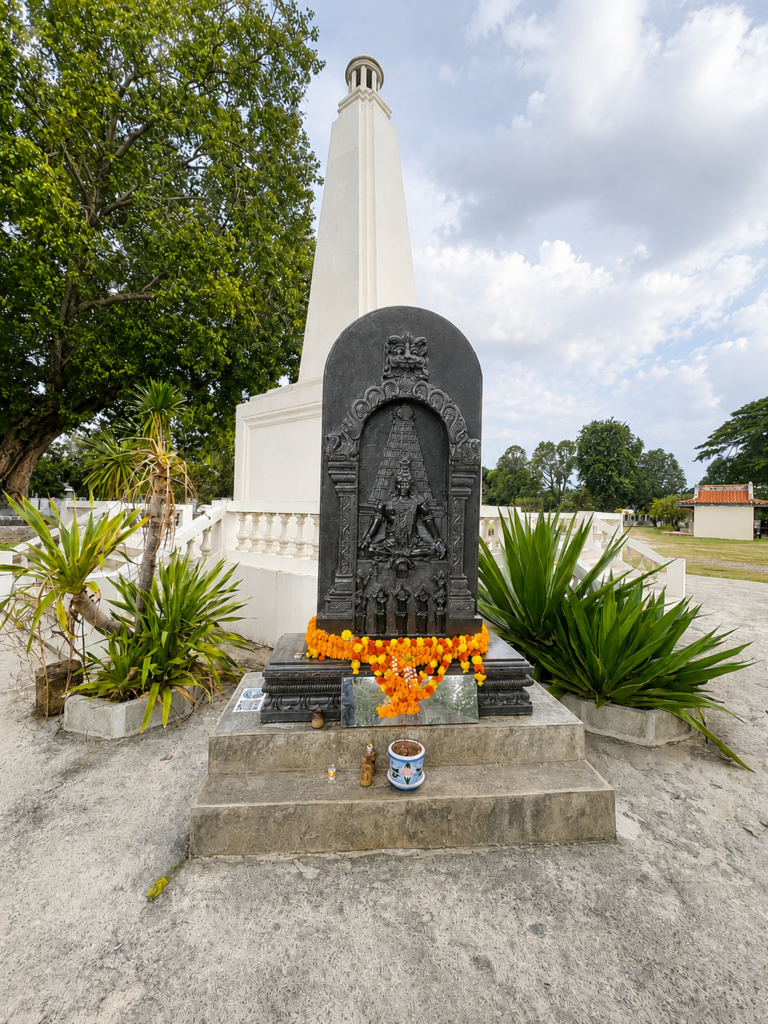
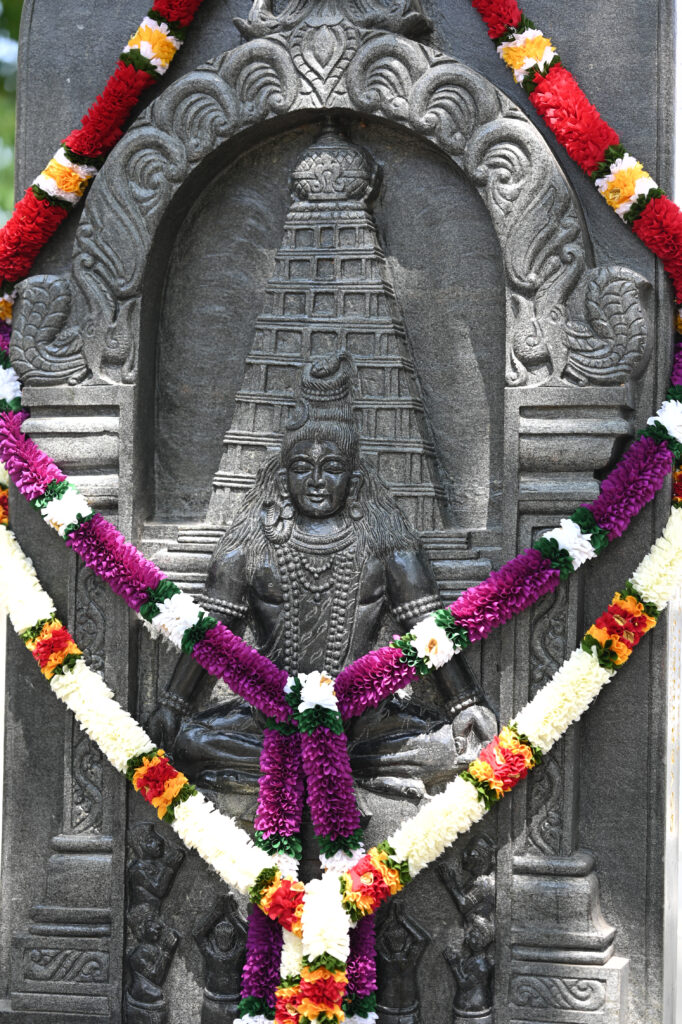
A Nadukal is a traditional South Indian-Tamil memorial stone associated with the remembrance and honoring of those who died. It is not a gravestone. Its inclusion at Chedi Niranam introduced a specifically Tamil and Hindu dimension to a memorial that had previously been defined primarily by anonymity.
The Nadukal therefore does not replace the Chedi Niranam. The two monuments have different but complementary meanings.
The Chedi preserves the remains and acknowledges the uncertainty surrounding their identities.
The Nadukal provides an identity and cultural context for the principal community now believed to be represented among those remains.
Together, they create a new memorial setting dedicated to all of the Asian Forced Laborers while recognizing that Malay-Tamils, predominantly followers of the Hindu faith, appear to constitute the majority of those buried beneath the chedi.
Why the Nadukal Matters
The history of the Asian Forced Laborers was marked by anonymity from the beginning.
They were recruited, coerced or otherwise compelled into Japanese labor projects without the systems of identification and record-keeping that protected the historical identity of Allied prisoners of war. During the railway construction, many died in jungle camps without their deaths being properly recorded. Others were cremated in mass fires, sometimes because of Japanese fears of epidemic disease, particularly cholera. Those who survived the construction period were subsequently concentrated in Kanchanaburi, where many continued to suffer from malnutrition, disease and neglect.
When the war ended in August 1945, the difference between the treatment of the Allied POWs and the Asian laborers became even more apparent.
The Allied prisoners were rapidly collected, medically assessed, evacuated and repatriated. Their dead were subsequently recovered, identified and buried in marked graves.
The Asian Forced Laborers received no equivalent organized evacuation or system of post-war care. Many remained in the former camps for months and, in some cases, years. Some attempted to make their own way home. Others died in Kanchanaburi after the railway itself had ceased operating.
For decades, the dead were therefore remembered without being identified.
The Nadukal begins to reverse that process.
It does not claim that every person beneath Chedi Niranam was Tamil, nor does it provide names that have been lost forever. Rather, it acknowledges the historical evidence that the majority were likely Malay-Tamil laborers and provides their descendants with a culturally meaningful place to remember them.
At the same time, the memorial remains explicitly dedicated to the broader population of Asian Forced Laborers. Malay-Tamil identity is therefore central to the memorial, but it does not exclude the Javanese, Chinese, Vietnamese, Burmese and other Asian laborers who also formed part of the vast forced-labor system associated with the Thai–Burma Railway.
The Dedication of the Nadukal
On 1 May 2024, after almost seventy years of anonymity, the Nadukal was formally placed at Chedi Niranam.
The dedication marked a significant transition in the history of the site. For the first time, descendants of the communities represented among the dead were given a permanent place in Kanchanaburi where they could come to honor their ancestors.
The ceremony deliberately brought together Buddhist and Hindu traditions. The memorial remained within the grounds of Wat Thaworn Wararam and therefore retained its Buddhist setting, while the Nadukal recognized the Tamil-Hindu identity of the principal group believed to be represented among the remains.
The message was consequently broader than a single religious tradition. It was an acknowledgment that the people buried at Chedi Niranam came from communities with their own cultures, religions and identities, even though those identities had disappeared from the original burial record.
The dedication also represented the beginning of a new relationship between the temple, the Malaysian-Tamil community and those seeking to preserve the history of the Asian Forced Laborers.
After eighty years, their descendants finally had a place to come.
The First Anniversary
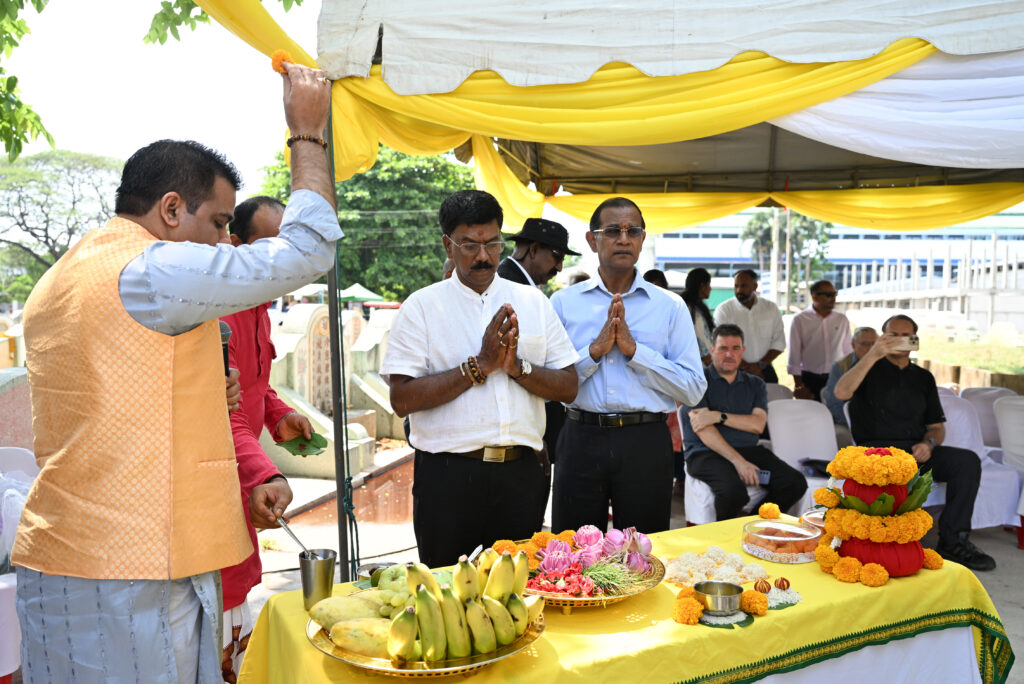
On 1 May 2025, members and supporters of the Malaysians and Indians in Bangkok (MIB) returned to Chedi Niranam to mark the first anniversary of the Nadukal.
The gathering included representatives of the Kanchanaburi provincial administration, the Malaysian Embassy, the temple community, Thai Tourism and Cultural organizations, the Thailand Tamil Sangam, academic institutions and members of MIB. Among those present were Deputy Governor Supamongkol Boochataites, representatives of the Kanchanaburi Provincial Office of Tourism and Sports, the Mueang Kanchanaburi District Office, the Kanchanaburi Provincial Cultural Office and the Tourism Authority of Thailand.
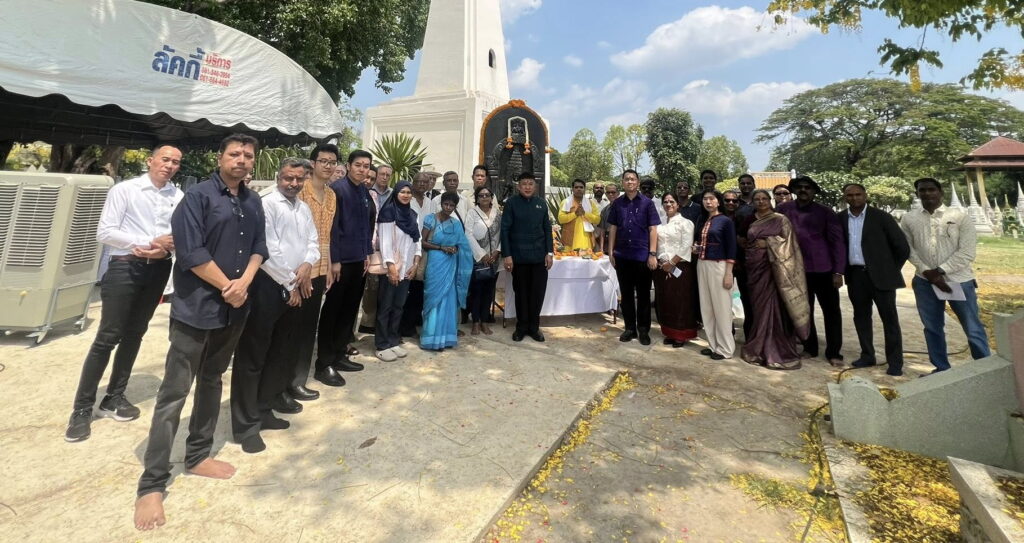
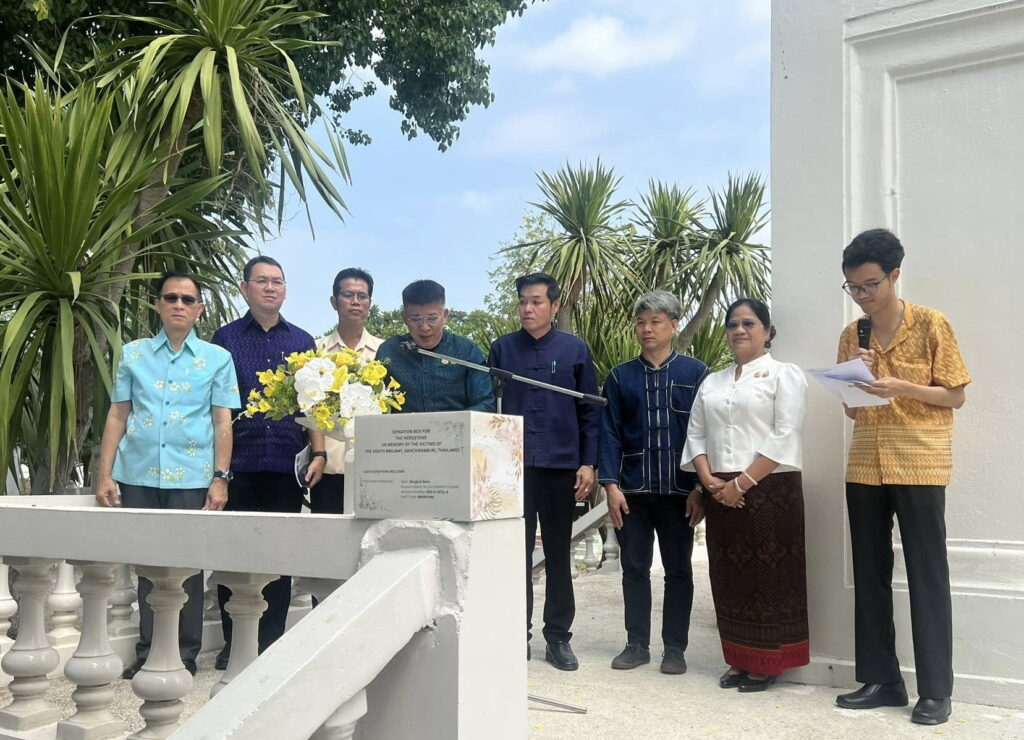
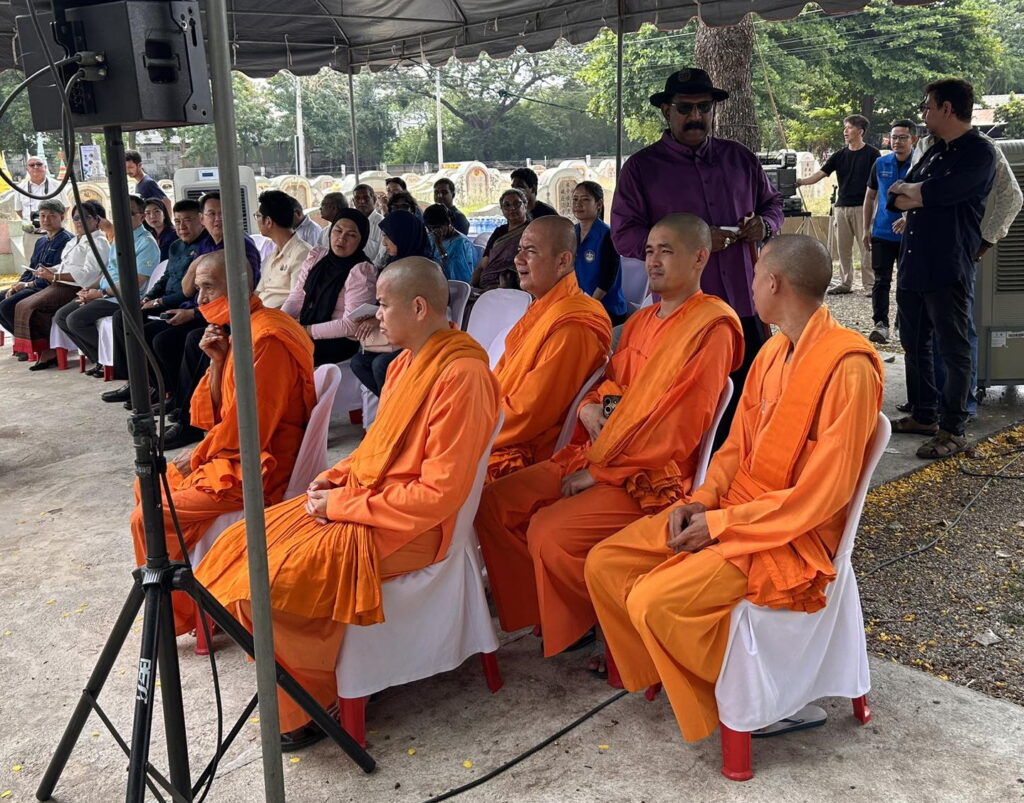
The temple committee was represented by a contingent of five monks. The Tamil community was represented by TS Sundar, Chairman of the Thailand Tamil Sangam. Academic and historical participants included Dr Branesh of the Asian Institute of Thailand, Professor David Boggett, Dr JJ Karwacki and Professor Andy Barraclough, who served as moderator.
MIB was represented by its Chairman, Dr Silva Kumar, together with Ramesh Dharmarajan, Krishna Kumar, Shyamraj and Ramesh Pandian. Visitors also came from Malaysia, including Mr and Mrs Sansai Naidu of Johor Baru and Mr Kalamani of Kuala Ketil, Kedah.
The ceremony again joined the Buddhist and Hindu traditions associated with the site. Five monks from Wat Thaworn Wararam conducted Buddhist prayers, followed by prayers and a Hindu ancestral ceremony conducted by Pandit Sandeep Kumar of Hindu Samaj, Bangkok, assisted by Pandit Ajit Tripthi.
The participation of the Deputy Governor in the ancestral ceremony was particularly significant. It demonstrated that the memorial was becoming recognized not simply as a private place of family remembrance, but as an important part of the wider historical and cultural landscape of Kanchanaburi.
A Memorial to All Asian Forced Laborers
The development of Chedi Niranam into a new memorial setting should therefore be understood carefully.
It is not a memorial exclusively to Tamils. It is a memorial to the Asian Forced Laborers whose remains were gathered beneath the chedi.
The Malay-Tamil community occupies a central position because the available evidence indicates that Malay-Tamils constituted the majority of those represented among the remains and because many were Hindus whose cultural identity had never previously been represented at the site.
The Nadukal gives that community a visible and culturally appropriate memorial.
But the wider Chedi Niranam story embraces all of the Asian Forced Laborers whose lives were consumed by the Japanese wartime labor system. Javanese, Chinese, Vietnamese, Burmese and other Asians were also subjected to forced labou on the railway and associated projects. Their individual identities have likewise been lost in many cases.
The new memorial therefore provides an opportunity to correct one historical imbalance without creating another.
The Allied POWs have their cemeteries.
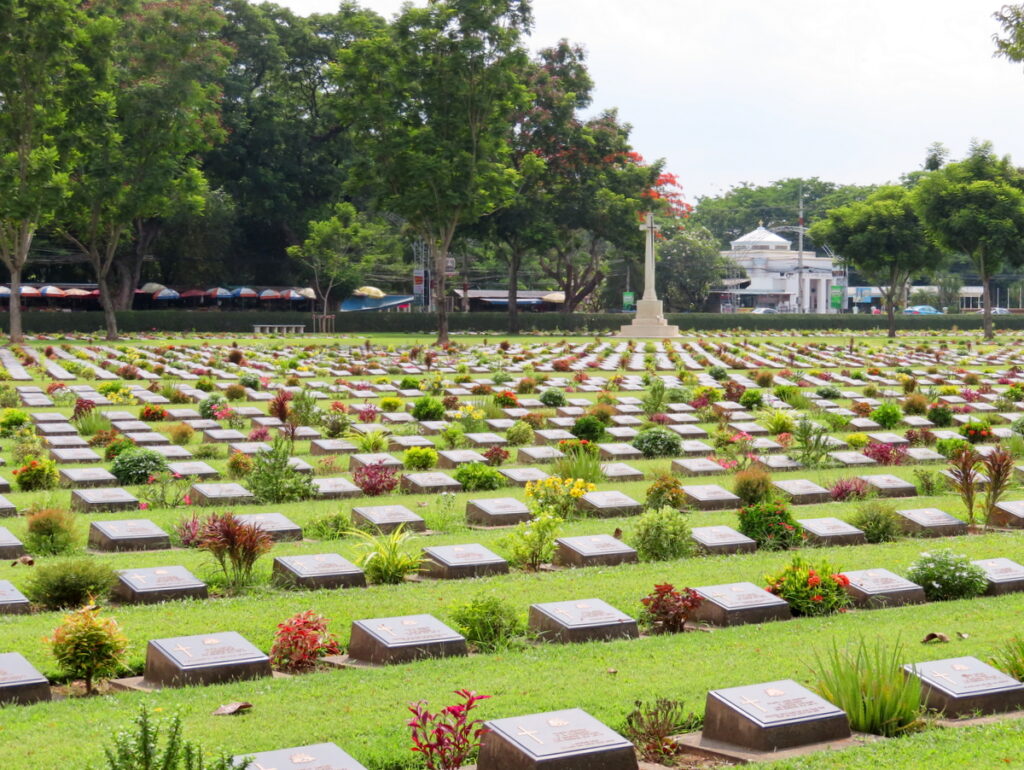
The Asian Forced Laborers now have the Chedi-Nadukal Paired Memorial.
The Commonwealth War Graves Commission cemeteries preserve the names of thousands of Allied servicemen who died during the railway experience. Chedi Niranam represents those whose names were not preserved. The Nadukal adds another essential dimension: it recognizes that among these anonymous dead were people who belonged to identifiable families and communities, people whose descendants still live today.
From Anonymous Dead to Remembered Ancestors
The transformation of Chedi Niranam is ultimately not about changing what happened in the past. It is about changing how the past is remembered.
In 1957, the temple could only say that thousands of unknown people were buried beneath the monument.
Today, the evidence allows us to say more.
They were overwhelmingly likely to have been victims of the wartime labor system. Many had worked on the Thai–Burma Railway. Many had survived the railway construction itself only to die later in Kanchanaburi. A substantial proportion were Malay-Tamils from Malaya, and many of those were Hindus.
Their names may never be recovered.
Their precise number may never be established.
The exact nationality of every individual may never be known.
But their identity as human beings, as forced laborers, as members of families and communities, and as victims of one of the great wartime construction projects of Southeast Asia can no longer be ignored.
That is the significance of placing a Nadukal beside Chedi Niranam.
The old chedi says:
We do not know who they were.
The new memorial says:
We now know enough to remember them.
And the two together create a memorial to all of the Asian Forced Laborers, while giving particular recognition to the Malay-Tamil community that appears to have formed the majority of those whose remains lie beneath the Grave of 10,000 Souls.
The memorial’s message remains deliberately simple:
We will never know their names.
We will never know how many, nor exactly where
they came from.
We can, however, try to tell their story
so that they will never be forgotten.
For the Malay-Tamil dead, the Nadukal provides a place where descendants can honor their ancestors according to their own cultural and religious traditions.
For the wider population of Asian Forced Laborers, Chedi Niranam provides a permanent place of remembrance.
And for Kanchanaburi, the combined memorial now stands as a reminder that the history of the Thai–Burma Railway was not only the history of Allied prisoners of war. It was also the history of hundreds of thousands of Asians whose suffering, labor and deaths were essential to the construction of the railway—and whose stories remained largely untold for generations.
After almost eighty years, Chedi Niranam is no longer simply the Grave of the Anonymous.
It has become a place where the anonymous dead can finally be remembered as people.
[1] One might be tempted to call them graves, but there was no solemnity or human respect in this disposal process.
[2] This group included the Ambassador from Malaysia and Dr. Silva Kumar and Mr. Rames. among others
A plaque suggestion written by CHATGPT:
CHEDI NIRANAM
The Grave of 10,000 Souls
This chedi was erected in 1957 by the elders of Wat Thaworn Wararam. Its name, Niranam, means “anonymous” or “unknown,” reflecting the fact that those who built it did not know the identities of the thousands whose remains were buried here.
Beginning in 1952, road construction and other public works in this area repeatedly uncovered human bones. As the land had formerly belonged to the temple, the abbot accepted responsibility for the remains. Over several years, three major reburials were conducted. Temple staff estimated that more than 10,000 skeletons were interred here before the site was sealed and this chedi constructed. The Chinese inscription reads: “Grave of 10,000 Souls.”
For decades, the local community preserved this place with annual Qing Ming ceremonies, honoring the dead even though their names and histories were unknown.
Research conducted many years later indicates that the majority of those buried here were likely Asian labourers—primarily Malay-Tamil romusha—who were forced to work on the Thailand–Burma Railway during the Second World War. Today, Chedi Niranam stands as a memorial to these forgotten victims and to all who suffered and died far from home.
August 2026 Update:
The history of Chedi Niranam entered a new phase on 15 August 2026.
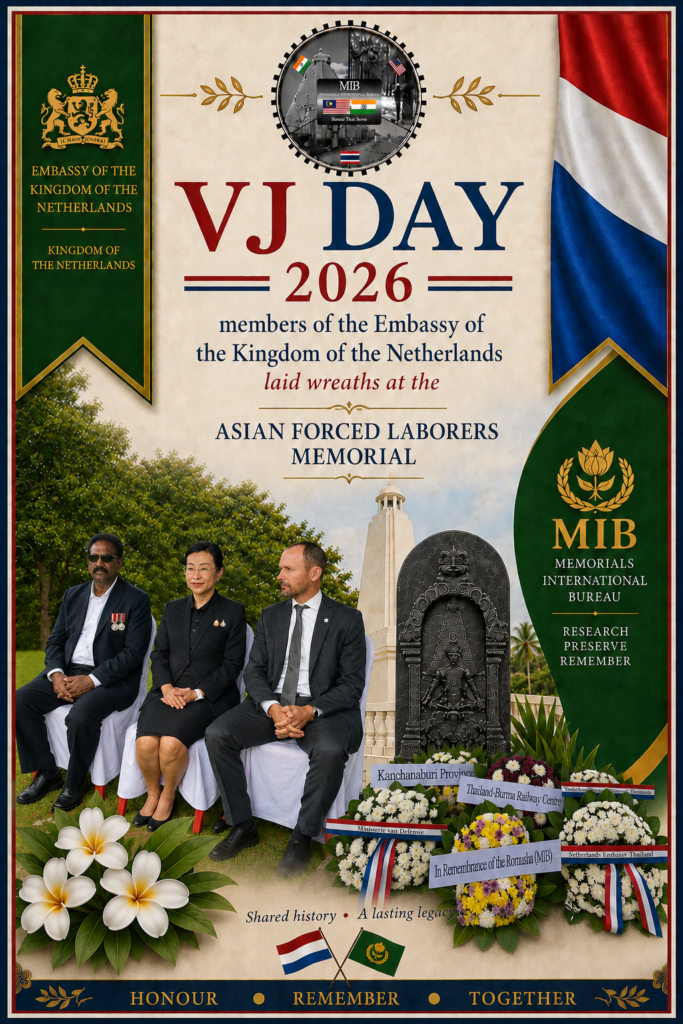
On that date, members of the Embassy of the Kingdom of the Netherlands participated in a remembrance ceremony at Wat Thaworn Wararam in Kanchanaburi and laid wreaths at the Asian Forced Laborers Memorial. The ceremony was conducted in conjunction with VJ Day 2026 and represented the embassy’s inaugural remembrance ceremony at the Wat Yuan site.
This event is historically significant for another reason. It constitutes the first documented formal acknowledgement of the Chedi–Nadukal Pairing by an organization external to the Malaysians and Indians in Bangkok (MIB), the temple community and the groups directly involved in developing the memorial.
Until this point, the development and recognition of the pairing had principally been an internal process involving the temple, MIB, the Malaysian-Tamil community, historians and other individuals and organizations associated with the creation and interpretation of the memorial. The Nadukal was formally placed beside Chedi Niranam on 1 May 2024, establishing the paired memorial concept: Chedi Niranam preserves the anonymous remains, while the Nadukal provides recognition of the people and communities represented by those remains. The existing history therefore describes the two monuments as complementary rather than interchangeable.
The Netherlands Embassy ceremony demonstrates that this interpretation has now begun to extend beyond the organizations and communities that created the memorial.
The 2024 addition of the Nadukal changed the memorial’s interpretive meaning without changing the historical function of the chedi. The Chedi remains the grave. The Nadukal is not a gravestone; it is a memorial recognition of the people whose identities were lost. The two therefore provide complementary statements: the Chedi preserves the physical remains of the anonymous dead, while the Nadukal restores a degree of cultural and historical identity to the community from which many of them appear to have come.
The significance of the 15 August 2026 ceremony is that for the first time, an outside national institution formally incorporated the Chedi–Nadukal Pairing into its own act of remembrance. The Netherlands Embassy did not follow the usual pattern of just acknowledging the graves or in the Allied POW cemetery. Its representatives participated in remembrance at a memorial dedicated to the Asian Forced Laborers.
This is particularly meaningful in the context of the wider history of the Thai–Burma Railway. The existing memorial landscape has long provided highly developed mechanisms for remembering Allied prisoners of war. Their names are preserved in military records and their graves are maintained in Commonwealth War Graves Commission cemeteries. The Asian Forced Laborers, by contrast, were largely excluded from comparable systems of identification and commemoration.
The Chedi–Nadukal Pairing represents an attempt to correct that imbalance without diminishing the remembrance of the Allied dead.
The Netherlands Embassy’s participation therefore provides an important external validation of the memorial’s developing place within the historical landscape of Kanchanaburi. It demonstrates that the story of the Asian Forced Laborers is beginning to move beyond a community-based memorial initiative and into the wider international remembrance of the Thai–Burma Railway.
The event should consequently be recorded as a milestone in the history of the memorial:
15 August 2026 — First documented formal acknowledgement of the Chedi–Nadukal Pairing by an external national institution.