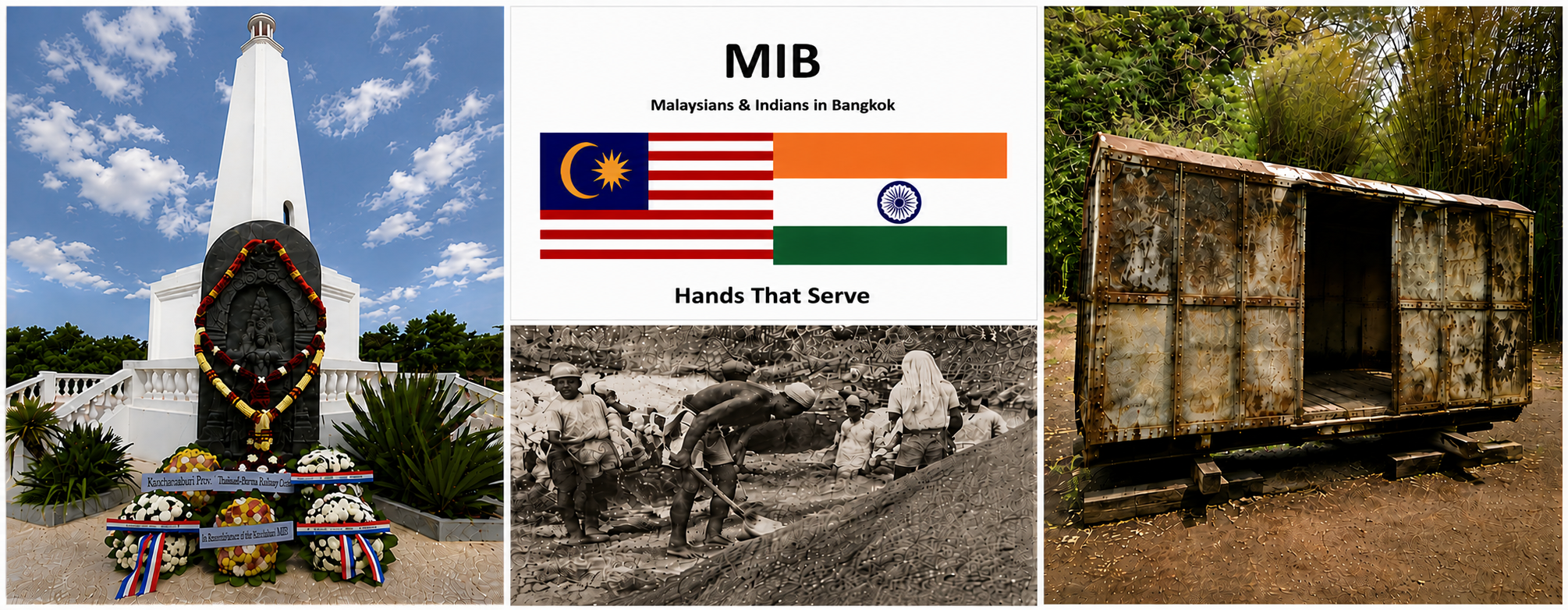
Since its dedication next to Chedi Niranam, the Nadukal or hero stone has received attention and praise from a small but meaningful population. Its dedication and subsequent ceremonies have been attended by Ambassadors and officials from many Embassy staffs. Malaysia, India and Sri Lanka have been deeply involved. News outlets in Malaysia, India, Japan and Germany have run stories on this memorial.
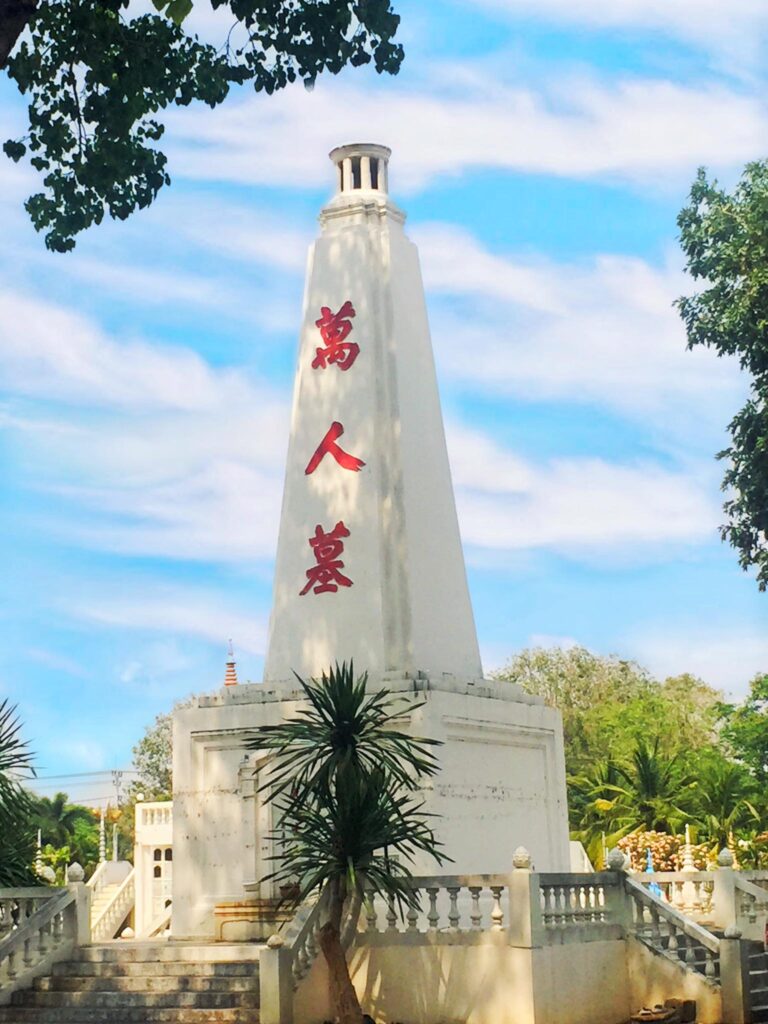
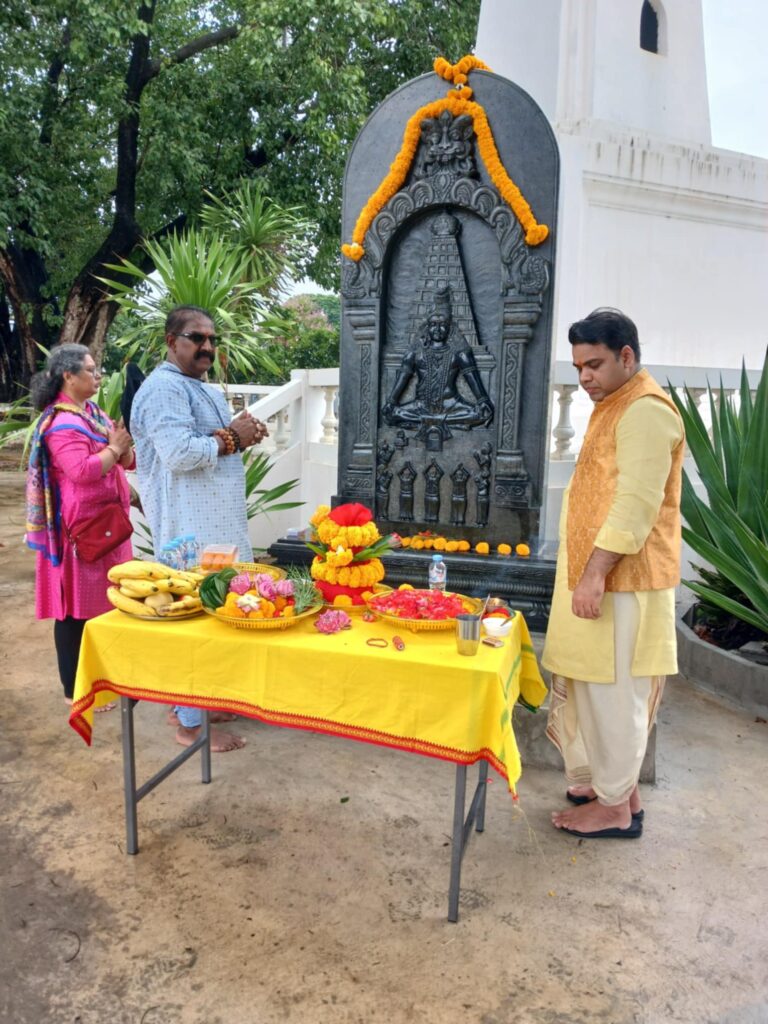
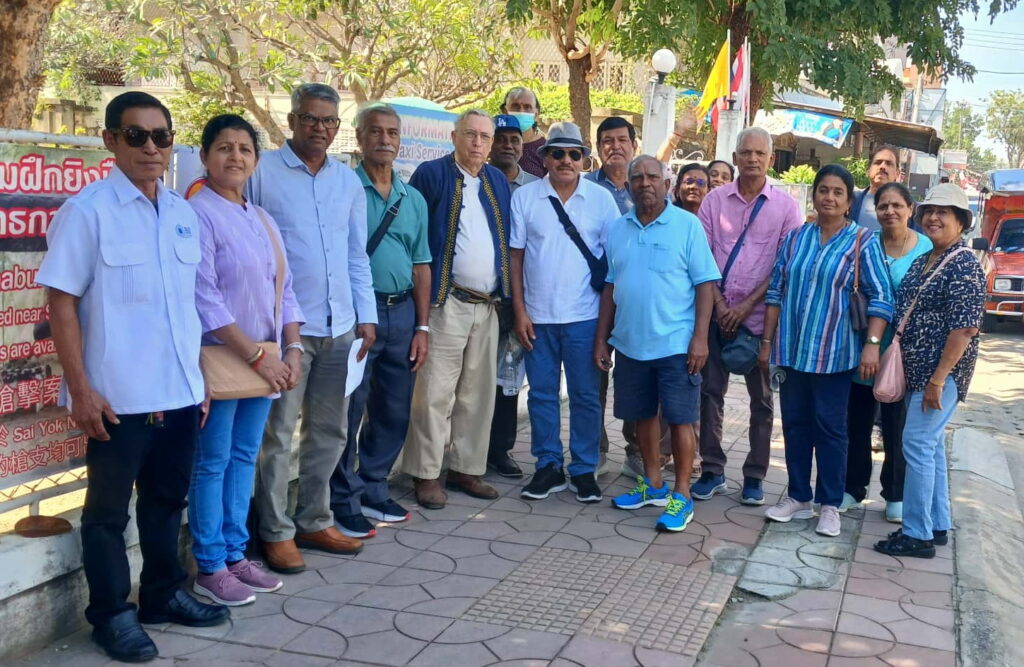
Over the two years of its existence, it has been visited by a number of organized tours and family groups, many of whom had ancestors who were involved in the seminal events during World War II. For them, it has a deep personal meaning.
Overall, the memorial landscape of the Thailand–Burma Railway has been centered on the Allied prisoners of war while marginalizing the vastly larger population of Asian romusha laborers who perished during that railway’s construction. Each year thousands of foreign tourists and Thai day-trippers visit the famous bridge, the war cemetery and museums associated with the Railway.
For nearly 70 years, Chedi Niranam has stood as a silent vigil to those Asian laborers. Mere meters from the renowned Kanchanaburi War Cemetery, it was unknown to those cemetery visitors and even largely neglected by its custodians. Generations of elders of the temple have held an annual honorific ceremony during the Qing Ming ancestral remembrance period. As is reflected in the name ‘niranam’ meaning unknown or anonymous in Thai, neither the current generation nor those preceding them are aware of just who they interred there long ago.
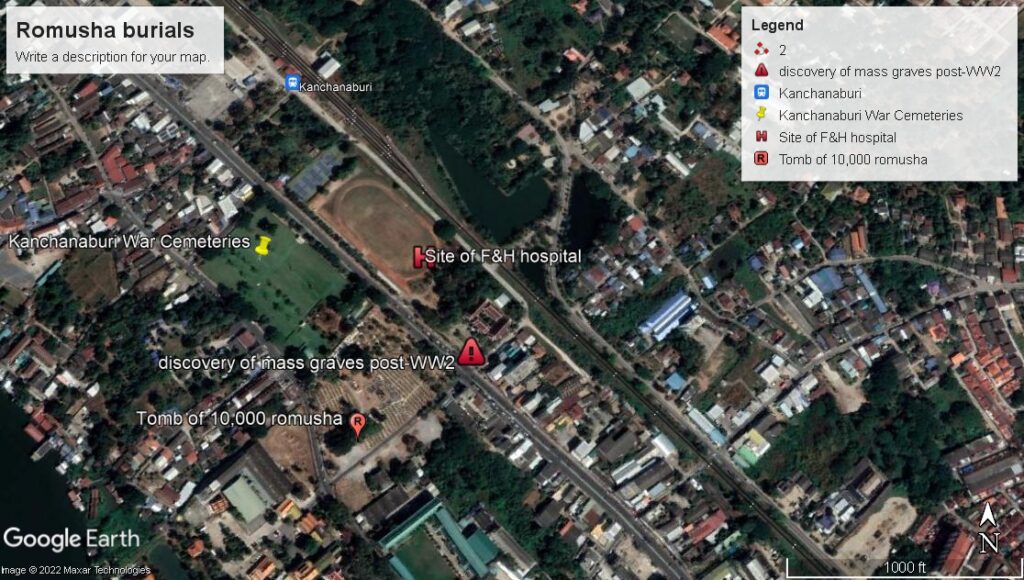
Over those ensuing decades, historians, archeologists and interested parties have contributed to a more detailed understanding of the events that culminated in the construction of this chedi in 1957. In 2024, a new era began when the Malaysians and Indians in Bangkok (MIB) and the Thailand Tamil Sangam[1] (TTS) re-dedicated this site to the Asian Forced Laborers who have lain here so long without recognition.
Those primary sponsors of this Nadukal ultimately hope that it may become one of the most important symbolic sites associated with Tamil romusha memory in Southeast Asia. In order to achieve this status, it is imperative that knowledge of it and its meaning is spread to a wider audience. One reason for the existence of this website is to tell the story of these memorials and those who worked and died on the Thai-Burma Railway. We will do our part to relate their story and impart the meaning of these sites.
We call upon historians and educators, but also social media content creators to familiarize themselves with this site and to assist in spreading the word by all possible means to encourage those tourists and day-trippers to extend their itinerary to include the memorial.
We will never know their names.
We will never know how many nor exactly where they came from.
We can, however, try to tell their story so that they will never be forgotten.
[1] https://www.thailandtamilsangam.com/
============================
CHATGPT’s attempt to convert this to an ‘academic’ format:
Reclaiming the Anonymous Dead:
The Chedi Niranam Nadukal and the Recovery of Tamil Romusha Memory
on the Thailand–Burma Railway
Abstract
The memorial landscape of the Thailand–Burma Railway has historically centered on Allied prisoners of war while marginalizing the vastly larger population of Asian romusha laborers who perished during railway construction under Japanese occupation between 1942 and 1945. In 2024, a Tamil nadukal (“hero stone”) erected beside Chedi Niranam in Kanchanaburi, Thailand, introduced a significant new commemorative intervention into this landscape. This article examines the nadukal as a form of diasporic counter-memory and postcolonial memorial reclamation. It argues that the memorial represents not merely a religious marker but a deliberate cultural and historiographical challenge to decades of selective remembrance. By connecting ancient Tamil hero-stone traditions to the anonymous mass deaths of Malay-Tamil romusha laborers, the nadukal re-humanizes populations historically reduced to categories such as “coolies” or “native labor.” The article situates the memorial within broader debates concerning heritage legitimacy, memory politics, colonial labor migration, and the unequal memorialization of wartime suffering in Southeast Asia.
Introduction
The Thailand–Burma Railway occupies a prominent position in global memory of the Second World War. Popular histories, memoirs, museums, and films have long focused upon the suffering of Allied prisoners of war compelled to construct the railway under Japanese military supervision. Cemeteries maintained by the Commonwealth War Graves Commission at Kanchanaburi and Chungkai institutionalized this memory through carefully maintained graves, archival identification, and annual commemorative rituals.
Yet the railway’s largest victim population was not Allied POWs but Asian romusha laborers. Estimates suggest that between 70,000 and 100,000 Asian laborers may have died during railway construction and maintenance, compared to approximately 12,000 Allied POWs. Exact figures remain uncertain because Japanese recordkeeping for Asian laborers was fragmentary and/or intentionally destroyed[1] immediately post-war. Many died anonymously from cholera, malaria, dysentery, malnutrition, exhaustion, and physical abuse.
Among these laborers were thousands of Tamils recruited or coerced from British Malaya. Chedi Niranam likely contains remains from multiple Asian labor populations, among whom Tamil romusha appear to have constituted a significant component. Descendants of these communities have increasingly challenged the asymmetry of railway remembrance.
The dedication of a nadukal beside the Chedi Niranam in Kanchanaburi in 2024 represents one of the clearest manifestations of this emerging memory movement.
This article examines the historical and symbolic significance of that nadukal. It argues that the memorial constitutes a form of diasporic historical recovery that repositions Tamil romusha dead within the moral and commemorative landscape of the railway.
Tamil Migration and Colonial Labor Systems in Malaya
The presence of large Tamil populations in wartime Malaya was the consequence of British colonial labor policy developed during the late nineteenth and early twentieth centuries. The rapid expansion of rubber plantations, railways, and extractive industries created enormous labor demands within British Malaya. Colonial authorities increasingly relied upon imported South Indian labor, particularly Tamil workers from the Madras Presidency.
Recruitment occurred through both indenture and the kangani system, whereby labor overseers recruited workers from their own villages and kinship networks. Poverty, debt, drought, caste oppression, and landlessness in South India contributed to large-scale migration.
By the 1930s, Tamil plantation communities had become deeply established throughout Malaya. Estate laborers frequently lived in segregated plantation settlements under highly controlled conditions that made them economically dependent upon plantation management within highly hierarchical colonial labor systems. Educational access remained limited and they were, in general, kept segregated from the indigenous Malay population both culturally and linguistically.
The Japanese conquest of Malaya in 1942 transformed these plantation populations into an accessible labor reservoir for imperial wartime projects. Tamil laborers became heavily represented among the romusha transported to Thailand and Burma to perform war-time construction projects.
The Romusha and the Politics of Anonymity
The Japanese wartime labor system treated Asian laborers differently from Allied POWs in both administrative and ideological terms. Allied prisoners, despite brutal conditions, remained identifiable military captives linked to nation-states capable of postwar recovery and memorialization.
Romusha laborers occupied a different category altogether.
Many were undocumented civilians transported through coercion, deception, economic desperation, or direct force. Mortality among Asian laborers was catastrophic. Disease outbreaks, particularly cholera, devastated these labor camps. Countless bodies were buried in unmarked graves, consumed in mass cremations or abandoned where they died.
Following the war, Allied recovery teams prioritized the location, identification, and repatriation of Allied military dead. This produced enduring memorial infrastructures: named graves, official registers, military ceremonies, and national remembrance traditions[2].
Asian laborers generally received none of these.
The consequence was a hierarchy of wartime memory in which Western suffering became individualized while Asian suffering remained largely statistical and anonymous.
Chedi Niranam emerged within this context.
Chedi Niranam as a Site of Anonymous Memory
Chedi Niranam, located at Wat Thaworn Wararam in Kanchanaburi, was constructed in 1957 over cremated remains associated with railway dead. The site gradually came to be understood locally as containing large numbers of Asian laborer remains, including Tamil romusha from Malaya.
Unlike Allied war cemeteries, the chedi did not individualize the dead through names or military identity. Instead, it functioned as a collective repository for unclaimed and unidentified remains.
This distinction is historically significant.
The Commonwealth cemeteries at Kanchanaburi and ChungKai present order, documentation, and state recognition. Chedi Niranam instead represents absence: of names, of records, or any institutional memory.
For decades, the site remained marginal within dominant railway narratives.
Nadukal Tradition and Tamil Heroic Memory
The nadukal tradition constitutes one of the oldest forms of commemorative practice within Tamil culture. Dating back to the Sangam period, hero stones were erected to commemorate individuals who died through acts of sacrifice, communal protection, or valor.
These stones were not merely funerary markers. They mediated relationships between memory, ancestry, locality, and sacred presence. In some cases, nadukal became objects of ritual reverence or localized worship.
Historically, nadukal frequently commemorated non-elite individuals rather than rulers or kings. Their function was therefore partly democratic: preserving memory for those otherwise vulnerable to historical erasure.
The placement of a nadukal at Chedi Niranam represents an important reinterpretation of this tradition.
The railway laborers were not warriors in a conventional military sense. They were coerced workers trapped within overlapping systems of colonial exploitation and wartime imperial violence. Yet the nadukal reframes endurance, suffering, and dispossession themselves as forms of historical sacrifice deserving heroic remembrance.
This transformation is culturally and politically significant.
The Heritage, Legitimacy, and the Future of the Site
The nadukal erected beside Chedi Niranam in 2024 may be understood as a counter-memorial. Rather than reinforcing established state narratives, it intervenes within an already-existing commemorative landscape to challenge its silences.
The memorial performs several functions simultaneously.
First, it re-identifies anonymous laborers as Tamil subjects with cultural ancestry and historical continuity.
Second, it contests the language historically used to describe Asian laborers as “coolies,” “native workers,” or “romusha.”
Such terms often obscured individual humanity beneath broad and even pejorative administrative categorization.
Third, the nadukal reconnects the dead to an ongoing Tamil ritual tradition. This is particularly important because most railway laborers received no enduring funerary or ancestral rites.
Lastly, the memorial reorients the railway narrative from an exclusively Allied military frame toward a broader account involving colonial labor systems and Asian civilian mass death.
The memorial therefore operates not only as a cultural artifact but as a historiographical intervention.
The nadukal also raises questions concerning heritage legitimacy. Because the memorial itself is recent, conventional social science frameworks may not easily classify it as “heritage” in the traditional sense. Yet contemporary heritage scholarship increasingly recognizes sites that memorialize past trauma and community remembrance as legitimate heritage formations regardless of antiquity.
The future legitimacy of the nadukal will likely depend upon academic engagement, ritual continuity, diaspora support, and incorporation into the broader railway interpretation.
The site possesses particular importance because it links three historically interconnected processes: British colonial labor migration, Japanese wartime forced labor activities, and postcolonial struggles over remembrance.
As such, the nadukal may ultimately become one of the most important symbolic sites associated with Tamil romusha memory in Southeast Asia.
Conclusion
The Chedi Niranam nadukal represents more than the addition of a new memorial object within Kanchanaburi’s wartime landscape. It constitutes an attempt to recover identities erased through overlapping systems of empire, war, labor exploitation, and postwar memorial inequality.
For decades, the dominant memory of the Thailand–Burma Railway gave precedence to Allied military suffering while leaving Asian laborers largely anonymous. The nadukal challenges this asymmetry by introducing an ancient Tamil commemorative tradition into a modern site of historical absence. In doing so, it transforms anonymous remains into ancestors.
The memorial’s greatest significance may lie precisely there: not in recovering lost names, but in restoring historical dignity to populations long denied recognition within official memory.
[1] https://www.afl-mib.org/2-4-destruction-of-records/
[2] Particularly Remembrance Day in November and ANZAC Day in April.
I’m not unhappy with the result but it does seem too pedantic!