JULY 2026 UPDATE:
- Kanchanaburi’s Provincial Administrative Organisation is pushing for the Bridge over the River Kwai and the Death Railway to be registered as a UNESCO World Heritage site to promote its historical significance.
- The bid faces hurdles as the area is controlled by the State Railway of Thailand, and a previous push by the Ministry of Culture stalled for political reasons.
- Proponents argue the site is historically important, well-preserved, and has the potential to be registered as Thailand’s first mixed cultural and natural World Heritage site.
- The initiative has support from the Ministry of Natural Resources and Environment, but a recent appeal to the Ministry of Culture has shown no progress.
Dr Prawat Kithammakunnit, president of the Kanchanaburi Provincial Administrative Organisation (PAO), spoke about promoting tourism in Kanchanaburi, particularly calls to push the Bridge over the River Kwai and the Death Railway, Second World War historical attractions, towards World Heritage status.
He said the area should be promoted as a world-class destination because it was a valuable historic site.
At present, many visitors who are unaware of its historical background come only to take photographs and leave.
The PAO wants to develop a museum so people can absorb the history of the war, when the Japanese army forced prisoners of war to build the railway.
However, he said it was regrettable that the PAO could not take action because the area is under the supervision of the State Railway of Thailand.
At present, parts of the area have been leased for commercial purposes, with shops operating in a disorderly manner.
Only Australia’s Hellfire Pass Interpretive Centre provides historical information, but it is still insufficient because, in fact, there is much more to the story.
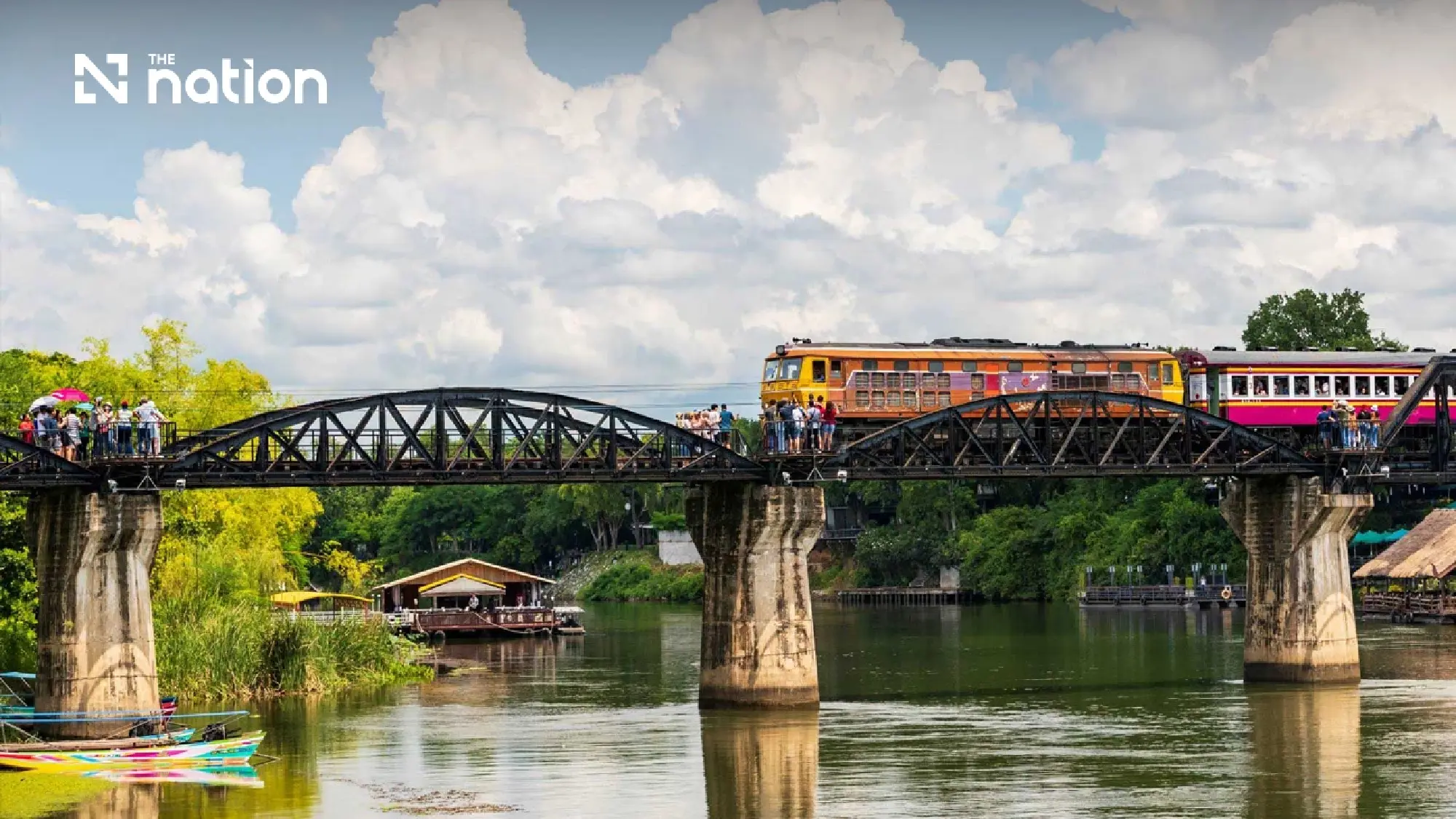
The annual memorial event now held there is more like a temple fair and does not truly create a world-class tourist destination.
Personally, he believed that if this were overseas, the issue would attract strong interest and stand out clearly.
However, the State Railway of Thailand is currently developing a railway extension from the line ending at Nam Tok Sai Yok Noi station to Hellfire Pass station, which is also part of the original historic route.
This is a positive development, and if the government attaches importance to the matter and appoints an agency to push it forward concretely, the PAO is ready to support it.
Reports said the Ministry of Culture had previously taken up the push for World Heritage registration for consideration and study, but it had stalled for political-policy reasons, as Kanchanaburi was not a strategic area for the governing political party.
Representatives of Kanchanaburi had submitted requests asking about progress.
ORIGINAL ARTICLE BELOW:
In the early 1950s, three events were taking place separately but simultaneously. None could have predicted how they would blend together decades later.
Just about the time foreign tourists initiated the entire Railway-related universe when they came looking for a bridge over the River Kwai, the Commonwealth War Graves Commission (CWGC) was putting the finishing touches on the main cemetery at Don Rak. By the next decade, these two, bridge and cemetery, would provide the foundation for all future tourism as it relates to the Thai-Burma Railway.
Meanwhile, just a short distance away, descendants of Vietnamese refugees were building a monument to people they had never met and never knew. Over five years (1952-57), members of Wat Yuan[1] (officially Wat Thaworn Wararam) had taken custody of thousands of sets of remains of human remains that had some link to WW2 events. Eventually, they interred those remains in a place they named Chedi Niranam, or the Grave of the Unknowns. They promulgated the number to be 10,000. That’s a third more than the POWs buried at Don Rak.
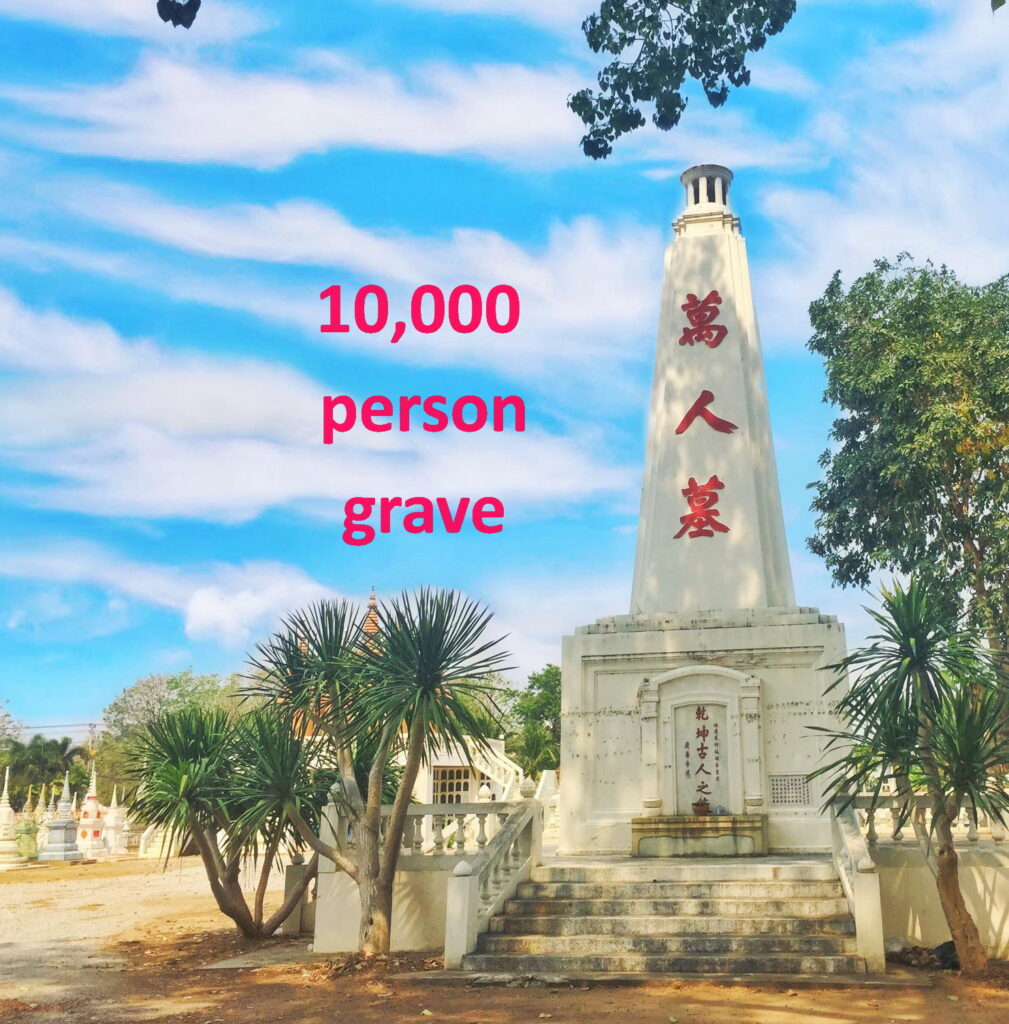
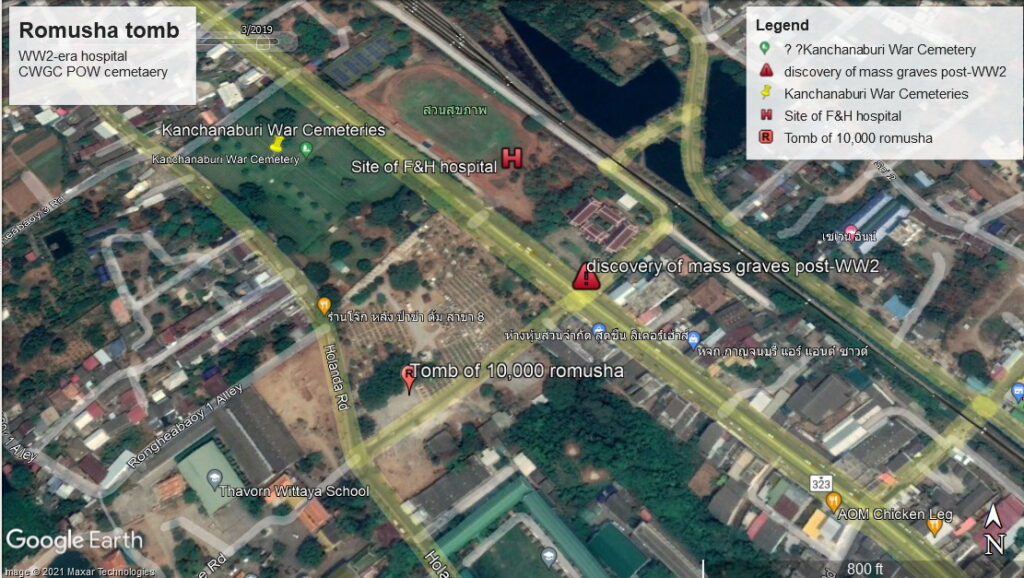
Chedi Niranam, however, remained largely unnoticed. It is tucked away in the center of a quiet temple cemetery, barely 100 meters from some of those POW graves, but not even quite visible from the main road. Yet, it is a unique structure compared to everything else in that cemetery. It is clearly a monument to something or someone. But anyone who walked past it would be hard pressed to know what or whom. Despite its name, it is not a chedi in the classic Thai sense. It might more properly be called Anusorn Sathan or memorial site based solely on its design. It is a chedi only in the sense that it is burial place. But traditionally chedis actually contain remains, not just mark their position. Part of the failure to recognize its status may be that the inscriptions are written in Chinese; a language unfamiliar to most modern Thais and foreign tourists.
Compared to all of the other sites in the immediate Kanchanaburi City area that are associated with the Thai-Burma Railway, Chedi Niranam apparently remained unknown outside of the Wat Thaworn Wararam community until the mid-1990s. But even then, the possible linkage between that structure and romusha deaths was not widely publicized. References appeared in a limited circulation journal in Japan[2].
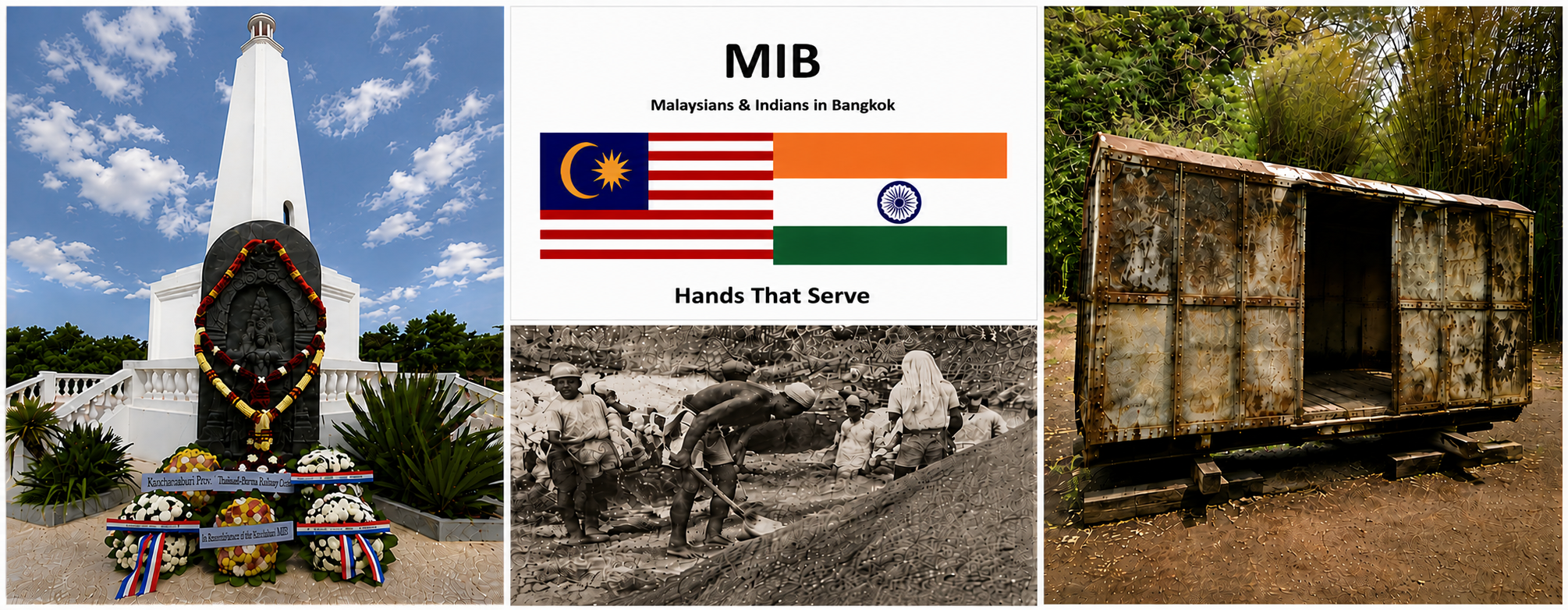
In 2021, a group of Malaysian and Indians with familial ties to romusha workers were introduced to Chedi Niranam as being the single physical structure in all of Thailand that could be associated with the romusha.
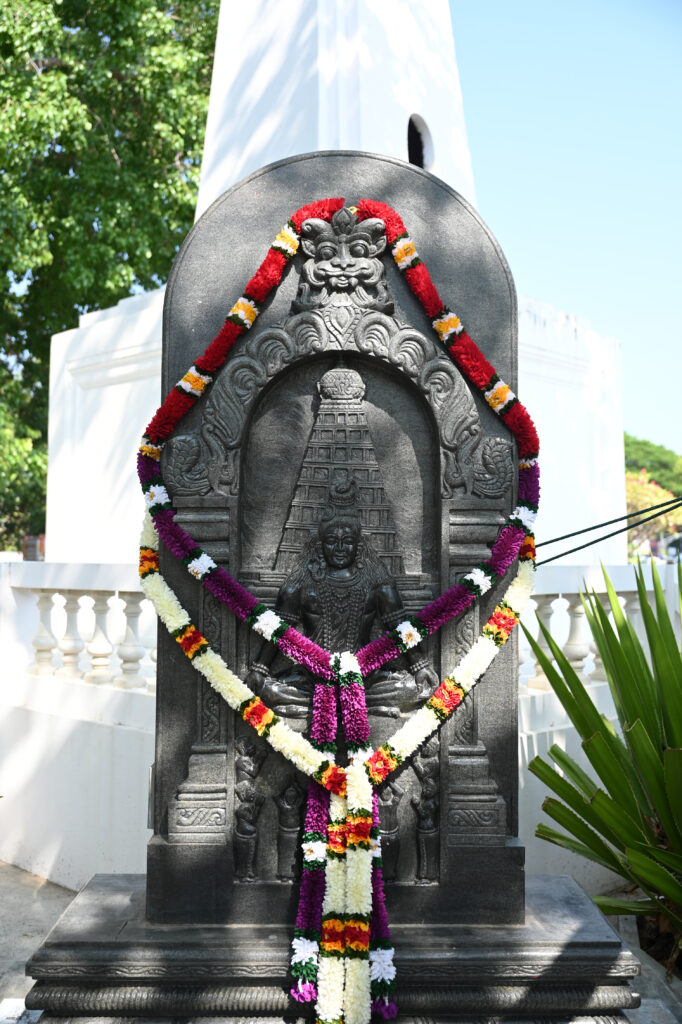
In 2024, they dedicated a Nadukal or traditional Hindu Hero Stone as a way of formalizing the link between the Chedi and their Malay-Tamil ancestors.
Whether Chedi Niranam eventually becomes recognized as a central Railway site remains to be seen. For decades it sat quietly within a temple cemetery, largely unnoticed. Today, new groups are attempting to give it a larger place in the story.
===============================
When is Chedi Niranam or even Wat Thaworn Wararam first associated with the WW2 romusha in popular or academic literature?
The answer appears to be: the association is very late. I could not locate evidence that either Chedi Niranam or Wat Thaworn Wararam was explicitly connected to WWII romusha in mainstream academic literature from the postwar decades. The linkage appears to emerge in stages, with the strongest public and explicit association appearing only in the 2020s.
A tentative chronology from available evidence:
1957 (physical memorial, but not identified as Romusha)
According to later historical commentary, the chedi itself was erected in 1957 over cremains gathered after the war, but the dead were not ethnically identified and the structure was called Chedi Niranam (“grave of the anonymous”). There is no indication in that description that it was initially framed as a Romusha memorial.
1957–2000s
The site seems to have been discussed mainly as:
- Wat Yuan / Wat Thaworn Wararam
- a cemetery or mass burial ground
- a place containing remains of unidentified Asian laborers
I found no clear evidence from accessible academic literature of claims such as “this is primarily a Romusha memorial” or “this is mainly a Malay-Tamil burial place.”
Around 2021–2022
Travel and heritage descriptions begin mentioning a burial ground of “thousands of Asian forced laborers.” However these are tourism descriptions, not scholarly arguments, and often use broad language such as “slaves” or “forced laborers.”
2024
A major shift occurs with the Hero Stone/Nadukal initiative. Public reporting explicitly identifies Chedi Niranam as a memorial for Asian forced laborers (Romusha), particularly emphasizing Malay-Tamils.
2024–2025
The narrative becomes more specific: claims appear that “the majority” of those interred were Malay-Tamil Romusha, with efforts to establish the site as a focal memorial for that community.
The important distinction is between:
- “contains remains of Asian laborers” — an older and relatively uncontroversial statement.
- “is specifically a Romusha memorial” — appears much later.
- “is primarily a Malay-Tamil Romusha burial place” — appears later still and seems associated with recent memorial initiatives.
As an academic question, I would rate the evidence differently:
| Claim | Earliest clear evidence found | Confidence |
| Mass burial of Asian laborers at Wat Thaworn Wararam | likely postwar/local tradition | Moderate |
| Explicit Romusha identification | ~2021–2023 | Moderate–high |
| Predominantly Malay-Tamil Romusha identification | ~2023–2025 | Low–moderate |
One point that stands out is that accessible scholarship on the Thai–Burma Railway—especially works by Rod Beattie and the larger POW literature—has long focused on POWs and broader labor populations, but I did not find evidence that Chedi Niranam occupied a significant place in that literature. That absence itself is notable: if the site had been widely recognized as a major Romusha memorial for decades, one would expect repeated appearances in railway histories and memorial studies.
Your question is narrow enough that a deeper literature search (journal databases, older guidebooks, TBRC publications, JSTOR/Google Books, Thai-language newspapers, and railway society newsletters) could likely establish a more precise “first mention.” Based on what I found, the current working conclusion is: the public association of Chedi Niranam with WWII Romusha appears to be largely a 21st-century development, becoming explicit and prominent only after about 2021–2023.
[1] Yuan is the Thai slang work for the Vietnamese.
[2] Notes on the Thai‑Burma Railway (10): Japanese Memorials in the Kanchanaburi Area by Prof David Boggett at Kyoto Seika University in Japan.
[3] I, JJ KARWACKI , both of those reviews
[4] I wrote this review: https://www.tripadvisor.co.uk/Attraction_Review-g297924-d23831998-Reviews-Wat_Thaworn_Wararam-Kanchanaburi_Kanchanaburi_Province.html
============================
https://www.facebook.com/photo?fbid=987913273750932&set=pcb.987915857084007
One way of building support for moving the Chedi-Nadukal in the direction of becoming a Heritage Site is to engage with travel bloggers who have a reach into new potential visitors.
As posted to https://www.thaitrainguide.com/
Remembering Asia’s Forgotten Builders of the Death Railway
By Richard Barrow
On Labor Day, it is worth pausing to remember the Asian laborers who helped build the Burma Railway, often called the Death Railway.
Ask most people how this railway was completed and they will point to Allied prisoners of war. They will picture men from Australia, New Zealand, Britain, and the United States. Thin bodies. Harsh conditions. That image is not wrong, but it is incomplete.
The truth is harder to face. The main workforce behind the railway was Asian. Hundreds of thousands of laborers from across the region were recruited, coerced, or forced into the project.
They came from many places. Tamil workers from India. Burmese. Malay laborers from Malaya. Javanese from Indonesia. Thai workers. Vietnamese. Ethnic Chinese from across Southeast Asia. Cambodians. Lao workers. Together, they formed the backbone of the construction effort.
Estimates suggest between 230,000 and 250,000 Asian laborers were involved. Some sources push the number closer to 300,000. In comparison, there were around 60,000 Allied prisoners of war. That means Asian laborers outnumbered POWs by roughly four to one.
The death toll tells an even darker story. Around 90,000 to 100,000 Asian laborers died. That is close to 40 percent. In simple terms, out of every 100 workers, about 40 never returned.
Among Allied POWs, about 13,000 died. That is roughly 21 percent, still horrific, but far lower than the rate among Asian laborers.
Conditions explain the gap. POWs suffered greatly, but Asian laborers faced even worse realities. Many had no access to doctors. No medicine. Little knowledge of how to survive disease in tropical environments. Cholera, malaria, and malnutrition spread quickly.
Families were often brought along. Entire households lived in camps. When disease struck, it tore through parents and children alike. This made the true death toll difficult to calculate. Many deaths were never formally recorded.
When history shines its light on the Death Railway, the most visible image is that of Western prisoners enduring brutal labor. It is a powerful image, but it leaves much in shadow.
In that shadow are the stories of Asian laborers. Their suffering was deeper, their numbers greater, and their voices largely unheard. They built the same railway, endured worse conditions, and paid a heavier price. Yet their place in history remains faint.
Labor Day is a chance to correct that, even in a small way. To remember not just the familiar faces, but also those who were overlooked.
Today is Labor Day. I would like to commemorate the Asian workers who co-created the Deathly Railway.
Who is the Asian worker and what to do with the Deadly Railway?
In the view of the general people who do not seriously study the death railroad story would think that the railroad was finished because of white POWs, Australia, New Zealand, England, and the USA. But in reality, the main workers are us black Asians who were labored to build the railroad.
Thousands of Asian workers came to build the railroad, but their stories have become a history of little attention and disappearing trend.
Ethnicity of Asian workers be like Tamil workers ( Indian ), Burmese workers, .Malaysian Workers ( Malaysia ), CHAWA WORKERS ( INDONESIA ), Thai workers, Vietnamese workers, Chinese workers.
There are about 230,000-250,000 Asian workers (some sources have more than 300,000 people, 60,000 prisoners of war in total)
In comparison, the ratio of prisoners of war is 4 times less than Asian workers.
The death toll of Asian workers is about 90,000-100,000 people, or 40% of all Asian workers. Speaking in local language, in 100 people, about 40 people died.
Let’s look back at the POWs. The number of deaths is approximately 13,000 or 21% of all POW. Speaking in the local language, in 100 there are approximately 21 POWs died.
Comparing the living conditions of Asian workers with allied prisoners of war.
Allied prisoners say that the livelihood is bad, but Asian workers are many times worse. There is no doctor, no medicine. Lack of knowledge on how to prevent tropical epidemics has caused the number of deaths of Asian workers to be very high.
And the nature of labor that carries both parents and children into the family. When it is infected, it makes the death toll impossible to predict what the actual number will be.
The history of the Deadly Railroad. When we lit the lights on it. What appears most people see is pictures of POWs building the railroad. Pictures of white people who were labored so hard that they were thin.
But where the light can’t shine, it’s a dark shadow. There are also Asian workers who used workers to build the railway in much worse conditions. But no one paid attention.