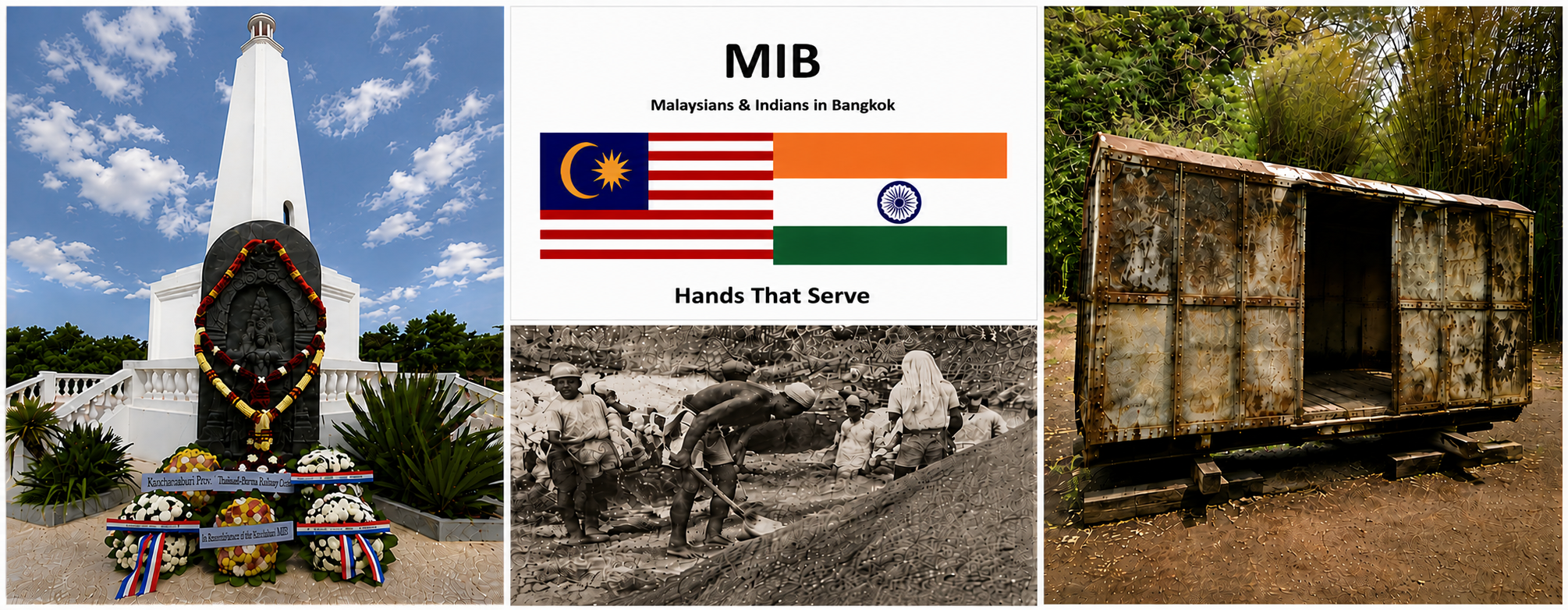
Until a more detailed version comes along, we provide the following summary:
- Tamil Nadu to Malaya
In the late 1880s, the British established large rubber, tea and sugar cane plantations in Malaya. They soon learned that the local inhabitants had no expertise or experience with these crops.
They recruited laborers from Southern India and exported them to Malaya. There they lived in purely Tamil communities isolated from the local population; completely dependent upon their British masters.
South Indian labour in Malayan rubber estates:
2. Malaya to Thailand
In 1942, when the Japanese drove the British out of Malaya and Singapore, the economy and social structure of the Tamils collapsed. The Japanese used this as an opportunity to offer them work in the north. Thousands of Malay Tamils volunteered, except the trains did not stop until they reached Ban Pong Thailand, near the beginning of the Thai-Burma Railway.
Promises of good pay and free food lured thousands of Malay Tamils who were facing starvation to volunteer, many taking their entire families to the train stations. After a short time, these promises no longer worked so the Japanese Army resorted to more drastic measures. They would raid a wedding ceremony and remove all the men. Similarly, they would offer free movies in a village, surround the crowd and send all the young men away.
3. Ban Pong transit camp
Trains carrying 5-600 laborers would arrive regularly at Ban Pong after a 2-4 day journey with little food or water. The ‘cargo’ would be pushed off the train cars and they would enter the grounds of Wat Don Toom. This was a reception camp for all of the workers both Asian and POWs. After a few days, they would then begin their trek to their assigned place of work on the Railway. This journey was a minimum of 150 Kms. For many it was closer to 300 Kms.
4. The Thai-Burma Railway
The first place Asian laborers were documented to work was at Km 150 at the infamous HellFire Pass. The vast majority of the Asians in Thailand worked between there and the Thai-Burma border at Km 300.
The most oft quoted estimate of the number of Malay Tamils is over 75,000.
5. Other Asian Laborers
The total number of AFL who worked the TBR is 250-300,000. The largest group were native Burmese and other mountain tribesmen (Mon and Karen). It is estimated that 180,000 were ‘recruited’ but that no more than 90,000 were are work at any given time. Desertion was easy and common.
There were also thousands of ethnic Chinese from either Singapore or Malaya. Most of these were deported by the Japanese after being judged subversive.
There was also a small number (less than 200) of Vietnamese (aka Animese) who were living near Kanchanaburi when the Japanese arrived.
The last to arrive were Javanese. Whether these were civilians or local conscripts into the Dutch Army (KNIL) is unknown. Estimates of their numbers range from a low of 7,500 to as many as 100,000!
6. Other projects
Although the TBR was largest, there were two other construction projects in Southern Thailand. The Kra Isthmus Railway was built at the same time as the TBR. In 1945, as the military situation in Burma deteriorated, an escape route was needed. A road was built from Mergui in Burma to Phrachup Khirikan in Thailand.
It is estimated that well over 150,000 Tamils were imported for these projects. This would bring the total number of AFLs to around 500,000 of all nationalities. Compare this to the 61,000 Allied POWs that worked on the TBR.
7. Death Tolls
It is well documented that 12,000 Allied POWs died as a result of their time on the TBR. An additional 2200 died when their Hellships were sunk en route to Japan following completion of the Railway. Overall, about 25% of the POWs died. Estimates of the deaths among the AFL is closer to 40%. Estimates of AFL deaths during the TBR construction are generally in the range of 90,000.
8. Thai involvement
Thai laborers built the first 50 kilometers of the Railway from Nong PlaDuk to Kanchanaburi between Jun and Nov 1942. These were men (perhaps as many as 15,000) provided to the Japanese under contract by the Chinese-Thai merchants in Bangkok who were trying to curry favor with their new masters. The conditions under which they worked and the short time involved hardly qualify them to be counted among romusha. There is no record or mention of any deaths in this work force.
Official Thai involvement in the Railway came to a halt in Dec 1942 in what is referred to as the Ban Pong Incident.
9. AFL camps
HellFire Pass at 150 Km is the first place were AFL are documented to have worked alongside the Allied POWs. The vast majority of the AFL in Thailand worked in the last 150 Kms between there and the Thai-Burma border. These are camps in which the F & H Forces of POWs were assigned. The camps nearest the border were hit the hardest by the cholera outbreak in April to June 1943. Death tolls among the POWs approached 40% during this outbreak. For the AFL, it was likely closer to 70%. Entire AFL work camps were wiped out.
10. Post-construction
The two sectors of the Railway were joined at KonKoita (about 40 Kms inside of Thailand) on 17 Oct 1943. Over the next 6 months, all of the POWs and the AFL in Thailand were consolidated to the Kanchanaburi area where the HQ for the project was located. A large AFL camp was established near where the CWGC war graves cemetery is today.
The Burmese workers simply slipped back into the jungles and found their way home; none were sent to Kanchanaburi.
When the Mergui Road was completed in 1945, those 100,000 Tamils were sent to a separate camp in ChumPhon.
11. Post-war
By the end of 1945, almost all of the POWs had returned to their home countries. The Dutch, however, remained in Thailand much longer due to political unrest in Europe and the Dutch East Indies (Indonesia).
Tens of thousands of AFL were British subjects from either Malaya or Singapore. Despite this fact, the British government all but abandoned them making no effort to assist in their repatriation. The two large AFL camps existed well into 1947 while deaths continued.
12. Unknown graves
In the early 1950s, as workers began to improve and widen the main road in Kanchanaburi, they began to unearth skeletons in unmarked graves. Even just a few years after the war’s end the identity of these remains was uncertain. Since the land in which they were buried had formerly belonged to the temple, the abbot of Wat ThaWorn Wararam agreed to accept responsibility for those remains.
Over the next few years, as more construction took place, more graves were unearthed. Temple records say that at least three different burial ceremonies were held. The total number of remains was counted as nearly 10,000!
In 1957, after a period when no more graves were discovered, the temple community erected a chedi to mark the burial site. Since no work had been done to identify the origin of those remains, the chedi was named Chedi NIranam or ‘grave of the unknowns’.
Despite annual ceremonies to honor these deceased souls, decades went by with no thought or recognition of who was buried there or what their story may have been.
13. More graves
In 1990, an archeological excavation was performed in the area near an IJA hospital camp on the east end of Kanchanaburi. A bracelet on the skeleton of a teenaged girl was identified as being of Tamil origin. Other artifacts scattered among the remains were WW II era.
While there is no actual proof as to who the Chedi Niranam remains were, who could they be? They are not Thai because they would have been cremated not buried. They are not POW remains. There were 12,000 POW deaths and while all the graves were not found, there were certainly not 10,000 more! The only possible conclusion is that they are AFL and most of the AFL in Kanchanaburi were Malay Tamils.
==========================
A query to CHAT-GPT revealed the following:
The role of Malayan Tamils in World War II, especially in relation to the Thailand-Burma Railway (Death Railway), is a powerful yet often overlooked chapter in wartime history. Their involvement highlights both their immense suffering and resistance, unfolding under Japanese occupation and British colonial legacies.
Background: Malayan Tamils Before WWII
By the 1930s, there were hundreds of thousands of Tamils in British Malaya, working mainly as laborers on plantations, in construction, and in public services. When Japan invaded Malaya in December 1941, life changed drastically:
- The British colonial government fled, leaving civilian populations, including Tamil communities, vulnerable.
- The Japanese occupied Malaya by February 1942, beginning a brutal regime of exploitation, repression, and forced labor.
The Death Railway: Tamils as romusha
The Thailand-Burma Railway, also known as the Death Railway, was constructed by the Japanese between 1942–1943 to supply their forces in Burma from Thailand.
Tamils in the Railway’s Construction:
- The Japanese forcibly conscripted over 150,000–200,000 Asian civilian laborers (romusha), including tens of thousands of Tamils from Malaya.
- Many Tamils were lured or tricked with promises of high wages and light labor in “Burma’s golden land.” Others were rounded up and forced onto trains to Thailand.
- These workers were used to build sections of the 415 km railway through jungles, mountains, and swamps.
Conditions:
- The working conditions were horrific: 14–16 hours a day in harsh climates with barely any food, medicine, or shelter.
- Disease (malaria, cholera, dysentery), starvation, and beatings were common.
- It is estimated that up to 60,000–90,000 romusha died—many of them Tamils—though exact numbers are still debated.
- Unlike Allied POWs, the romusha were undocumented, and their deaths often went unrecorded.
Legacy and Remembrance
Aftermath:
- After the war, the suffering of Allied POWs (e.g., British, Australian, Dutch) gained international attention, but the Asian romusha story was largely neglected.
- Malayan Tamils received no compensation, no official status as veterans or victims, and were often forgotten in post-war narratives.
Recent Recognition:
- In the 1990s and 2000s, local researchers, community leaders, and NGOs began raising awareness of the Tamil contribution and suffering.
- In 1990, a mass grave of Tamil laborers was discovered in Kanchanaburi, Thailand—sparking efforts to commemorate the romusha.
- A nadukal (Tamil hero stone) and plaques have since been installed at the Kanchanaburi War Cemetery.
- Sites like AFL-MIB.org and historical markers (e.g., HMDB) now help preserve their memory.