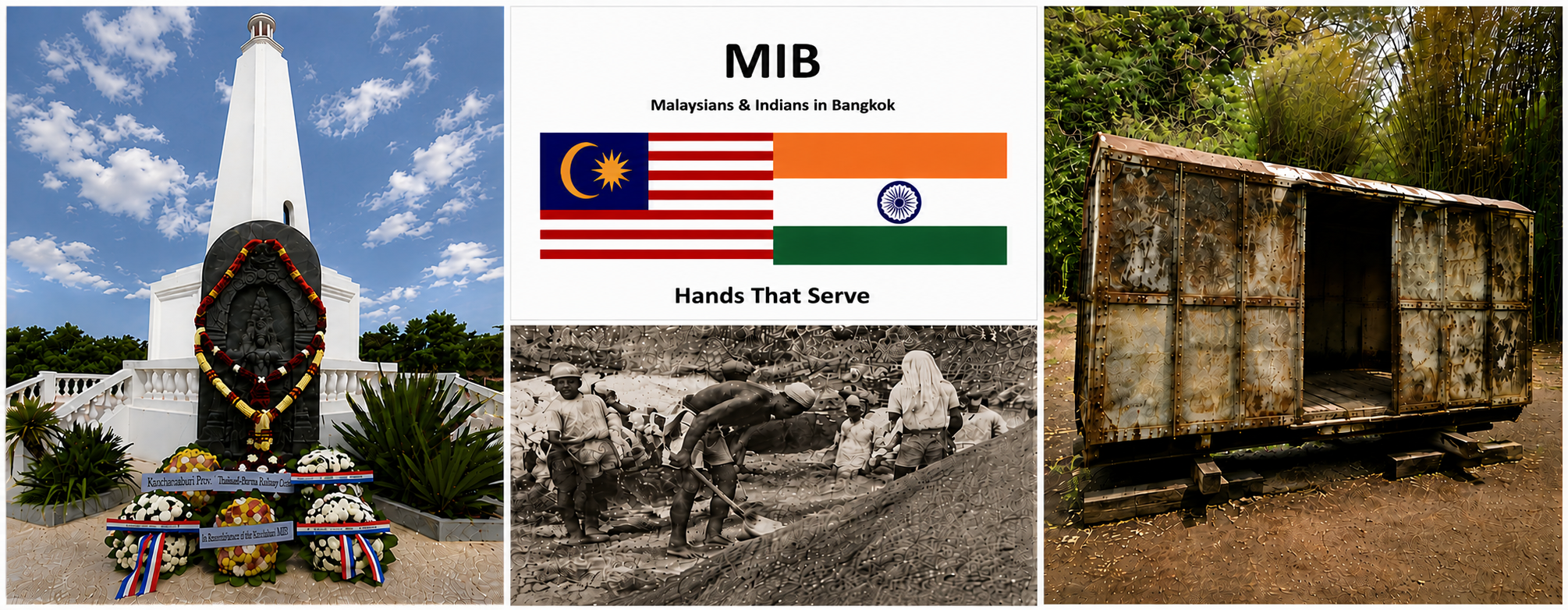
This is my first excursion into the parallel universe of historical fiction. My intention is to convey both the emotion and the impact that the presence of the Malay-Tamil population had during this era, as seen from the singular perspective of one young man.
I hope that it meets with your approval.
Arrival
He was jolted back to consciousness; he must have drifted off again momentarily. Instinctively, he rocked from side to side to release the cramps in his legs, but all he did was bump shoulders with those squatting next to him. Squatting was a natural position for him but it wasn’t a position you wanted to hold for a long time. Here he had no choice. There was no room to move much less change position. Squatting did let you sway from side to side to avoid the cinders. His group were in the first flat car behind the engine, Smoke and cinders regularly found their way there. By squatting and facing the engine you had a chance to move or swat them away. That was better than facing the rear of the train and having cinder land in your hair.
The jolt that brought him back to life was due to the slowing and a slight touch on the brake. There must be another bridge up ahead. He was facing the way the train was moving but couldn’t see past the engine. But he caught a glimpse. The train was making a slight curve to the right; there he could see a thin line over some water. Yep, another bridge and this looked like a long one. Hopefully, not like the last one…
Earlier this morning, the train had crossed the longest most unstable bridge he’d ever seen. A sheer rock wall rising on the left and a long, long drop to the water on the right. The train had slowed to a crawl like it too was afraid to advance another foot. But once they had lived through that experience, they seemed to have been on solid ground. The train sped up, got rolling about as fast as it ever had, probably as fast as it could. He knew that an engine burning wood could never go as fast as when it used coal. Until three or four days ago he’d been felling trees and chopping them into the fuel that this engine was now burning. Moving downhill over solid ground it could achieve a bit of speed, but then it had to slow for every bridge so as not to shake that bridge apart. It had taken then a long, long time to cross that trestle as while back.
His mind snapped back to the present. They were on the bridge now. It was so narrow that it seemed like the train floating in the air with nothing supporting it. Off to the left was another bridge, that one made of steel, but he soon saw why they were using this one. The iron one had a huge hole in the middle. He guessed that the British pilots had got lucky one day. His fleeting thoughts of the British vanished as a new sight appeared. As they reached the far side of the river, he spotted something he hadn’t seen in a while: some white men. They were standing motionless beside the tracks, some just leaning on their chungkuls. There was no real acknowledgement that a train was passing, just a blank stare into space.
Off to the right were some huts, huts like all the other huts he’d seen and lived in for these many months. Was it really a year already? Almost.
The train began to gather speed again. The rails curved to the right and even though the huts disappeared behind some trees he could see that it was fair sized camp. The land beside the tracks returned to what he’d been seeing since that precarious bridge earlier in the day: mostly rice fields, some vegetables and even fruit trees. He could hardly imagine the amount of food just out of reach as the train reached its maximum speed again.
But then there was a sudden jolt followed by the screech of steel on steel as the driver applied the brake. Soon the train seemed like it was just rolling freely without power. It was coming to a full stop. The white faces were replaced by the familiar bucket-like Japanese helmets. As the train shuttered to a halt, the screaming began. The words were familiar if not exactly understood, the intention clear: Get off the train! What new horrors awaited them at this stop? As he waited his turn to move, his mind wandered back. The last few months flashed before him.
the village
He and his brother had eagerly run through the village. There was something going on in the village common. Some men he’d never seen before were unloading what looked like a huge light from the back of a truck. Across the way, others were driving bamboo poles into the ground. Intrigued and even a bit confused the boys squatted down to observe. They’d picked a spot in the shade of one of the few trees on the edge of the open common area. A few minutes went by and the light was off the truck. One of the men was waving. Was he calling them? It seemed so. Warily, they approached the truck. The man was speaking but neither understood a word. Whatever language he was speaking it wasn’t Tamil. It took a few minutes and some hand gestures to convey the thought. The men wanted them to fetch some water. No harm in that! The brothers skipped off in the direction of the well. They collected an old discarded bucket and brought it back to the men. For their effort they received a playful swat on the head! They were immediately ignored as the men seemed to disagree on where the light was to go. The brothers figured out what was going on. The other group of men had suspended a large canvas from those poles. There was going to be a movie! What fun! Movies weren’t unknown in the village, but they usually happened to mark some festival. The boys weren’t aware of any such holiday, but what did they know? If there was going to be a movie, they ready to find the best place to sit. But movies couldn’t happen before dark and it was only mid-afternoon. They decided to go home, eat supper and bring their sister back with them. She was younger and hadn’t seen but one or two movies in her life. They were twins and ten years older than her; they’d seen their share.
By the time they returned, the square was filling with people. Their village only had a few dozen houses and a few hundred people. Word spread fast and every one was interested. Families spread out blankets, fruit and tea were brought from home. Soon it was dark enough and the movie started. Disappointedly, it was in Japanese, but the story was easy enough to follow. Sword-wielding men in black fought with others jumping off boats on the shoreline. Everyone’s attention was rivetted to the screen. No one really noticed that uniformed men with bayonets on their rifles had crept to the edge of the square. Some carried lanterns others torches. Suddenly before the men in black had won, the lights went out. Moments of confusion followed. Some of the women screamed. The uniformed men plunged into the crowd and began grabbing the men and boys by their arms. Their hands were tied behind their backs and bayonets prodded them out of the square. Anyone who spoke out was clubbed with the butt of a rifle. Not knowing exactly who was the target, people began to flee. No one stopped the women and children, but teenaged boys and men were knocked to the ground. The truck that had hauled the projector and another that had appeared nearby, were soon crammed with the village’s fathers, sons, brothers and cousins. It was a small village, two trucks were enough. Standing erect, stacked like logs, the men could only imagine their fate.
Food
Perumal’s attention returned to the present. The train was emptied of its cargo. They were now in a rather mindless shuffle on the side of the tracks. Ahead they could see the roofs of those oh so familiar bamboo huts that they had gotten to used to. There seemed to be quite a few of them. No one knew what to expect and given the horrors of what had transpired in the prior year, no one even dared to speculate. But what happened next not a single man would have guessed if his life depended on it. There before them was the longest line of pots on cooking fires that any of them had ever seen! Rice, fish stew, and vegetables; more food in one place that they had seen in the last year! Was the war over?
At the end of the line, men who were too sick walk were being carried off the train and into the railside huts. Perumal learned later that this was a hospital, of sorts.
After the most filling (and tasty) meal they’d had in months, the men were herded farther down the tracks where they entered another group of huts. They were greeted there by countrymen who had proceeded them. They learned that they were in the part of Thailand known as Kanchanaburi and that this was to be their new home. No, the war wasn’t over but their part in it had changed. No more 16-hour days rushing to complete the railway to Burma. The train that they had just ridden on was returning from delivering supplies there so was empty coming back. This camp was fairly new; created by those who had proceeded them. Men, women and even a few children in Tamil garb were everywhere. More than he had seen together in months.
He was offered a tub of water for a bath, followed by a place on the split bamboo to sleep. Despite the fact that it was only late afternoon, he collapsed into the deepest, most restful sleep he’d had in months. He might still be far from home, but he was closer to heaven. He dreamt of his brother.
a train
With guards sitting cross-legged on the cab of the trucks they drove for what seemed like hours. It was nearly dawn when they next stopped. The approaching whistle alerted them to the arriving train. Their hands were untied as they were ordered off the truck. A nearby rain barrel allowed them a handful of water as they passed. No body spoke; the guards yelled unintelligibly. The brothers clung to one another. An uncle shuffled over and placed his hands on their shoulders. He’d do what he could to protect them. Their group of a few dozen was told to sit. They waited, confused, shivering not so much from the morning chill, as the uncertainty of what was happening. Any attempts at conversation grew the wrath of the guards.
Three more trucks arrived from a different direction. The tiny station area was getting crowded. As the train replenished its water supply from the tower, there was rush as men tried to slake their thirst from the water that splashed out. Bayonets and rifle butts stopped that. The doors of the carriages stood open. Those same bayonets and rifle butts herded the men to the train. All of the men from his village, both truckloads, were crammed into one carriage. Again, they found themselves stacked like logs, but standing, no room to even turn around much less sit!
With another blast of the whistle, the train lurched forward.
Journey
It wasn’t long before the carriage became stiflingly hot, so much so that it was even hard to breathe. The door was open only a few inches. What developed was something of a slow dance. The men began to shoulder their way towards that opening. It was the only source of air. It was also the only outlet for urine.
Perumal and his brother were more or less dragged along as if in a queue. They each got a moment to push their face out the door before the queue shouldered them away. After an immeasurable length of time the train screeched to a halt and the doors were opened. No one needed a command to get down. Some men ran into the sugarcane field to relieve themselves. Others went searching for water. The men in the first carriage were made to load wood from a huge pile. The tank holding the water for the train had a leak and a small group had gathered beneath it catching water in their cupped hands. Others caught the splash as the pipe was swung over and the tank refilled.
As if on cue, some villagers appeared with coconuts and bananas but there was a bit of confusion over the fact that they wanted to sell them and also that they were not speaking Malay nor Tamil. Someone pointed out that the train must have crossed over into Thailand. No one quite knew what that meant but it couldn’t be good.
Arrival
The cycle of periodic stops continued for two full days and nights. At one station there was a meal of rice porridge with a hint of fish and some weak tea. The brothers learned that they could actually sleep standing up leaning on one another. Some men could no longer stand and collapsed into a squat that just packed the others more tightly together.
At what must have been near midday on the third day of their journey, the train ground to a halt at a fairly large station and the men tumbled out yet another time. But this place was different. There were a lot of soldiers around, not just those from the train. There were also piles of what looked like military equipment. There was even piano just sitting there beside the tracks! This new group of soldiers seemed energized but the arrival of the train. Excited shouts, bayonets and rifle butts were used to herd the men into a line which was directed down along the track. Off to the left was a small canal, some men tried to head that way but were in uncertain terms pushed back into line.
There were enough roofs visible to tell them that they were in a town of some sort. After about a 20-minute walk, the distinctive red roofs of a temple could be seen above the trees. The line made a left turn and entered through a gateway that had a hand painted sign in what must have been Thai script.
The first thing that hit was the smell. The place smelled of death, of rot, of urine and feces. It also seemed to be a large place but the view was blocked by an endless line of thatch-roofed bamboo huts. As the new arrivals staggered deeper into the camp, they passed huts with inhabitants staring at them with hollow eyes. One brave soul called out in Tamil: “Where are we?” The reply came back as “Ban Pong”.
Ban Pong and beyond
Perumal had no possible way to place all that was happening in any context. It was all a new experience to a teenager who had never been far from his birthplace and had never had an education that stretched beyond learning about his language and culture. At this point in time, he was being swept along by events as if he had fallen into a river with a swift current. He barely had time to focus on anything that flowed past him.
Narrator’s Note: I’ll pause his narrative here to provide the reader with the bigger picture of what was happening in the world that Perumal was moving through. Ban Pong was the arrival and transit point at the beginning of the railway that the Imperial Japanese Army (IJA) was building to connect Bangkok to Rangoon. Parts of this railway existed. What was missing was a 415 Km-long link in the middle; one that crossed the mountains that constituted the border between Thailand and Burma.
Perumal was one of tens of thousands of Asians who were conscripted to do the manual labor to lay the rails to fill that gap. He was a Tamil living in Malaya. His ethnic group was particularly vulnerable to such conscription because they had been abandoned by their British plantation owners as the IJA had swept through Malaya en route to Singapore.
The first workers to arrive at Ban Pong were British and Australian POWs captured when Singapore surrendered. As that pool of manpower dwindled, the IJA turned to the local populations to make up the shortfall. Inside Burma, tens of thousands of villagers were added to the mainly Dutch and Australian POW workforce there. These men, including a few hundred Americans, had all been captured in the Dutch East Indies and funneled to work in Burma. The Burmese civilians far outnumbered the military POWs.
It was the Spring of 1943, the beginning of the rainy season in Thailand. Work on the 300 Km part of the railway that ran through the Thai countryside was falling behind. The Malay-Tamil villagers were part of the workforce known to the Japanese as the romusha. They were the largest contingent. There were also many ethnic Chinese from either Singapore and Malaya who had been exiled to work the railway. Added to this were a few thousand Javanese as well.
The workers on the Thai side all traveled by train to this arrival point at Ban Pong. From there they would trek hundreds of kilometers to the place where they would then begin work on the Railway.
What will follow in this fictional narrative is the day-by-day experiences of Perumal and his brother and their group of romusha as they first wend their way to their assigned workplace then toil to carve a rail line into the jungle.
another journey begins
It seemed as if the new group of soldiers who herded they from the train into the camp were their new minders. They funneled them into a hut in the middle of the camp. Then just left them there. Some of the men wandered off in search of water. Must just crawled onto the bamboo platform and promptly fell asleep.
Their attention was focused later by a clamor about food. A line was forming on the edge of the camp and they joined it. Much to their surprise, each man was handed a coconut shell of rice and a mug of a thin stew, mostly just hot water with a leaf or two floating around. Yet, it was more food than they had seen in days. No one seemed to be watching so the ambitious ones got back in line for a second go.
With no place else to go, Perumal and his brother returned to their hut to eat. They watched in awe as a group of soldiers were marched in and assigned to the adjacent hut. Although these men were taller and wore remnants of uniforms, they seemed just as dejected as Perumal’s group. One thing he noted immediately and envied them for is that each had a metal container to carry water. He’d never seen one before but he appreciated its utility.
In the morning and once again at mid-day more rice and stew were served for all who were interested. The food may not be tasty but it was plentiful. After the second supper, both the soldier’s and Perumal’s group were herded to the north edge of the camp. There was a general kerfuffle while everyone was counted. Then with bayonets, boots and rifle butts they were told to start walking.
stop #1
The two groups started off at a rather brisk pace, but both soon realized that they had no idea how far they were expected to walk so they slowed to a shuffle. As the first rays of the sun broke through the clouds, they were herded into a field. Once more, there was a line of cooking woks from which rice and tea were served. There weren’t any buildings in sight except those of a Thai temple. The exhausted men collapsed wherever they could and slept. They were awakened hours later by the rain and thunder of the monsoon shower. Without the benefit of another meal or even tea, they started walking again. This was when Perumal especially appreciated the usefulness of those containers the soldiers carried. He vowed to get one!
The soldiers were marched out first. Perumal grabbed his brother and followed closely behind. He had noticed that a few of those soldiers were weaker than most and had struggled into the site after everyone had settled down. He calculated that they might be easy prey. Sure enough, after a moderate distance a few of them began to lag back. Perumal and his brother rushed over to assist one. First, they relieved him of the blanket and satchel slung over his shoulder, thus making it easier for him to walk. He seemed rather grateful! Hours later his knees buckled and he fell to the side of the road seemingly too exhausted to continue. The brothers stayed by his side, fanning him with some leaves and urging him to drink water. Despite their ministrations, he drifted off to sleep or passed out, they didn’t know which. They had also noted that a few of the guards were assigned to police up the stragglers as best they could and keep them moving. Lastly, there was an ox cart to scavenge up those who couldn’t be prodded alone. Perumal and his brother fell in amongst the middle of their group sporting their new found gear!
day #2
At dawn, the pattern repeated. Perumal and his brother used the blanket to shade them from the sun and refilled their water jug at the nearby well. Rested and well pleased with themselves, they jumped to the front of their group again. They soon spotted a man struggling to heft a valise. Otherwise, he stood tall and straight, so must have been an officer. Without even a word exchanged among them, they relieved him of the valise and took turns carrying it. He got the drift and being used to being catered too, smiled at their offer of assistance. Hours later, he stepped off the road to relieve his bladder. Perumal and his brother scampered back into their Tamil group and blended in as best they could. As they walked, they forced the valise but found little of interest or use. They kept the cigarettes and lighter as well as a pen and promptly tossed the valise into the jungle.
Bridges
In the middle of day three, they passed the stone wall of a Thai town and shortly thereafter passed the largest bridge they had ever seem. In fact, there were two: an iron bridge that crossed moderately wide river and a companion (older?) wooden bridge a bit downstream. Their travel group stopped briefly while the sickest men who were deemed unable to sustain the pace were culled out and left behind. The rest marched on.
Not too much later the column was halted on the bank of a river – likely the same one that those bridges crossed. In groups of about 30, men were loaded on rafts and ferried across the river. On the far side, they were treated to another coconut bowl of rice and bedded down until dusk. By now it was obvious that even the guards did not wish to face the heat of the day so they were moving at night.
The rising sun had told them that until this point they were travelling more or less due west, but now they made hard turn to the left (south). Whereas they had been following a road of sorts, now they were on a jungle path. One had to be much more careful where to step so as not to stumble over the rocks, vines and fallen logs. Progress was much slower as they picked their way in the dark.
the river
Another day, another meal, another night and they came of the jungle into a clearing that contained more of those long huts like the first camp, but many more. But this time they were not herded into them. From all the activity, it appeared as if they were already occupied. More of the sick and lame were pushed or carried there and the rest slept in an open field. The meal they were served was the most pitiful. They longed for the days of bowls of rice!
Much to their delight, they were on the bank of another river. The guards settled in to sleep so there was no one to stop them from bathing and generally splashing around in the river. It was very refreshing to feel a bit cleaner and have a bit of actual fun. They would soon regret this bit of enjoyment.
Narrator’s Note: In point of fact, they had arrived at the TARSAO camp on the north bank of the Kwai Noi River. The construction had passed this point some time ago and the camp was now one of the main ‘hospitals’ where the sickest workers were sent to die. For hundreds (thousands?) of men, this is where they drew their last breath.
Perumal and his group and the accompanying soldiers didn’t know it yet but they were part of what the IJA called H Force. They were close to the end of their 150 Km trek to their assigned places of work at a place called HINTOK.
After a refreshing bath and frolic in the river, the brothers went in search of a place to rest. This country (Thailand) seemed to be covered in a layer of bugs: mosquitoes, gnats and flies. But this place had a new horror, ants! To escape them, the two brothers went back to the beach and scraped out a shallow pit. They then rolled themselves in the blanket and settled in for the night. With the dawn came a new surprise. They were awakened to the sensation of their feet being wet. Overnight, the river level had risen considerably and was now slowly flooding their bed. Rested, they set off to find something to eat. Off in the distance, they noted the glow of fires through the trees.
Moving cautiously to avoid the men sleeping anywhere and everywhere, they approached to find a line of six cooking fires. Perched over each as a metal barrel, actually half of one. Some had rice and others just boiling water. Behind the fires was a huge pile of cut firewood. The boys sat with their backs to the woodpile waiting for the rice to be fully cooked. In the soft light of the fires, they soon drifted off again shoulder to shoulder. But this didn’t last long; one of the guards noted the presence of these new recruits. He tapped their feet with his rifle butt and by hand gestures indicated that he wanted them to carry wood to feed the fires.
Over the next few hours, they had quite a dent in the wood pile. Each boy grabbed three pieces of wood and dropped one in each of the cookfires. They walked in a circle repeating the same action over and over. The rice was ready, men gathered and shuffled past in a seemingly endless line. But these men looked different. They looked more like ghosts than men; hollow lifeless shells. Unlike the soldiers they had been marching with, these men were hardly recognizable as soldiers. Other than an occasional hat, they had no uniforms. In fact, they were practically naked, with just a loin cloth. They didn’t walk they shuffled, almost floated as they gathered their rice and tea. The one thing they all seemed to have was a metal military plate and water container. This was the only thing vaguely military about them.
The boys were brought to a halt from their circuitous route by the arrival of a completely different sight. A group of about a dozen men approached, they were boisterous and loud, clothed in tan uniforms. It was obvious that they had not been here as long as the others, they still had a soul!
Perumal would later learn that these were Americans; survivors of ship that was recently sunk. They had arrived in Singapore when they were placed on trains headed north. The brothers learned that they could tell at a distance the difference between the more subdued British and the boisterous Americans with the Australians somewhere in between.
Narrator’s Note: For greater clarification, these were not soldiers or sailors but rather Merchant Mariners. Civilians who had manned the sunken SS Sawokla.
to work
Noting that the line had dwindled and wishing the eat before the rice was gone, the brothers abandoned their task and slipped into the line. They retrieved their blanket and loot and drifted back towards the beach. Along the way they discussed how they might get their hands on some of those metal trays the soldiers carried.
Shouting and the sound of whistles drew their attention. The guards were rounding up his group of travelers. For over an hour they sat in neat rows as the guards countered and recounted until they reached a number that satisfied them. The group began to move inland. They passed the huts occupied by the soldiers and continued up a hill until they were faced by a sheer cliff. Oddly, there were bamboo ladders attached to the rise. It was clear that the guards intended they to climb. As they scrambled over the top, they were greeted by an entirely new set of the now common huts. As the brother entered, they immediately tossed their gear on the platform and claimed the space against the wall. It was immediately clear that they were not the first to occupy this hut. There was a lingering smell of urine and even feces. Since there had been regular monsoon storms, everything was damp and mildewed. There were items of clothing scattered about. Dead flies were everywhere in the process of being consumed by the ever-present ants. They wondered how long they’d be here.
Having nothing else to do, the two brothers polled themselves in the blanket to isolate themselves. Any opportunity to sleep was to be taken advantage of. More shouts woke them out of their stupor. A guard was walking through smacking the feet of the prone men with a wooden stick to rouse them. Once outside, the interminable process of counting and recounted was repeated.
After climbing down the ladders, they were herded along parallel to the river until they came upon a pile of tools. First there was a pile of bamboo poles with a rice sack sling beneath. Then a pile of chungkuls. After much confusion and haggling, teams were formed consisting of three men with chungkuls and two pairs with poles. Without ever demonstrating what they wanted, the guards indicated that dirt was to be moved up the hill a short way and dumped there. Three men would dig; two pairs would carry and dump the dirt.
Here, for the first time, a new group appeared. These were haughty looking Japanese in impeccable uniforms who stood off to the side. They seemed to be in charge of the operation without actually participating. They yelled at the guards; the guards yelled at the workers. The Engineers never got too close to the workers as if they were afraid of getting their uniforms dirty! And so, the work on the Thai-Burma railway was pushing west.
Narrator’s Note: Perumal’s group had arrived at the place called the ‘mountain camp’ by the POWs, perched on the hillside in the area known as HINTOK.
the routine
Their multi-day, 150 Km trek was complete. They had reached a destination. They settled into a routine. Up at dawn for a light meal. March to the work site. Shift and pile dirt for few hours. Short break to eat a ball of cold rice. More hours of digging. Shuffle exhaustedly back and climb the ladders. More tasteless, gritty rice and then blissful sleep, broken by the thunder and leaky roof. The boys now understood why those soldiers on that first day had looked so soulless!
The workers looked for any excuse to alter the boredom of the day. Asking for ”benjo” = a break to answer the call of nature was not often refused. But if you simply stopped moving and took a deep breath you risked a blow with a bamboo stick across your shoulders or at your knees. As often as possible, the men in the small teams would switch tasks. The guards cared less who dug and who carried as long as the set amount of dirt was moved. The Engineers would drive stakes into the ground to indicate the amount of dirt they wanted placed for the rail bed. Everyone worked until those stakes were covered. If the ground was rocky or had a lot of bamboo thickets, it would take longer and the work party would not return to camp until well after dark. The end of day count-off included the chuckles and poles. Standing in line to get your pitiful amount of gritty rice was in itself now just another chore before sleep.
After only a few weeks of this drudgery, a new problem arose. More and more men were too sick, too feverish to work! With no medical care of any sort, they were usually just left on their rack. One or two healthier men would reluctantly be left behind to tend to their needs. Malarial fevers were common but even worse was the body convulsing throes of dysentery. The men stricken by this were befouling the camp and even the interior of the huts. It got to the point where the able workers would force the sick to congregate in one hut to confine the stench and mess.
Narrator’s Note: This is one of the circumstances that contributed to the appallingly high death rates among the romusha. Not only did they have no access to any medical care and no medical like that embedded in most military units, they had no knowledge of the causes of these illnesses. They had no cultural appreciation for the link between flies, cleanliness and disease. They had all seen them before in their home villages, so they were just a part of everyday life to be endured. Separation of the sick was not a medical quarantine. It was simply get them out of here!
a change in routine
After weeks of piling up dirt, one morning things changed. The group was marched past the chuckles and down the hill. They were randomly placed in two lines and marched past a shed. Each man in one line was handed a steel rod; the other a large hammer. The Engineers then demonstrated what they wanted done. One man knelt holding the rod vertically; the other struck it with the hammer. When the rod reached a depth of about one meter its full length, the pair moved a few steps to the side and repeated the process.
But the work crew immediately noted that thy were standing on a rock while the Engineers were driving the rod into dirt. It was also quite obvious that this was a much more dangerous operation. The top of the rod was the size of a thumbnail. If the hammer didn’t hit it squarely, it could glance off and hit the holder in the arm, or much worse, the head. It was going to take a lot of concentration to do this all day safely. Fortunately, it didn’t matter which of the pair was hold or hitting. They could switch frequently to maintain their concentration. Another change was that the work area was much more concentrated. The pairs were working only a few meters apart, so the guards and Engineers overseeing them were closer. Oddly, even though they had been working for weeks on minimum rations, the workers seemed somewhat stronger. All that digging had strengthened their back and arms. Swinging the heavy hammer was easily than they expected.
This new work assignment came with new housing. No need to climb the ladders. They were now occupying huts in what was known as the Malay camp. They also noted that they were never housed together with the soldiers nor worked directly with them. Generally, their camps were close by but completely separate. Also, the soldiers were working on the opposite end of the same rock; close but never together. It was as if the Japanese didn’t want them to have any contact. As if the language barrier wasn’t enough.
Slowly, almost imperceptively, the rock began to shrink. Once a row of holes was drilled about a meter deep, everyone cleared out and the Engineers would place explosives that would blast away that section of rock, almost like a step. One group would clear away the loose rock while the others returned to drilling. The total amount of rock blocking the right of way shrank until only a few men could stand on it at one time. The others were shifted back to building up the rail bed beyond the cutting.
Narrator’s Note: This group of workers were what the Japanese called H Force. They were working in the area known as Hintok. Because it was a link between what could be called the lowlands and the highlands, it had been initially skipped. In other words, the railway was actually being completed in the mountainous highlands area to the west before work at Hintok even began. So when the multiple cuttings and trestles in the Hintok area were finally finished, the final link between the Burmese and Thai sectors was about to be made.
FEB 1944
Perumal awakened with a start. He’d been in a deep sleep. Images of these past few months had been racing through his mind. He reached out to locate his brother, only to remember that he was no longer there sharing the blanket. As he gathered his thoughts, Perumal remembered that was at a new camp, same long huts with two rows of sleeping platforms, just a new place. A new place with better and more food. Maybe things weren’t going to be so bad after all. He missed his brother. His thoughts tracked back to when he last seen him.
woodcutters
He and Velan had been tramping through the forest looking for a place to hide from the guards and rest. It was easier to do now. The guards were more relaxed; less interested. The work on the railway had been finished for some time. Trains were now running quite regularly. But they needed fuel. Digging and drilling had given way to tree felling. The forest was quite dense. It was, however, easier to saw through the dead trees than the living ones. They were also drier so they burned better. The brothers were on a hunt for such trees. They had walked up the slope, deeper into the forest. They figured it would be some time before anyone came looking for them. They’d find a shady spot and hide.
There were a number of elephants that would drag the felled trees closer to the tracks where they would be reduced to fire wood. Likely, the boys would hear the beasts in time to rejoin the crew.
They spotted a tree with thick roots that formed a natural niche, shaded and hidden. As they walked towards it, Velan threw up his hand and blocked Perumal’s way. He pointed up into the branches. There, unmoving and barely visible, was the head of a snake hanging down in its ambush position. The head was about the size of a hand, indicating that it was a medium sized python, as pythons go. But even an adolescent snake could be meters long and deadly.
The boys backed away and sought be safer hideaway. Upon their return to their hut that evening, they learned that once again there was to be no food! Since the trains had begun carrying supplies to Burma, there was little effort spent on sending food to the work crews still in the forest. Fortunately, cutting few trees each day was physically less demanding than any of the railway work, but hunger was hunger. They missed even the gritty rice and thin stew that should have awaited them. Tonight, they’d fall asleep hungry!
The current small cluster of huts that they occupied were immediately adjacent to the tracks. Three to five trains would pass by everyday going one way or the other. That meant for a fitful night’s sleep. The trains tended to run at night because the Allied planes were patrolling the skies during the day. The buzz of the fighter planes or the drone of the larger bombers was an all too familiar sound. Someone, some-where had figured out what the Japanese were up to and wanted to stop it!
These huts were need a refueling point. Wood was stacked next to a water tower on a siding. For so few trains, it was hard to believe how much wood they needed. Of course, his work crew also loaded the wood onto the waiting trains. That’s where it happened!
It was early evening and a train was about to continue its journey west so needed to be loaded. The brothers usually tried to stay side by side but Velan had been at the latrine and joined the crew after they had moved next to the train. They formed a line with Perumal next to the train and Velan at the wood pile a few meters away.
They couldn’t yet see it but one of the elephants let out a deep shriek. Something had scared or spooked it. It came crashing out of the tree line running towards the tracks. It was dragging a tree by a chain behind it. As it came into the clearing it saw the wall of wood piled in front of it between it and the train. It veered sharply to the right. Like a long heavy tail, the tree swung in an arc and smashed into the wood pile. The crew loading the wood onto the train heard the noise but saw nothing. The log hit the pile like a battering ram. Chunks of wood and men flew through the air. Velan among them. When the dust and the confusion cleared, there was Velan pinned under the log. There was little that could be done. The men tried to lift the log but it was just too heavy. The mahout was attempting to get control of his charge. If he could maneuver him into place, the elephant could likely lift the log to get Velan out. But there was no time! Velan’s chest was crushed beneath the log. Perumal was kneeling and cradling his head as he stared up longingly, blinked and drew his last short breath. Part of Perumal’s life departed as well. The twin he’d spent every moment of his life with, shared memories and meals and that stolen blanket with was no more! Could he go on?
FEB 1944b
The answer was yes, he had gone on with his half of their life! And now he had reached a new chapter in that half-life in a new place. Now he had to push and continue to survive until he could go home and tell his family about Velan.
Now that he was at this new camp, it seemed as if he wasn’t going to be part of any more work crews. No more digging or wood cutting. What would he do all day? He decided to go out and explore this new camp. He sure wished his brother was there to do it together.
He wondered how far it would be to the river. He knew that the railway was generally close to the river at the places he had been. The tracks were immediately next to this camp, so the river might not be far away. But then he realized that he didn’t even know in which direction to go; left or right. He decided that he’d just wait and ask when he had the chance. The only landmark he knew he could find was where he had originally been dropped off a few days ago. He began walking in that direction. It was farther than he’d thought. This camp was quite large. He’d have to take some time to explore it. He finally came to the end of the camp and just a short distance beyond that was that first group of huts he’d seen. He continued walking along the tracks. He could tell from the general activity that he saw as well as the smell that those huts were a hospital of sorts. He squatted down to watch what was happening. Uniformed Japanese, some western soldiers and some brown skinned people who looked like him were moving about between the buildings. One short man dressing like him was waving his arms. It was sometime before Perumal figured out that he was trying to get his attention. The two walked towards each other. The man sized him up and said in Tamil: “Come with me.” Wary, but game, Perumal followed. The man grabbed a shovel and a changkol that were leaning against the hut wall and waved Perumal to follow him. They walked to a space passed the last row of huts and the man motioned for Perumal to start digging. The ground was soft and soon they had dug a long narrow hole. Perumal had seen enough graves to know that this was one. The man tossed him a tiny coin and headed back where he came from. Curious, Perumal squatted down to see what came next. A few minutes later, that man returned with a second. They were carrying a stretcher. As Perumal expected, it was a body. Hospitals always had new bodies. Perumal gave them space as they unceremoniously dumped the body into the hole. As they headed back towards the huts, Perumal picked up the shovel and started to refill the grave. The man waved him off. Minutes later, the two returned with a second body which when into the same pit. Now the man motioned for him to refill the hole.
There hadn’t been much use for money while working the Railway. Any buying and selling that went on as via barter. Perumal wandered back to his assigned hut and soon learned that he had a 10 satang coin. That was 1/10th of a Tical, the Thai unit of currency. It wasn’t much but it could buy a piece of fruit or other small item if one could find a seller. He was told that if he walked a kilometer or so through the camp. He’d find an open area on the edge of the camp away from the tracks. This was a place that Thais from the village would come most mornings to sell things.
His knowledge of the camp and how life worked there grew immensely. He know knew where he could make some money if he needed it. He didn’t want to appear too anxious or greedy so he waited a few days before he went back to the hospital. He had another motive as well. As he approached the grave area, all was quiet. He went over and found the changkol and started digging a grave. He figured it was only a matter of time. Sure enough, the same man appeared soon thereafter. Perumal asked if there was any where he could get some clothes.
new clothes
None of the men on the train that had brought them to Ban Pong had anything more than the clothes on their back. Between the sweat, the sun and the hard work, their clothes soon began to rot away. Perumal and his brother soon learned that dead men didn’t need clothes. If you were quick about it, you could relieve the recently deceased of their clothes and even the occasional personal item. Most men worn a sarong rather than pants – known as a veshti in Tamil. If neither of them needed a newer one, they could always barter it for something else!
Perumal asked the man if there were any unused clothing to be had. He was led back to one of the huts in the last line, where the man waved his hand to the side but kept walking. There on the ground was three new deceased awaiting burial. Perumal helped himself and then went back to dig a deeper hole. He was rewarded with a 25 satang coin!
Never one to trust anyone outside their family. Perumal and Velan had taken to carrying their blanket and other meager belongings with them at all times. They found a piece of twine around which they rolled the blanket with everything else they had tucked inside. It was always sling over one of their shoulders. Perumal rolled up his newly acquired veshti inside the blanket and headed back to his sleeping space.
the market
Early the next morning Perumal set off to find the market. He wasn’t sure what he might buy, if anything, but he thought that it would be good to know where it was and what was being sold. Just off the edge of the camp he saw people milling about. Thais had spread woven mats on the ground and were displaying their wares. Many different types of food were available. Some he recognized, others he did not. There were many types of fruits. Bananas were the most common. Thailand offered a large variety of fleshy fruits, some sweet some sour. There was also breadfruit and an extremely smelly one the Thais called durian and known as Mao Shan Wang in Malay.
There were some vendors selling common use items made from local materials like bamboo and coconuts. Other were offering second hand clothing and blankets. Perhaps the thing that caught Perumal’s eye the most were the women! He’d spent the last few months exclusively in the company of men. Seeing women, especially the younger girls, trying to attract customers was a whole new delight. Most wore a tall, woven straw hat with a wide brim. This, of course, was to protect them from the sun, but it also allowed them to shield themselves from his gaze. Most giggled, covered their mouths and tilted their head away as he approached. Also, in most cases, there was a stern older woman standing nearby to prevent and conversation beyond the exchange of goods. Perumal was carrying his 35 satang in his hand, trying to decide if he really wanted to spent any of it. He spotted one particularly attractive young lady selling bananas. Naturally, they did not speak the same language. He displayed the tiny 10 satang coin and waved it over the bananas. She held up 3 fingers; he replied with 4. With a smile, she snapped off a cluster of 4 small bananas and handed them to him. Perumal was happy he didn’t have to bargain any more. Four bananas were about all he could eat. He had no place to store them and even if he did, they’d most likely be covered in ants in short order.
His mind wandered back to those days in the jungle with his brother. If you paid attention, it wasn’t too hard to find things to eat, especially fruit. There were likely other eatable plants, but neither of them was familiar enough to chance sampling unknown things. That’s where they learned of the large variety of fleshy (plum-like) fruits that Thailand had to offer. They would grab a couple and devour them on the spot. It was best to keep such a treasure as secret. There were just too many hungry men and too little fruit if word got out. That’s why they never took any back to the hut. The one exception was breadfruit. Each tree only had 1-3 pieces, but some were quite large. If you broke one open, you likely couldn’t eat it all and if you left it, the ants and birds would consume the rest. You could make a few friends by smuggling some into the camp to share, but you had to get it past the guards! Most often they’d hide it in a tree and go back after dark to retrieve it. As long as you hadn’t broken the thick skin the ants and animals wouldn’t bother with it.
While eating his bananas, Perumal decided to explore the far end of the camp to get a feeling for how big it was and what it might have to offer. He never actually found the gar end of the camp. Without really noting a change, he soon found himself in a different world. The men were dressed differently and speaking a different language, that had a lilting sing-song quality to it. Feeling uncomfortable, he retraced his steps back to his sleeping place.
Narrator’s Note: Perumal had wandered into the Javanese section of the camp. A few thousand of them, no where near as many as the Malay-Tamils, had been transported north via Singapore. Their actual numbers and even their post-war fate, are largely unknown. We know that the Dutch languished in Thailand well into 1947 due to the economic and political disruptions in Europe and the Dutch East Indies. We can only assume that the Javanese who survived the Railway had a similar fate.
a routine
Secure in the knowledge that he could count on a few satang by digging graves and that there was a place to spend that money if he wanted, Perumal settled into a routine. Amazingly, there was plenty of food available. It seemed that the Japanese were still providing rice and there were always people willing to cook it. More often than not, there was a thin stew containing vegetables and either fish or meat. There was at least the vague flavor of meat if not actual pieces. There were after all, tens of thousands of Malay-Tamils who had survived their time on the Railway and now awaited a new chapter at the hands of the Japanese. Feeding them was easier now that they were not spread over hundreds of kilometers of mountainous jungle, but the meat, marrow and bones of a buffalo still did not afford much per serving at any meal. None the less, Perumal knew that he felt ever so much better after only a few weeks in this new camp. He wondered if this would be the last place he’d stay.
The main problem was that for an energetic and curious boy, this camp provided few distractions. It was outright boring. Once he has explored the camp, he longed to see what lay beyond. The guards had become completely disinterested in their charges. They occupied small shacks on the edges of the village and had no inclination to have any interaction. There was no work for the people to do, so no one was needed t order them around. Although they remained armed, the guards just seemed to sit and smoke, played games or dozed. Perumal wondered what the punishment might be if he were to be seen outside of the camp. He’d wandered from one end of the camp to the other. It was large but not huge; meaning that he could easily walk end to end. Beyond the hospital area, there didn’t seem to be anything of interest. The far end of the camp ended where there were building that were probably part of the local town. But there was nothing of note. His curiosity was drawn to finding the river which he assumed would be nearby. What he’d do if he found it, he didn’t quite know. He also couldn’t think of anyone he could ask about anything in the area. It was highly unlikely that anyone he could communicate with knew anything about the town or the river. There was also the fear of the unknown. The old guards didn’t seem to care what their charges did, but what if he ran into real soldiers outside the camp? Might they shoot him? Was it worth the risk to even try to find the river?
bombs
One afternoon, something completely unexpected and quite wonderous occurred. Off to the south, where he expected the river to be, there was a tremendous roar. You couldn’t ignore it and everyone’s eyes turned that way. Four huge, loud airplanes descending out of the clouds heading west. Perumal had figured out enough about war that he immediately assumed that their target was that bridge that the train had crossed as he arrived at this camp. Sure enough, moments later, there were explosions and a lot of smoke. The planes had flown low enough that they disappeared from view, but then he could see them climbing away in the distance. Soon they disappeared back into the clouds. As far as Perumal was concerned, the war was over. But for some soldiers it was still going on!
He knew nothing about war or even who exactly was fighting who, but he’d seen planes before. Not that long ago, before his brother was killed, a much smaller plane had appeared. It was quite close before they heard it coming. It seemed to be flying along the path of the tracks. As it would happen, a train had just passed them by a few minutes before. Bullets rained down out of the plane, but not aimed at them. It was obviously shooting at the train. The two boys never learned if he hit it or not.
Another time, a similar attack occurred from a huge plane flying quite low. And this time the bullets flew from the back end of the plane. It had already passed them by before the noise and smoke erupted from the plane. It was both a wonder and a terror to know that these things could shoot from either end. They truly were beasts!
Narrator’s Note: The boys had never seen a map. They knew a bit about their heritage, that originally, generations ago, their people had been lived in a place called Tamil Nadu, far to the west. Their ancestors had been brought to the place where they worked the plantations by the British owners of those plantations. Those British had been driven away by the Japanese. The boys speculated that it must be those British now fighting with those Japanese to get their plantations back. The brothers would have been amazed to learn that the planes they were seeing were actually flying some 2200 Kms from near Tamil Nadu to this Railway.
dreams of home
Perumal had no idea how long he’d been at this camp. He gave no thoughts as to whether or not this was going to be his last stop before he went home. He never gave up the dream that there would be a time when he’d go back, but at the same time, he refused to dwell on that idea. There was obviously a war going on. It had swept over his village quickly and without much effect. The British masters had simply vanished one day. Some soldiers drove past in trucks but never stopped. They heard and saw planes overhead but that was all. There hadn’t been fighting in their immediate area. The village was unaffected. That it until they realized that with the owners gone, there was no one to pay wages or provide food as before.
The older men of the village took charge. They knew where the rice was stored. The cooks kept cooking. Everyone had food daily even if it was not quite enough to keep away the feeling that they wanted more. Then came that movie night! Sometimes his mind wandered down a path to wonder how his parents and sister were. Were they OK? Had the war found its way back to the village? Since he had no answers for such questions he brushed them aside. They made him want to cry.
an adventure
His life had settled into something of a routine. A few times a week he’s wander over to the grave area and earn a coin for digging graves. He always had a feeling of independence when he went to the market to see what he might spend that money on. He found that he could just squat down under a tree and watch the people. It was like a movie with no story.
He could never shake the idea that he’d like to see the river. He was convinced that those planes he’d seen a while ago were likely following the river to that bridge that he’d crossed. He thought about how he could make his way there. His main concern was that he’d never actually been out of the camp. There were some scattered shacks for the guards but there was no wall or fence. But there was also no reason that he could think of to be out of the camp. What if he were caught? Would anyone care? Would they just shoot him? He never really sat and talked with people about such things. But at the same time, he never heard anyone talking about people disappearing. It was just a topic that was never touched on. Yet it was something that nagged at him. He really didn’t know why he had the urge to see this river. Or even what he’d do when he got there. It was just something that seem left undone. It would be an adventure!
He must have even dreamed about it. One morning he woke up with an idea that he developed over the day. Would it be possible to get to the river and back if he were on an errand? If he had a reason to be going there? Maybe his brother was listening to his thoughts and planted the idea. What about a funeral? What if he were on his way to (or from) the river to place his brother’s ashes in the water. As a Hindu, he had vague memories of a funeral in the village and the family sending the ashes down a nearby stream.
He told the old man who paid him for helping with the graves that he was looking for a jar, something that he could use to bury some belongings for safekeeping. He’d almost forgotten that conversation when during one of his visits the man pointed to a green clay jar that he’d hidden nearby. Perumal’s mind raced with possibilities as to how he’d use it to get to the river.
First, he’d need to decide on a route. The planes told him that it couldn’t been too far. But he wanted to avoid meeting people especially soldiers. One sure way to get there was to follow the tracks. He remembered crossing the river on the train that day that he arrived, but he hadn’t paid any attention to where it was because he had no idea that the train was going to stop a short time later. He had no idea how far that route was.
He had also figured out that at the far end of the camp there must be a city where the Thais lived. They wouldn’t want to come too far from there to the place that they set up the market. He definitely wanted to avoid entering the town. There would be just too many people and too great chance of getting lost or caught!
He’d spent enough time in the area of the graves to note that wasn’t much traffic there. He could also see some buildings and hear some chanting that suggested that there was a temple that was likely between the camp and the river. He decided that that would be the way to go.
the funeral
It was a heavily overcast morning following a night of monsoon rain when Perumal decided that today would be the day for him to find the river. He had visited the cook area late the night before and collected ashes which he wrapped in banana leaves. He dug up the clay jar and added the ashes to serve as his reason for seeking out the river, should he be stopped along the way. He went to the edge of the camp where graves were. Except for the last few places, the recent rains had evoked the growth of grass and weeds that covered the area. Unless one knew what laid below the surface, they’d be hard pressed to identify it as a burial site. He skirted the edge of the area and crossed the road. The Japanese Engineers had attempted to facilitate movement by dumping gravel but there were still ruts and large puddles from last night’s rain.
He walked slowly into the open field in front of him. A short distance away he could see a bright red gate. It was highly ornamented and had both Thai and Chinese characters. He decided not to go through the gate so as not to attract attention. He drifted to the right. Farther over to the right, he noted another structure. His first impression is that it was the tallest thing he’d ever seen. There wasn’t much to it, just a red roof but there were four tall posts supporting it. He moved closer to see what it was. On the ground he saw some partially burnt logs and some ashes. It was reasonably that this must have been a cremation site. Nearby a man was sleeping on the ground. He must have been overseeing the cremation ceremony.
Perumal quietly moved away so as not to disturb the sleeping man. He continued across the field and soon found himself among a series of mounds. Most were covered in weeds that disguised their purpose. But closer inspection revealed that they were Chinese style family graves. Perumal bent over slightly to use them as cover. After crossing another road, he climbed through a barbed wire fence. He was now within the temple grounds. It was a singularly unimpressive place! He leaned against the wall of a small outbuilding and surveyed the area. The buildings were small; built mainly of wood and bamboo. Beyond one, he could make out the red tile roof of what must have been the main temple building, but most of it was blocked from his sight. It seems that the gate he had just passed was the brightest and most elaborate structure at this temple.
He noted some motion. There was a group of men approaching in a single file line, coming from where he expected the river to be. They were wearing the bright saffron robes of the. Thai monks, but something was different. As they drew closer, he noted that rather than the flowing robes he had grown used to seeing, these men were wearing loose shirts and baggy pants! They were the same saffron color but a completely different style.
Narrator’s Note: Perumal was standing in the grounds of Wat ThaWorn Wararam. The monks at this temple practiced the Mahayana Sect of Buddhism that was popular in China and Japan. In fact, these men were Vietnamese (aka Animese). This temple and a nearby village was inhabited by ethnic Vietnamese who had lived there for centuries. The exact mechanism that brought them to Kanchanaburi from what in the 1940s was French-Indo China was lost to history. Speculation is that they originally prisoners of war or slaves that had obtained their freedom.
Hewaited out of sight next to the small building until the monks entered one of the other buildings then he moved in the direction that they had come from. He soon came to a low stone wall that overlooked a drop of about five meters. He was forced to move to his left and follow the path that the monks had used. This placed him at greater risk of discovery but was safer than falling down the slope. He was now on a flat area and he could see the river. There were also some small scattered buildings here and to his left a line of small trees. He went in that direction thinking that he could hide among them if anyone came along.
Finally, he had reached the river, now what? It wasn’t particularly wide but it was flowing steadily. Directly across was a channel that joined the main river so there was some roughness where the two flows joined. But from where he stood, it seemed rather calm. He remembered his plan if caught. He emptied the ashes from the jar. It wouldn’t work if he were caught on the way back from his ‘funeral’ with ashes still in the jar! Having now found the river after all these weeks of wonder, it was rather a disappointment.
Placing the jar aside, he waded into the water and sat down. The water was a bit murky, probably due to the rain. He had no desire to test how deep it was. He’d swum in some small ponds but had no intention of testing his strength against the current. After a short while, he decided that his adventure was over. It was time to retrace his steps back to the camp.
Seeing how sparsely populated this area was and figuring that there would be no reason for any soldiers to be on the temple grounds, he decided that he could move faster if he used the path that went through the temple rather than recrossing the field. He tucked the jar under his arm and headed back. He got as far as the ornate gate. The general silence was broken by the rumble of trucks. He crouched down behind one of the gate’s pillars and watched.
From his left came an open Japanese truck, a military vehicle. He was momentarily afraid that the driver might see him. He made himself smaller. But the driver seemed to be concentrating hard on the rutted dirt road. Behind him were 3 more trucks. The astonishing thing was what they were carrying. Standing shoulder to shoulder in the back of each were white men. Except for an occasional hat and shirt, he’d hardly have known that they were soldiers. What else could they be? Like him, they must have been brought here to work on the Railway. But now they were going somewhere else. It hurt his brain to even thinks about where that may be. He sat quietly as they rumbled by, then waited a bit longer to be sure that no more were coming. Once he crossed that road, there was a considerable distance with no place to hide except to drop down among the weeds. He jumped up and ran most of the way. He only slowed down as he approached the other road. He squatted next to a big raintree to be sure that it was safe to cross. He realized how cavalier he’d been the first time he crossed there. Hearing nothing, he dashed across and back into the field of overgrown graves. He still had his precious funeral jar. He decided bury it there in case he needed it again. He was safely back at his hut in time to eat the mid-day meal.
Puut Thai
He had to admit that his much anticipated adventure to find the river was rather anticlimactic. His guess as to where it was turned out to be correct, but there really wasn’t much to do there. However, he had learned a lot about temple. He wondered if he might try a different route. His greatest concern was encountering other people. He could generally blend in with the local villagers, but he couldn’t speak Thai. He pondered possibilities for a few days, then it hit him. Could he use his knowledge of the temple to fix that gap in his ability to move about?
Over the next week or so, he spent a lot of time squatting on the outskirts of the market area. He listened intently to try to learn the words that he thought that he needed. So armed, he headed back to the temple. This time, he marched boldly through the ornate gate. He squatted at the base of a huge Bo tree and waited. He didn’t exactly know what he was searching for but thought that he’d know when he found it.
It wasn’t long before a young monk ca me out of what had to have been a school, he could hear children’s voices, and was crossing front of him. He launched himself away from the tree and as he neared the monk, he sank into a deep, respectful Wai.
Narrator’s Note: A wai in Thai culture is a combined greeting and gesture of respect. The person of lesser age or social status usually initiates the greeting by raising their hands, palms together. The greater the difference in age or social status, the higher the hands are raised in front the face. If there is an extreme difference, the wai may be accompanied by a bow or genuflection.
As best he could, using words that he had overheard at the market, Perumal explained to the young monk that he wished to learn to speak Thai. It was an unusual request to say the least but not really so strange. The monk was coming out of the school because part of the monk’s duties was to provide lessons in Buddhism to the students. Teaching Thai would be different but not impossible.
They started the lesson right there by establishing their respective names. The monk’s name was Li; officially Luang Phra Li. Li’s mind immediately flew back to the school where the teachers had any number of charts that were used to teach the youngest children. The easiest way to start was with concepts like colors and numbers; concepts that were easy to grasp. They agreed to meet again at the same time on the next day. And so began what would prove to be a decades-long friendship.
It wasn’t clear if he had a true aptitude or perhaps it was just his eagerness, but over the next few months, Perumal progressed rapidly in his ability to speak and understand Thai.
Both teacher and student struggled with the transition between languages. Of course, it didn’t help that neither could speak the other’s language so as to be able to offer any explanations. From Perumal’s point of view, he was an infant just learning the concept of language. He more or less had to forget everything that he knew about speaking Tamil and wipe his brain to insert Thai. By mutual decision, teacher and student put off any attempts to learn to read or write in Thai. Perumal was barely able to read Tamil and the two languages used completely different alphabets. The five tones of Thai and the fact that the two languages used a different sentence structure was difficult enough.
Testing his Thai
Months went by. After a while, formal lessons under the tree, evolved into Perumal following Li and his fellow monks around the temple grounds as they went about their many chores. Li’s friends were happy to join and teach and correct Perumal’s pronunciation and grammar.
Perumal finally felt confident enough to test his Thai. He had been spending more and more time squatting in the edge of the local market. Part of his plan was to try to listen to the various conversations taking place to see how much he could understand. One problem he had was that Thais tended to talk very fast. As he was trying to remember the meaning of a word, the conversation would just run away from him. His other motive is that he had picked out a mother and daughter who sold cloth and clothes at the market. He could sit for hours and just watch her (the daughter) as she went about her tasks.
He was loathe to approach them directly. So he devised a plan. The vendors always aligned themselves in the same order. Next to their cloth mat was a man who sold various hand-made tools and household utensils. Perumal screwed up his courage and approached that man. Speaking loudly and casting glances to the side to see if the pair even noticed, he began to make inquiries about random items. To his amazement, the man seemed to have little trouble carrying on the conversation. Perumal was never quite sure if either of the two were aware he existed. He left promising to return when he had enough coins to make a purchase.
War’s end
And then one day, everything changed! It took a while to notice but all of the guard shacks were empty! With his newly acquired language skills, Perumal raced off to the market to see if he could figure out what was happening. THE WAR WAS OVER! Thais were literally dancing in the streets!
What would this mean? What would change? Could he go home — wherever that was? He had thought about his village and his family often—at first. Now a days, less so. Had they survived the war? How much had the war affected that area? His other main question, that he preferred not to dwell on was: Where was his village? He truly had no idea where he was in relation to his home nor how to find it again. He put off worrying about it by assuming that he’d link up with men from his area and travel back with them. But after all this time, there weren’t many men left in the camp that recognized.
A few days later, a new concern appeared: there wasn’t any rice to cook for supper. The Japanese had been providing the rice and other meager elements of the meals. But now the supply was exhausted. The next day, however, an oxcart stacked with bags of rice appeared. Perumal was able to determine that it had been donated by the owner of the local factory. It was enough for a few days; maybe a week.
He had no way to know that the elders already had a plan. Knowing that the war would have to end sometime, they had spoken to some of the British officers about having rice provided. There was even a merchant in Kanchanaburi City who was making arrangements for what would happen after the war.
Post-war departures
It wasn’t long before the men were making plans to start to find their way back to Malaya. If nothing else was available, they were simply going to walk. They truly had no plan, just an overwhelming desire to get home again.
Perumal was torn. He truly had no idea what there might be to go back to for him. He decided that he’d wait before joining any of those heading south. Maybe there would be some organized effort to move people back.
There were still people in the hospital, more still dying every day. He could still make a few satang by helping to dig graves. Life was reasonably comfortable and predictable for the moment. If circumstance changed, maybe he’d change his mind.
A bamboo house
Months passed and most of the camp residents remained. There was still no organized effort to repatriate anyone. The Javanese who had been living at the far end of the camp had been moved elsewhere, so mainly Tamils remained.
He was no longer restricted to the camp area, Perumal wandered far and wide. He wasn’t searching for anything in particular, just exploring. One day he had walked far beyond the camp in the direction of the city. He came upon what had once been a small soldier’s camp. It had the same style of huts that everyone had been living in, but these seemed quite new and even unused. Scattered around was quite a bit of discarded military kit and gear. It was as if the soldiers had left in a hurry. He collected an armload of stuff, but then was struck by the fact that he had no place to store anything. He was still sleeping in his original place all these many months.
He decided that he’d make a place of his own. One of the few items he owned was a knife that he had bought at the market. It was old and well used but it served him well. He began slicing away at the bindings that held the bamboo together at the corner of one of the large huts. It wasn’t long before he had quite a pile of bamboo. He didn’t feel comfortable inside the compound where the soldiers had been, but to get in he had to climb over a wall or berm made of dirt. He dragged the bamboo outside the berm and using the knife as a pick, he ‘planted’ some in the dirt. In a short time, he had a lean-to or rudimentary house. Taking a chance, that his cache would not be disturbed, he left it and went in search for more.
To his amazement, he found a small shack in the corner of the compound. It had a lock of sorts but between his knife and some bamboo slivers, he soon had the door open. Inside was all manner of tools and supplies like nails. He filled a basket from the shack and carried all that he could to his cache site. On further exploration, he found a useable well complete with bucket and rope. They truly must have left in a hurry.
Over the course of the next few days, he had built a tiny house for himself. With access to water and the abandoned latrine, he had the makings of his own village; one with no neighbors.
A budding romance
Now that he had a residence—of sorts, Perumal knew what he needed next = companionship! He had already decided that he was better off here than undertaking what might be a fruitless and even endless journey. Did his family survive the war? Where might they be? Could he ever hope to find them? Would he even survive the journey south? These questions plagued him. He weighed the uncertainty against what he had and could have right here.
He had spent countless hours squatting on the edge of the market area, watching her. She accompanied her mother nearly every day. She helped lay out the pieces of cloth and second-hand clothing they were selling. He was loathe to make a direct approach. He had bought the knife that he could hardly afford and actually didn’t need, because the vendor who sold various utensils and tools was next to her mat. That was as close as he dared approach.
Today would be different. He assumed his place at the edge of the market and waited patiently. His heart skipped a beat when her mother stood up and walked away, leaving her to oversee the mat. He sprang to his feet before he lost his courage. This was his chance!
She was arranging the various pieces of cloth and clothes on the mat as he approached. He came to a stop and her gaze moved upward from his feet. Was there a hint of a smile when she saw his face? He asked how much the piece of yellow cloth was. When she answered, he opened his hand revealing how much money he had. Not quite enough for that cloth. She simply gestured to a wore and tattered shirt at the edge of the mat. She had counted the money in his hand and pointed out something in his price range. As she handed it to him, their fingers brushed together, both blushed! He slipped it on over his shirt. It was a bit snug, but serviceable. Jokingly, he spun around to model it. That brought a real smile to her face.
He introduced himself. She replied with eyes down casted, that her name was Sumalee. Just then, her mother reappeared behind her. He quickly dropped the required amount in her hand and withdrew, still wearing two shirts.
Had there been a connection made? He dared not hope. Yet, he still didn’t even know her name!
He continued to work on his ‘home’ gradually making it larger and stronger. He avoided the market for a few days, not wishing to break the spell.
A new norm
Once again, Perumal’s life settled into a routine. While he now slept alone at his house, he still visited the camp for the meal distribution. He was never exactly sure who was providing the ingredients, but he was grateful that they did. Over time, more and more men were departing to try to make their way south. This meant that there was more food for those that remained. Even if he skipped a meal, there was enough food for him to go back a second or even a third time.
He continued to make regular visits to Luang Pi Li, his monk tutor. For the most part, their formal sessions had ceased. Now they just talked as Li went about his chores. In addition to daily prayers, meditation and ceremonies like funerals, the monks did all of the care and maintenance of the temple.
His next stop on the way back ‘home’ was often at the grave area where he could usually earn a few satang. Despite the reduced population of the camp, people continued to die.
He was making constant improvements to his house. He added a second room. The rear wall was the embankment of the old soldier’s camp. He carved into the hardpacked dirt and then drilled down from the top. He inserted a short but wide piece of bamboo to serve as a chimney. He intended for this to be the hearth of the kitchen. He didn’t yet have any utensils or even a charcoal brazier, but one day he would.
He continued to spend a considerable amount of time squatting at the edge of the market. One day, he’d had enough of just watching, he had to do more. In the few face to face encounters they had had, he was always the customer on the far side of the mat where she and her mother displayed their goods. This morning, he circled around and approached them from the back. His heart was pounding was he squatted down between them and said “My name is Perumal.” At first, neither of them reacted. They both were all too aware of his presence never very far away, but just watching. Both marveled at his inaction. The reply came: “I’m Sumalee.” Mom remained silent but gave a hint of a smile. The dam had broken! There was hope! There wasn’t much of a conversation that afternoon. Perumal was too afraid to speak. But he became a fixture, a third party to their sales crew.
At first, it was subtle, but things changed. Mom discovered more and more reasons to go off to speak to someone else. She obviously trusted Sumalee and felt that she was old enough to sell their cloth on her own. She and Perumal were never actually alone, mom was always nearby. But they could talk about mundane things. The next milestone occurred when Perumal noted that Sumalee was leaning over with her left hand on the ground. He discreetly moved his right hand to cover hers. She acted as if nothing had happened; that all was as it should be. Mom soon returned and Perumal excused himself.
Odd jobs
He really didn’t plan it, but one day he decided to place his small cache of tools in a basket and carry it to the market. As he sat behind Sumalee and her mother, the basket was in plain sight. Another vendor, a middle-aged lady, stopped and asked if he could see if he could fix her cart. It was a two-wheeled cart that she used to bring the earthenware jars that she sold. One wheel, an old bicycle wheel was loose. It only took him a few minutes to tighten it up. He never noticed the many pairs of eyes that watched this transaction. Realizing that he had both the tools and the talent for fixing things, he fashioned a sling and took to carrying his tools everywhere he went. No one ever asked how he came into possession of such items.
Whereas he had never had more than a few satang coins at any one time, [There are 100 satang to a baht] Perumal now found that he could earn actual baht coins by doing repairs and odd jobs.
It was now many months after the war ended. The Japanese and the soldiers were all gone. The camp still housed many thousands of Tamils who had chosen not to try their luck on a journey south.
Narrator’s Note: The vast majority of the workers who had built the Railway in Thailand were recognized as British subjects if not fully British citizens. These consisted of the Tamils from Malaya as well as ethnic Chinese from either Singapore or Malaya. The respective governments took great pains and worked rapidly to send their soldiers back to Australia and Britain. Neither lifted a finger to get the Asians home. It does seem as though the British arranged local contracts to ensure that they were adequately supplied with food, but they offered little else.
It wasn’t long before Perumal had developed a reputation as a reliable and hard worker. By comparison, he now had ‘real money’ at his disposal. So much, that he feared carrying it all with him all the time. He went back to his first ’employer’ and bought charcoal brazier from her. He installed it in his hearth. He still has no cooking utensils but he wanted it for another purpose. He dug a small hole, placed his coins in it and set the brazier on top.
Song Kran 2490
As the weather heated up in preparation for the forthcoming rainy season, Thailand was preparing to celebrate its New Year. This occurred on the day that the sun was directly over the King’s palace at noon. At this latitude, that occurred in mid-April. April was also the hottest month of the year, only to be relieved by the coming rains. It also coincided with the end of the sugar cane harvest and the planting of a new crop of rice. All of this meant that the people had reasons to party!
As he was helping Sumalee and her mom gather up their wares at the end of the market day, she (the mom) broached a new subject. She invited him to join the family for the New Year Day celebration – known towards her home.agreed. He quickly realized how little he really knew about their family. He didn’t know where they lived, he didn’t even know the mom’s name nor their family name. He had never met the father nor any other siblings; that was about to change. His head was swimming.
At the appointed time, Perumal found Sumalee waiting in the shade of a tree on the market grounds. She was accompanied by her younger brother, after all she could hardly be seen meeting him unaccompanied. They exchanged wais and she led him off towards her home. He was immediately impressed. It was a typical wood and bamboo structure set a few meters off the ground on sturdy pillars. He was sort of surprised that the cooking area was outside with no walls and partially under the house to protect it from rain.
As the first part of the Song Kran ceremony, the family members gathered to pay respect and homage to the parents and grandparents who were present. This was done by pouring jasmine-scented water over their cupped hands while invoking blessings for good health and prosperity.
Next everyone migrated to an open area community center. Here, the water pouring was repeated for the eldest members of the community. This was followed by a similar pouring of water on a Buddha image.
A group of five monks appeared and took their prepared place on a mat. Following about a half hour of chanting, multiple plates and bowls of food appeared as if by magic. The monks ate their fill and added one more post-meal prayer then departed. There was obviously more food than five monks could consume. As they walked away, the people gathered up the remainder of the food and ate.
As the meal ended, a band started playing. People started dancing, but it was a kind of dance Perumal had never seen before. There was no organization, no choreography, everyone seemed to be performing their individual dance to the beat of the music. Men and women, young and old, waved their arms and moved their feet to the music. No one was seemingly cognizant of what anyone else was doing. No one was paired off, no one was even touching anyone else. Then the party was started. Using the water from the barrel that had been used to wash the Buddhas, people began splashing and pouring water on each other. There was much screaming and laughing. Little children were running among the dancers throwing water in every direction. Perumal stood on the edge of the crowd watching in confused amazement. That is until he felt a stream of water on his shoulder. He spun around to spot Sumalee trying to sneak away. He grabbed a bowl and gave chase. The crowd seemed to segregate quickly. The women were gathering up the plates and food remnants. Some of the men including Sumalee’s father had gathered on the mat that the monks had vacated and were passing around a jug. Perumal found out later that this was a fermented rice wine not dissimilar from the Saki that the Japanese preferred. As the band played, the younger crowd danced and splashed water. Although they never touched or paired off exactly, Sumalee was never far away.
Next Steps
From that day on, everyone who mattered knew that they were destine to be a couple. The serious question was how to move on. Mama Nok helped a bit. Perumal showed up at the market most days and sat with them at their mat. Nok seemed to find more excuses to go off to talk to someone. They were never actually alone, just free to talk between themselves for a few minutes.
Then one morning Perumal found Sumalee setting out their goods alone. She explained that her mother wasn’t feeling well and had stayed home. As the placed the goods in the basket at the end of the day, Perumal stated that he would walk her home to ensure her safety. But first, he had something to show her. He’d been wanting to do this for some time, but never had an opportunity. He shouldered the basket and headed off toward her home; sort of. His course tool them a bit farther to the left than needed. They were headed to his house. He had mentioned it but she had never seen it.
What neither of them was aware of is that Mama Nok had been making her way to the market to escort Sumalee home. She watched with interest and a bit of trepidation as the two of them drifted off the most path.
Nearing the house, Perumal laid down the basket and ran ahead. He tossed his sling of tools through the door and with great flair swept back the curtain. It was a large piece of yellow cotton that he had purchased from her some time ago. She’d wondered what use he had for such an item. She was curious but wary. Did he want h er to go in? That wouldn’t exactly be proper nor something she’d wish to explain to her mother. She moved a bit to her left so that she could see better through the door frame. Perumal was busy explaining how he had built the hearth but had yet to actually use it.
Mama Nok stood like a statue behind a tree, wondering what both Sumalee and she would do next. Sumalee stood firm, then with a departing wai she shouldered the basket and turned towards home. Nok’s heart leapt with joy at her daughter’s reaction. She might have considered, even wanted to go inside, but she resisted. Perumal promptly took the basket on his shoulder and the couple headed towards the city wall and home. He didn’t go all the way. At a short distance he handed her the basket and simply watched as she climbed the steps into the elevated house. He turned back and nearly floated back towards his house. He wasn’t really sure but he thought that he caught a glimpse of Mama Nok walking a bit faster than normal in an attempt to get home.
The Accident
Once again, their deepening relationship plateaued. They met regularly but always under the same circumstances: in the middle of the public market. Perumal couldn’t help wishing that there was some Thai holiday coming up soon. Song Kran had been such a leap forward, but here they were stuck again.
One morning, to his utter surprise, Sumalee was outside knocking on his door frame. Pulling back the curtain, he saw how much distress she was in. Without a word, she grabbed his hand and started dragging him in the direction of the city wall. As best she could while trying to catch her breath and run at the same time, she explained that there had been an accident and that her father was hurt. Perumal couldn’t help but wonder what role he was supposed to play.
Things calmed down a bit at the house. Than, that was the father’s name, was lying in a hammock beneath the house. On Song Kran, Perumal remembered seeing him drop into that same place for a nap when they all had returned from the ceremony. He was a bit drunk. Today, his body was sunk deep into the bottom with his right foot elevated near the ring. That foot was wrapped in some sort of leaves. Perumal was confused as to what he was expected to do.
While everyone fussed around Khun Than, Sumalee pulled him aside. She explained the immediate problem. He father was one of the town’s ferry men. He carried people across the river. Now, he couldn’t do that until his leg was better. Her mom was worried about money to feed the family. Could / would he help?
Narrator’s Note: The walled city of Kanchanaburi was a center of commerce. The surrounding area produced a host of vegetables and, of course, rice. What wasn’t used or sold locally, passed through merchants to be sold up and down the rivers. The city sat where it did because it was where the two main rivers of the area met. The largest number of people lived downstream. Commercial boat traffic was the heartbeat of the city. Also, the city was on the north back of the river. There were any number of reasons why people needed to cross the river. But there were no bridges. So they used ferries. A short distance upstream were the bridges that the Japanese had built as part of the Railway that had brought Perumal here. By this time, neither was usable. The iron one had been bombed and the wooden one was falling apart. It too had been bombed and repaired many times during the war. Besides, those bridges were too far upstream to be useful to most travelers.
Other that walking or riding an ox, a bicycle was the only means of transport. There were essentially no cars and certainly no motorcycles. There were a few more trucks, of late, since the Japanese had left then behind, but they were in the hands of the wealthier elite like Khun Boon Pong, the former town major. His was one of the richest and most prominent families in town.
Khun Than had a boat that crossed the river at a place called Chuk-a-Don. He was in demand because his boat was slightly larger than most of the others. He could carry two passengers plus goods plus a bicycle.
Sumalee often helped her father on the boat. She knew what to do, but she wasn’t strong enough to paddle. Her family needed Perumal’s muscles; at least for a while. He was completely uncertain, but willingly agreed. Sumalee led him though a small gate in the city wall and then down the river. She explained that her father had injured –and perhaps even broken – his ankle the night before while he was dragging the boat up the bank at the end of the day in a rain storm. He had slipped and stepped into a hole. The other men carried him home.
From repairman to sailor
Perumal had hardly ever even seen a boat and certainly had no experience rowing one. But then again, how hard could it be? He was about to find out. A couple of the other men helped him and Sumalee get the boat in the water. Sumalee showed him where to kneel and handed him the paddle. She pointed to a large tree on the opposite side of the river. It was quite a distance to their right, upstream. For the next few minutes, Perumal paddled fiercely. When he checked his progress, he was near the middle of the river but no where near the tree. With a wry smile, Sumalee explained that the river current was pushing them left, downstream. The trick was to angle upstream, get to the middle then ride the current to the other shore. This way, one ended up roughly directly across from where you started. The return trip was a bit different. Because of abending the river, there was very little current near the shore. One paddled upstream close to the bank then steered out into the current and rode it while steering the boat to shore; back where you started.
For the rest of the day, he paddled, she steered and also collected the fares. It reminded him of those endless days of moving dirt on the Railway. Just repeating the same actin over and over again. As the sun finally dipped toward the horizon, they pulled the boat well onto shore.
In a few minutes, they were back at her house, where Mama Nok handed him a heaping bowl of fried rice and a bottle of beer. It was his first beer, but he agreed that he’d earned it. What came next was a complete surprise. He had given no thought to what he was actually doing other than helping Sumalee’s family in a time of need. While he was eating, Sumalee has disappeared up into the house. When she came back down, she handed something to her mother who turned and handed it to him. It was a purse full of coins; more coins than he had ever seen before! Mama Nok called him her employee. He hadn’t viewed it that way but they were paying him for a day’s work. If he wasn’t yet to be her son-in-law, he’d accept being an employee.
Terminated
For the next week, Perumal and Sumalee held down the family business while Khun Than recovered. It seemed that he no seriously injured his ankle. It swelled up and turned nasty colors but was improving. Finally, on the tenth day, he told Perumal that in the morning he’d be taking the boat out again. Everyone knew that this was a temporary arrangement, but the knowledge that he’d not be spending his days with Sumalee was a shock.
The night, Khun Nok handed him few extra coins from the fares purse and he shuffled off after supper. Feeling a bit sad, rather than go home, he headed off to see Luang Phra Li. He wanted to tell him of his river adventure.
There were fewer people now in the camp. Many had set off south, others had gotten jobs and even married local girls and were establishing new lives in their new land. Perumal began to wonder which path he’d follow. But he settled back into a routine.
Unless they were selling food, most of the vendors only came to the market area a few times a week, like every other day. Even on the days when Sumalee and her mother were not there selling their cloth, he would perch under a tree with his sling of tools. That’s where people knew how to find him if they needed his services. When the utensil vendor came one day, Perumal bought a pot and a few cooking items. He really didn’t know how to cook, but he wanted his hearth to look more used than just a cover for his coin stash!
He hardly ever stopped at the grave area any more. Surely, there were people still dying but he’d have to hang out there for a long time to get even a few satang. He was making more by making himself available at the market.
Holiday Night
The next big Thai holiday fell at the end of the rainy season. Loi Kratong is celebrated in November and is a time to make amends for past transgressions. A kratong is a basket or anything that floats such as a coconut shell or crosscut of a banana tree trunk. Decorated with flowers, a candle and a stick of incense and floated on water, it carries away one’s sins. In Kanchanaburi, that waterway he river.
Sumalee brought Perumal a kratong that she had made and invited him to their house on the night of the full moon. After dinner, the whole family went to the river. The place where the boat was kept was a popular place to float one’s kratongs because it was a gentle slope to the water.
Most people waded out about knee deep and released the kratong. For those who did not wish to get wet or the elders who might be unsteady, there were plenty of young boys more than willing to assist. When the candle was lite, the kratongs making their way down steam could be seen for quite away. They snaked along as they were caught up in the current.
But Khun Than had a different idea. The whole family climbed into the boat and he paddled out and upstream. As they reached the middle, they cautiously release their kratongs over the side so as not to swamp the low sided boat. He then let the boat be carried by the current among the kratongs. All of the candles reflecting on the water looked like a mirror image of the stars in the sky. Sumalee and Perumal sat on the middle seat with her sister, packed shoulder to shoulder. It was a magical night!
Narrator’s Note: In this post-war era neither Christmas nor the New Year’s Eve of the western world were widely celebrated in Thailand. Those would come later as western influences and the Vietnam War of the 1960s came about. The next big holiday was the Lunar New Year as celebrated for centuries by the Chinese and was adopted in Thailand because of the many Chinese merchants. This is celebrated during the February Full Moon.
Lunar New Year blessings
Mama Nok and Khun Than upcoming took the opportunity of the Lunar New Year to sit Perumal and Sumalee down and seriously ask if they wished to be married. Their mutual love and relationship was obvious to all who witnessed them together. The way they interacted and worked together revealed their compatibility. Without hesitation, they answered in the affirmative!
Thai weddings are a big deal even among families that do not have a lot to spare. Since Perumal had no family to represent him. Sumalee’s father Than took full responsibility for the arrangements. In Buddhism there is no marriage ceremony administered by a monk. Monks may be involved to offer a blessing to the couple but the actual marriage is a civil contract performed in a local office. Most western countries have both a civil and religious option. Thailand has only one.
Sumalee made the cloth for both of their wedding day clothes. It was only then that Perumal learned that she had her own loom in the house. She had made much of the cloth that they sold at the market.
Theirs wasn’t a large family; a few aunts, uncles and cousins. After the monks chanted a blessing and were provided lunch – monks do not eat after noon – everyone danced their way to the local administrator’s office where the papers were signed and a marriage certificate provided. Back at her house, there was singing and dancing until well into the night. Neighbors joined in and brought gifts. Nearly exhausted and a bit tipsy, the couple snuck away to their new home. Such as it was. Perumal had only learned of her loom about two weeks before, but in that time he expanded the main room so there was space to set the loom. Her mother ensured that she had all of the right kitchen necessities including the usual sauces and spices.
A new chapter
Sumalee and her mother continued to sell cloth and some secondhand clothes at the market. Sumalee spend much of her time at home making new cloth on the loom. Perumal was in reasonable demand as a repairman or just a bit of extra muscle.
One day Mama Nok brought news to the market for Perumal. There was a rumor moving through the village that the Thai State Railway Authority was planning to repair the iron bridge and renew train service between Bangkok and Kanchanaburi.
Bridge contract
Khun Than knew one of the men responsible for hiring workers. He gave a heartly recommendation for his son-in-law. Although the boss did not actually know Perumal, he knew him by reputation. He was one of the first hires.
It turned out that the Japanese government had come to an agreement with the Thai government that the Japanese would pay for the repairs to the iron bridge. It had been unusable since June of 1945 when a British bombing raid knocked out three of the spans at the center of the bridge. While the iron to make the repairs was being repaired, the workmen began to completely dismantle the wooden bridge. It wasn’t widely known except to the workers and bosses that the wages being paid by this contract were well above the usual Thai standard. The year was 2495. Perumal was able to buy a real house for Sumalee and their new daughter. It was a bit far away from the walled city but it was close to the bridge. The city was expanding rapidly partially on the speculation that the new rail link would bring more business and even make it easier and cheaper to move local products to new markets near Bangkok.
Unexpected news
Perumal had kept in touch with his friend and teacher, Luang Phra Li, but between his new family and a steady job, they hadn’t met in quite a while. Luang Phra Li had also risen somewhat in the administration of the temple. One day, he sent one of the boys from the temple to find Perumal and bring him to the temple. His message had a sense of urgency. On his next day off, he went to find Li. Never in 100 years could he have imagined what his friend wanted to show him.
As they walked toward one of the out buildings on the river bank, Li explained that as part of reopening the Railway the Provincial Governor had undertaken to improve and widen the main road that ran east to west generally parallel to the original tracks leading to the bridge.
When Li opened the door to the small bamboo and wood building, Perumal could hardly believe what he saw. There were three piles of human bones! Filling one corner was a pile of skulls. At the opposite end was a huge stack of arm and leg bones. Filling the center was an even larger pile of all the other smallish bones that made up a human skeleton.
It seems that the roadwork had cut into the graves area between the old workers’ camp and the old hospital. Both those structures were long gone and for many nearly forgotten.
Luang Phra Li’s boss, the abbot of the temple, had agreed to accept custody of the bones as they were dug up. Prior to the war, the temple had owned the land that they had been buried in. This area just west of the walled city was being developed rapidly. It seemed that every time anyone dug in that area, they found bones. It was not only the roadwork crews, but anyone digging the foundation for a building next to the road.
Then Perumal spotted it! In the corner opposite the skulls was a small pile of items that had been dug up with the bones. There were some metal plates and eating utensils, some glass which had most likely once been bottles. But there, unmistakably, was Perumal’s jar! The jar he had hastily buried in that area after his first adventure to locate the river. The jar itself had a chip out of the upper rim, but right next to it was the lid! He hadn’t thought about that jar or even the graves for many years. Yet here they were laid out before him. Li wasn’t sure, but he thought he remembered Perumal mentioning that he had participated in burying the dead from the hospital. He thought Perumal would be interested in knowing what was happening. He finally decided to summon his friend since the abbot had decided that there were too many bones in the shed and that he was going to have them cremated and buried. Li wasn’t exactly sure where or when that burial would take place. As he left the temple that day, he had the jar in his tool sling.
Burial ceremony
Luang Phra Li got word to Perumal that the burial was to take place. He arrived to find that workers had dug a huge hole more or less in the center of the field near the ornate gate. Stacked nearby were many linen bundles containing the cremains. Perumal was surprised at the depth of the grave. The news that he didn’t expect was that the repository was rapidly filling up with more bones. The abbot had directed that the hole be large enough to accommodate a second burial. By the end of the day, the workers had placed just enough dig to cover the first set of bundles, but left much of the hole unfilled. According to Li, a whole new series of graves had been uncovered, when foundations were being dug for new buildings along the improved road. Perumal walked out to the road to see where those buildings were. He knew instantly that the hole as it existed may not be big enough. He looked east from the corner of the cemetery and knew that he had helped bury some bodies farther to the east. There were more to be found.
1957 chedi
After the second burial ceremony that nearly filled the original hole, there was a hiatus in finding more bodies. This was only because construction in the area had slowed down. But in the mid-1950s, more buildings yielded even more graves. Not nearly as many as had been uncovered during the first two project, but still a substantial number. When that group of buildings was completed, a third cremation and burial took place. The ground was now level. Any more skeletons would require additional digging.
There was no search made for additional graves. The abbot did not see it as his responsibility to actively look for more. He had agreed to properly dispose of any that were delivered to the temple, but he didn’t consider it his responsibility to find them. Likewise, the abbot and the temple elders undertook no efforts to determine exactly who they were laying to rest. That was the duty of others. Had they asked Perumal, he could have given them a good idea that they were mostly his countrymen. There would have been some ethnic Chinese and probably some Javanese and potentially even some Thais who had no families to accept their bodies for cremation. The most common funeral practice for each of these involved nationalities was cremation. The only reason the hospital staff chose burial was cost and expediency. It would have required a considerable amount of wood to cremate those bodies. There was simply no one to harvest that much wood nor to tend the pyres. Immediate burial was the only practical way to dispose of so many. Despite the fact that there were up to seven bodies in any one grave, the grave area that Perumal was familiar with extended over quite a large area.
Finally, in the Thai year of 2500 (1957 by western count), after a period when no new bones had been uncovered, the last few were cremated and added to the vault. The temple elders decided to bring an end to their involvement. A dozen or so families contributed the necessary funds and a chedi was built on top of the vault. Although there were no cremains contained within the chedi itself, the design included a vent shaft and opening to allow for the release of any decomposition gases.
As per their lack of knowledge or even interest as to who they had buried over the past years, the inscription they placed on the spire in Chinese read “Grave of 10,000 souls”. No further attempts were made to identify for future generations who was interred there. Perumal knew!
In a very literal sense, the building of the chedi sealed the fate of those Tamils and other romusha. There very existence was all but forgotten. To their continuing credit generations of temple elders held an annual remembrance ceremony at the chedi during the Chinese festival to honor the dead called Qing Ming. At no time, however did anyone make inquiries to determine who those 10,000 people were. The best guess that many could make as the years dimmed the memory was that they were Allied POWs who had died either during or soon after the construction of the Railway.
Ironically, immediately adjacent to the temple cemetery where the chedi sat nearly forgotten except for that annual ceremony was the Allied War Graves cemetery. It contains nearly 8000 individual named graves of British, Australian and Dutchmen along with a few New Zealanders. Had anyone from the temple walked 100 meters over to the office, they could have learned immediately that there were surely not 10,000 missing Allied soldiers to account for those buried under the chedi. Military records of the era can account for all of the Allied POWs who lost their lives in association with the Railway. That number is just over 15,000. Not all of their remains were recovered. Fully 2000 (including at least 1500 died at sea as they were being sent to Japan from Thailand) are memorialized without an actual grave at the Singapore Memorial.
1990 discovery
Perumal lived a long and happy life in Kanchanaburi. He and Sumalee had three children. In the years following the bridge repair contract, Perumal worked many different types of jobs. His reputation as a willing, reliable and strong worker made him a sought after employee. They were never rich, but they were quite comfortable.
Perumal never knew precisely when he was born. It would have been about the Thai year 2473 (1930) perhaps a year or two before. He was about 60 years old when in 2533 (1990), he read in the newspaper that some skeletons had been discovered near the Governor’s office building in Kanchanaburi. The article went on to describe how the land owner had contacted local authorities and they in turn called in archeologists from a local university. Over the course of the next few weeks, some 500 total skeletons were uncovered. Unlike the haphazard unearthings that had occurred in the 1950s, a proper archeological dig was conducted and documented. The follow-up investigation revealed something that Perumal suspected. These skeletons belonged to Tamils; at least some of them did. There was one particular artifact that pointed to this conclusion. One of the skeletons was of a teenaged girl. Around her wrist was a bracelet. When examined that item proved to be in the Tamil style. There would be no reason for Tamils to be in Kanchanaburi except as part of the railway romusha. But why a young girl? In the immediate post-war weeks, Australian military units documented many of the Thai-Burma Railway sites. Their main focus was the recover and consolidation of the remains of the Allied POWs who had died at the various camps. But they also photographed many romusha workers. In those photographs can be seen many adult women and children of all ages
It seems that the earliest groups of Tamils recruited out of Malaya were offered contracts to come work for the Japanese. Because of the deteriorating conditions across Malaya brought on by the British exodus in the face of the Japanese invasion, many of those early hires brought their families with them. Later, the Japanese means of procuring workers snared only young men – as in the case of Perumal and his brother. So finding the remains of a teenage girl would not have been unusual. One can only dread knowing the horror she must have endured prior to her death.
Something quite unusual occurred as the excavation was completed. A Chinese Volunteer Group took control of the majority of the bones. These were taken to Saraburi, cremated and buried in a mass grave. But some of the bones were handed over to a local Chinese-Thai who operated a museum near the famous bridge. He put them on display in a specially built glass display case. He wrote an explanation on the glass that there were the bones of 106 in that case.
Driven by curiosity, Perumal once paid the admission fee and went to view that display. At the top were two full skeletons, but the remainder of case contained a jumble of human bones. It was impossible to tell how many individual skeletons there might have been. He remembered back to the first time Li had taken him to see the bones at the temple some 40 years before. There were no intact skeletons, just separate piles of skulls, long bones and the other smaller bones that make up a human. Perumal left wondering why anyone would want to prepare such a display much less pay to look at it!
Having roamed all over the romusha camp, he assumed that he might have come in contact with some of the Tamils found buried in that field. Since he would have been the same age as that girl, he would surely have remembered if he’d ever seen any girls of that age. Perhaps the family groups were separated off in a different area. He had no memory of seeing women or young children. One reason why he was initially drawn to Sumalee was that there were few boys his age anywhere to be seen.
End of an era
The world was debating if civilization would come to an end as the clocks ticked over into the western year 2000, leaving behind the 1900s. For Thais, of course, their traditional way of counting time placed the changeover date in the middle of the year 2542. It seemed that the fuss had to do with computers that all operated on western time! But for Perumal, the hullaballoo was more than he wanted to deal with. His health had begun to fail. He was just tired. He felt like a clock whose spring was winding down.
He made a request of his eldest daughter. It seems that over all these decades, he had held on to that jar that he had taken to the river, buried and then recovered almost a decade later.
He asked that his cremains be placed in that jar and that instead of a traditional Thai chedi, they take that jar to the cemetery and bury it under a tree next to the Chedi Niranam. This was his way of finding his own way ‘home’ by resting for eternity near his follow countrymen.
When his son and daughter went to scout the area to see exactly where they might bury his jar, they were struck be a new and even better idea. They’d have to be stealthy and come under the cover of darkness, but they knew that they could do it.
The Chedi Niranam was built over the vault containing the thousands of romusha. The chedi itself contained no remains but the designer had included a vent that ran up through the center of the pillar. On the reverse side of the structure that vent was an opening in the pillar.
Once they got the ladder in place, it only took his son only a minute to lower his dad’s jar through that vent opening and into the pillar itself. Perumal was finally re-united with his fellow workers with whom he shared so much suffering but also camaraderie.
So ends Perumal’s journey…